
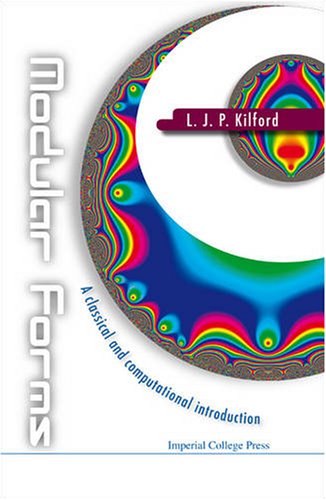
Modular forms A classical and computational introduction 1st Edition by Lloyd Kilford ISBN 978-1848162136 1848162138
Original price was: $50.00.$35.00Current price is: $35.00.
Modular forms A classical and computational introduction 1st Edition by Lloyd Kilford – Ebook PDF Instant Download/Delivery: 978-1848162136, 1848162138
Full download Modular forms A classical and computational introduction 1st Edition after payment
Product details:
ISBN 10: 1848162138
ISBN 13: 978-1848162136
Author: Lloyd Kilford
Table of contents:
1. Historical Overview
1.1 18th Century: A Prologue
1.2 19th Century – The Classical Period
1.3 Early 20th Century: Arithmetic Applications
1.4 Later 20th Century: The Link to Elliptic Curves
1.5 The 21st Century: The Langlands Program
2. Introduction to Modular Forms
2.1 Modular Forms for SL₂(ℤ)
2.2 Eisenstein Series for the Full Modular Group
2.3 Computing Fourier Expansions of Eisenstein Series
2.4 Congruence Subgroups
2.5 Fundamental Domains
2.6 Modular Forms for Congruence Subgroups
2.7 Eisenstein Series for Congruence Subgroups
2.8 Derivatives of Modular Forms
2.8.1 Quasi-Modular Forms
2.9 Exercises
3. Results on Finite-Dimensionality
3.1 Spaces of Modular Forms Are Finite-Dimensional
3.2 Explicit Formulae for the Dimensions of Spaces of Forms
3.2.1 Formulae for the Full Modular Group
3.2.2 Formulae for Congruence Subgroups
3.3 The Sturm Bound
3.4 Exercises
4. The Arithmetic of Modular Forms
4.1 Hecke Operators
4.1.1 Motivation for the Hecke Operators
4.1.2 Hecke Operators for M(SL₂(ℤ))
4.1.3 Hecke Operators for Congruence Subgroups
4.2 Bases of Eigenforms
4.2.1 The Petersson Scalar Product
4.2.2 The Hecke Operators Are Hermitian
4.2.3 Integral Bases
4.3 Oldforms and Newforms
4.3.1 Multiplicity One for Newforms
4.4 Exercises
5. Applications of Modular Forms
5.1 Modular Functions
5.2 n-Products and n-Quotients
5.3 The Arithmetic of the j-Invariant
5.3.1 The j-Invariant and the Monster Group
5.3.2 Ramanujan’s Constant
5.4 Applications of the Modular Function A(z)
5.4.1 Computing Digits of π Using (2)
5.4.2 Proving Picard’s Theorem
5.5 Identities of Series and Products
5.6 The Ramanujan–Petersson Conjecture
5.7 Elliptic Curves and Modular Forms
5.7.1 Fermat’s Last Theorem
5.8 Theta Functions and Their Applications
5.8.1 Representations of n by a Quadratic Form in an Even Number of Variables
5.8.2 Representations of n by a Quadratic Form in an Odd Number of Variables
5.8.3 The Shimura Correspondence
5.9 CM Modular Forms
5.10 Lacunary Modular Forms
5.11 Exercises
6. Modular Forms in Characteristic p
6.1 Classical Treatment
6.1.1 The Structure of the Ring of mod p Forms
6.1.2 The Θ Operator on mod p Modular Forms
6.1.3 Hecke Operators and Hecke Eigenforms
6.2 Galois Representations Attached to mod p Modular Forms
6.3 Katz Modular Forms
6.4 The Sturm Bound in Characteristic p
6.5 Computations with mod p Modular Forms
6.6 Exercises
7. Computing with Modular Forms
7.1 Historical Introduction to Computations in Number Theory
7.2 MAGMA
7.2.1 MAGMA Philosophy
7.2.2 MAGMA Programming
7.3 SAGE
7.3.1 SAGE Philosophy
7.3.2 SAGE Programming
7.3.3 The SAGE Interface
7.3.4 SAGE Graphics
7.4 PARI and Other Systems
7.4.1 PARI
7.4.2 Other Systems and Solutions
7.5 Discussion of Computation
7.5.1 Computation Today
7.5.2 Expected Running Times
7.5.3 Using Computation Effectively
7.5.4 The Limits of Computation
7.5.5 Guy’s Law of Small Numbers
7.5.6 How Hard Is It to Calculate Fourier Coefficients of Modular Forms?
7.6 Exercises
7.6.1 MAGMA
7.6.2 SAGE
7.6.3 PARI
7.6.4 MAPLE
People also search for:
modular forms a classical and computational introduction
modular forms a classical and computational introduction pdf
modular forms examples
what are modular forms
history of modular forms
Tags: Lloyd Kilford, Modular forms, A classical, computational introduction