
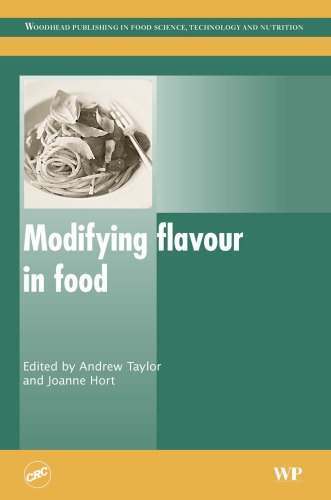
Modifying Flavour in Food 1st Edition by Taylor J Hort ISBN 978-1845690748 1845690748

Original price was: $50.00.$35.00Current price is: $35.00.
Modifying Flavour in Food 1st Edition by A.J. Taylor, J Hort – Ebook PDF Instant Download/Delivery: 978-1845690748, 1845690748
Full download Modifying Flavour in Food 1st Edition after payment
Product details:
ISBN 10: 1845690748
ISBN 13: 978-1845690748
Author: A.J. Taylor, J Hort
Ingredients and technologies which improve the flavour of food have always played a major role in food formulation. With increasing consumer demand for diet products, ready meals and natural ingredients, there is considerable pressure on food manufacturers to adapt ingredients in order to produce nutritious food. This important book provides professionals within the food industry with a comprehensive review of recent developments and research.
The book begins with a comprehensive introduction followed by chapters on flavouring substances and the extraction of flavourings from natural sources. Chapters discuss technologies which improve flavour such as white biotechnology, the development of yeast flavour enhancers and the formulation of flavoursome low fat food. Further chapters cover techniques for flavour modification such as the controlled release of flavours, developments in sweeteners and masking agents for foods. The book concludes with chapters on the applications of new ingredients such as bitter blockers and masking agents.
Modifying flavour in food provides a unique reference for manufacturers and scientists concerned with flavour modification.
Table of contents:
1 Modifying flavour: an introduction..
A. J. Taylor and J. Hort, University of Nottingham, UK
1.1 Introduction.
1.2 References.
2 Flavouring substances: from chemistry and carriers to legislation.
D. Baines, Baines Food Consultancy Ltd, UK
2.1 The importance of olfaction in the appreciation of flavour.
2.2 Flavouring substances in foods..
2.3 Flavouring substances legislation
2.4 Conclusions.
2.5 Acknowledgement
2.6 References.
3 Extraction of flavourings from natural sources.
G. Cravotto, University of Turin, Italy and P. Cintas, University
of Extremadura, Spain
3.1 Introduction.
3.2 General overview
3.3 Supercritical fluid extraction: SC-CO₂.
3.4 Continuous subcritical water extraction (CSWE)
3.5 Ultrasound-assisted extraction (UAE)
3.6 Microwave-assisted extraction (MAE)
3.7 Extraction in the analysis of flavours
3.8 Drying methods and solvent distillation.
3.9 Conclusion.
3.10 Acknowledgements
3.11 References.
4 From fermentation to white biotechnology: how microbial catalysts generate flavours
R. G. Berger, Leibniz University of Hannover, Germany
4.1 Introduction..
4.2 Flavour formation along known pathways
4.3 Flavours from complex substrates
4.4 White biotechnology
4.5 Future trends…
4.6 Sources of further information.
4.7 References.
5 New developments in yeast extracts for use as flavour enhancers
B. Noordam and F. R. Meijer, DSM Food Specialties,
The Netherlands
5.1 Introduction.
5.2 Developments in yeast extracts
5.3 Materials and methods.
5.4 Results and discussion
5.5 Conclusions
5.6 References
6 Chiral chemistry and food flavourings
S. Serra, C.N.R. Milano, Italy
6.1 Introduction..
6.2 Chiral flavour – synthesis
6.3 Chiral flavour
6.4 Key flavour compounds…..
6.5 Sources of further information and advice.
6.6 References.
7 Formulating low-fat food: the challenge of retaining flavour quality
J. Hort and D. Cook, University of Nottingham, UK
7.1 Introduction..
7.2 Lowering the fat content of food: what happens to the flavour?
7.3 Strategies for replacing fat in foods and the implications for flavour
7.4 Why is fat so hard to replace?
7.5 Representation of fat in the brain
7.6 Future trends.
7.7 References.
8 New pungent and cooling compounds for use in foods.
C. C. Galopin, Givaudan Flavors Corporation, USA
8.1 Introduction.
8.2 History
8.3 Fundamental differences between chemesthetics and flavours.
8.4 Physiology
8.5 Common pungent chemicals and their activity
8.6 Common cooling compounds and their activity.
8.7 Future trends.
8.8 Conclusion.
1
8.9 References.
9.1 Introduction..
9.2 Industrial approaches for protecting flavourings from deterioration.
9.3 Industrial approaches to achieve controlled release of flavourings.
9 Controlled release of flavour in food products.
G. Reineccius, University of Minnesota, USA
9.4 Needs in flavour encapsulation/controlled release
9.5 Advice
9.6 References.
10 Developments in sweeteners.
S. Kemp, Cadbury Schweppes, UK and M. Lindley, Lindley Consulting, UK
10.1 Introduction..
10.2 Mechanism of sweetness perception
10.3 Novel sweeteners
10.4 Sweetness potentiators.
10.5 Sweetness inhibitors.
10.6 Future trends.
10.7 Sources of further information and advice.
10.8 References
11 Enhancing umami taste in foods.
J. B. Marcus, Kendall College, USA
11.1 Umami: what it is, what it does and how it works……
11.2 Culinary history of umami in flavour enhancement
11.3 Scientific background of umami in flavour enhancement..
11.4 How the culinary aspects and science of umami interact.
11.5 Asian condiments that impart umami taste and taste-active components
11.6 Western foods that impart umami taste and taste-active components
11.7 Other umami taste-activators
11.8 Taste-active components and umami synergy
11.9 Umami formed in ripening, drying, curing, ageing and fermenting
11.10 Practical aspects of umami in consumer acceptance.
11.11 Consumer applications of umami.
11.12 Food technology applications of umami.
11.13 Umami applications that maximise flavour, food acceptance and food preference.
11.14 Umami applications for the development and enhancement of recipes and products.
11.15 US umami initiatives
11.16 European umami initiatives
11.17 Future trends.
11.18 Conclusion..
11.19 Sources of further information and advice.
11.20 References.
12 Bitter blockers in foods and pharmaceuticals.
R. McGregor, Linguagen Corporation, USA
12.1 Introduction.
12.2 Why reduce bitterness in foods and pharmaceuticals?..
12.3 Current approaches to reducing bitterness.
12.4 Advantages to bitter blocked pharmaceutical formulations.
12.5 The science of taste perception
12.6 Identifying compounds that decrease the perception of bitterness.
12.7 Future trends..
12.8 Sources of further information and advice.
12.9 References.
13 Masking agents for use in foods
M. Gascon, Wixon Inc., USA
13.1 Introduction.
13.2 How masking agents work
13.3 Ingredients used to formulate masking agents.
Contents
13.4 What to consider when working with masking agents
13.5 Masking agents: when to use or not to use.
13.6 Outlook and perspectives
13.7 References…
14 Selecting the right flavourings for a food product
K. B. de Roos, Givaudan Nederland B.V., The Netherlands
14.1 Introduction.
14.2 Creation of the desired flavour profile
14.3 Stability of the flavouring
14.4 Solving flavour release problems.
14.5 Solving flavour stability problems in products.
14.6 Future trends.
14.7 Sources of further information and advice.
14.8 References…
People also search for:
flavour modifier
flavour changing berries
flavour changing bottle
flavour modifiers
flavour changing charged current
Tags: Taylor, Hort, Modifying Flavour