
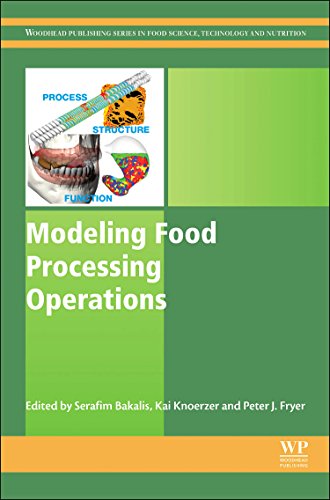
Modeling Food Processing Operations 1st Edition by Serafim Bakalis, Kai Knoerzer, Peter J Fryer ISBN 978-1782422846 1782422846

Original price was: $50.00.$35.00Current price is: $35.00.
Modeling Food Processing Operations 1st Edition by Serafim Bakalis, Kai Knoerzer, Peter J Fryer – Ebook PDF Instant Download/Delivery: 978-1782422846, 1782422846
Full download Modeling Food Processing Operations 1st Edition after payment
Product details:
ISBN 10: 1782422846
ISBN 13: 978-1782422846
Author: Serafim Bakalis, Kai Knoerzer, Peter J Fryer
Computational modeling is an important tool for understanding and improving food processing and manufacturing. It is used for many different purposes, including process design and process optimization. However, modeling goes beyond the process and can include applications to understand and optimize food storage and the food supply chain, and to perform a life cycle analysis. Modeling Food Processing Operations provides a comprehensive overview of the various applications of modeling in conventional food processing. The needs of industry, current practices, and state-of-the-art technologies are examined, and case studies are provided.
Part One provides an introduction to the topic, with a particular focus on modeling and simulation strategies in food processing operations. Part Two reviews the modeling of various food processes involving heating and cooling. These processes include: thermal inactivation; sterilization and pasteurization; drying; baking; frying; and chilled and frozen food processing, storage and display. Part Three examines the modeling of multiphase unit operations such as membrane separation, extrusion processes and food digestion, and reviews models used to optimize food distribution.
Comprehensively reviews the various applications of modeling in conventional food processing
Examines the modeling of multiphase unit operations and various food processes involving heating and cooling
Analyzes the models used to optimize food distribution
Table of contents:
Part One: Introduction to computational modeling in food processing
1: Different modelling and simulation approaches for food processing operations
Abstract
1.1 Introduction and intended contribution
1.2 Basic considerations of food processing
1.3 Modelling and simulation approaches
1.4 Conclusions and outlook
Part Two: Modeling of food processes involving heating and cooling
2: Thermal processing and kinetic modeling of inactivation
Abstract
2.1 Introduction
2.2 Quality and microbial modeling during thermal processes
2.3 Dynamic temperature parameter estimation for microbial inactivation
2.4 Model selection for dynamic parameter estimation
2.5 Software programs dealing with dynamic forward and inverse modeling problems in food science
2.6 Future trends
3: Modeling thermal processing and reactions: sterilization and pasteurization
Abstract
3.1 Introduction
3.2 Heat transfer
3.3 Sterilization and pasteurization criteria
3.4 Quality evaluation
3.5 Optimization
3.6 Conclusions
Appendix: Nomenclature
4: Modelling of drying processes for food materials
Abstract
4.1 Introduction
4.2 The drying process
4.3 Modelling approaches
4.4 Modelling of the drying process
4.5 Case study
4.6 Future directions
5: Modelling of baking processes
Abstract
5.1 Introduction
5.2 Physical, chemical and biological phenomena
5.3 Product description and simplification assumptions
5.4 Literature overview
5.5 Modelling an oven with a simple food product description
5.6 Modelling coupled heat, mass and momentum transfers in a simple geometry
5.7 Conclusion: trends and challenges
6: Modeling of food-frying processes
Abstract
6.1 General description of frying
6.2 Frying modeling background
6.3 Case studies
6.4 Conclusions
7: Modelling cold food chain processing and display environments
Abstract
Acknowledgements
7.1 The cold food chain
7.2 Introduction to common modelling techniques
7.3 Chilled food processing environments
7.4 Modelling food storage and display equipment
7.5 Conclusions
Part Three: Modeling of multiphase unit operations
8: A review of shear-induced particle migration for enhanced filtration and fractionation
Abstract
8.1 Introduction
8.2 Hydrodynamic interactions in concentrated suspensions
8.3 Experimental evaluation of shear-induced migration (SIM)
8.4 Particle migration in microfiltration (MF) and flow field-flow fractionation (F1FFF)
8.5 Options for fractionation technology
9: Modeling extrusion processes
Abstract
9.1 Introduction
9.2 Overview of modeling approaches
9.3 3D computational fluid dynamics simulation of biopolymeric melt flow in a twin-screw extruder
9.4 Concluding remarks
10: Modelling food digestion
Abstract
10.1 Introduction
10.2 Numerical methods useful for predicting food breakdown
10.3 Mastication and food transformation in the mouth
10.4 Food transport and processing in the stomach
10.5 Processes in the small intestine
10.6 Processes in the large intestine
10.7 Conclusions
11: Using logistic models to optimize the food supply chain
Abstract
11.1 Introduction
11.2 Features and current trends in food supply chain logistics
11.3 Overview of fruit and vegetable logistics
11.4 Overview of grains logistics
11.5 Overview of beef and meat logistics
11.6 Overview of logistics in fisheries
11.7 Urban distribution of food products
11.8 Dairy logistics and the Castrolanda Cooperative case study
11.9 Conclusions and opportunities for further research
Part Four: Conclusions
12: Conclusions and future trends in modelling food processing operations
Abstract
12.1 Introduction
12.2 Modelling across scales
12.3 Different types of models
12.4 Summary and conclusion
People also search for:
modeling food processing operations
food processing operations modeling design and analysis
stages process modeling
what is food processing techniques
what are the steps of food processing
Tags: Serafim Bakalis, Kai Knoerzer, Peter J Fryer, Modeling Food, Processing Operations