
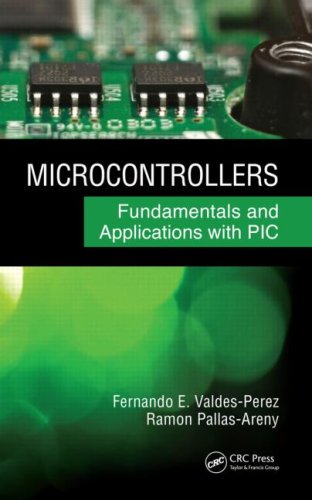
Microcontrollers Fundamentals and Applications with PIC 1st Edition by Fernando Valdes-Perez, Ramon Pallas-Areny ISBN 978-1420077674 1420077678


Original price was: $50.00.$35.00Current price is: $35.00.
Microcontrollers Fundamentals and Applications with PIC 1st Edition by Fernando E. Valdes-Perez, Ramon Pallas-Areny – Ebook PDF Instant Download/Delivery: 978-1420077674, 1420077678
Full download Microcontrollers Fundamentals and Applications with PIC 1st Edition after payment
Product details:
ISBN 10: 1420077678
ISBN 13: 978-1420077674
Author: Fernando E. Valdes-Perez, Ramon Pallas-Areny
Microcontrollers exist in a wide variety of models with varying structures and numerous application opportunities. Despite this diversity, it is possible to find consistencies in the architecture of most microcontrollers. Microcontrollers: Fundamentals and Applications with PIC focuses on these common elements to describe the fundamentals of microcontroller design and programming. Using clear, concise language and a top-bottom approach, the book describes the parts that make up a microcontroller, how they work, and how they interact with each other. It also explains how to program medium-end PICs using assembler language.
Examines analog as well as digital signals
This volume describes the structure and resources of general microcontrollers as well as PIC microcontrollers, with a special focus on medium-end devices. The authors discuss memory organization and structure, and the assembler language used for programming medium-end PIC microcontrollers. They also explore how microcontrollers can acquire, process, and generate digital signals, explaining available techniques to deal with parallel input or output, peripherals, resources for real-time use, interrupts, and the specific characteristics of serial data interfaces in PIC microcontrollers. Finally, the book describes the acquisition and generation of analog signals either using resources inside the chip or by connecting peripheral circuits.
Provides hands-on clarification
Using practical examples and applications to supplement each topic, this volume provides the tools to thoroughly grasp the architecture and programming of microcontrollers. It avoids overly specific details so readers are quickly led toward design implementation. After mastering the material in this text, they will understand how to efficiently use PIC microcontrollers in a design process.
Table of contents:
1 Introduction to Microcontrollers
1.1 Microprocessors and Microcontrollers: Characterization
1.2 Components of a Microcontroller.
1.2.1 The Watchdog.
1.2.2 Reset Signal..
1.2.3 Low Consumption.
1.2.4 Protection against Copying.
1.3 Von Neumann and Harvard Architectures
1.4 CISC and RISC Architectures
1.5 Manufacturers of Microcontrollers and Microprocessors.
2 PIC Microcontrollers
2.1 Main Characteristics of PIC Microcontrollers
2.1.1 The Arithmetic and Logic Unit (ALU) and the Working Register in PIC Microcontrollers.
2.1.2 Machine Cycles and Execution of Instructions.
2.1.3 Pipelining for Instruction Execution
2.1.4 Oscillators
2.1.5 Configuration Bits.
2.1.6 Reset Options
2.1.7 Low-Power Consumption Mode.
2.1.8 Watchdog Timer.
2.2 PIC Microcontroller Families
2.2.1 Low-End Microcontrollers…
2.2.2 Medium-End Microcontrollers
2.2.3 High-End Microcontrollers.
3 Memory in Microcontrollers
3.1 Basic Concepts.
3.1.1 Logic Organization of Memory
3.1.2 Types of Memory
3.2 Memory in Medium-End PIC Microcontrollers.
3.2.1 Program Memory.
3.2.1.1 Addressing Program Memory
3.2.1.2 Reading and Writing the Program Memory.
3.2.2 RAM Data Memory.
3.2.2.1 Addressing Data Memory.
3.2.2.2 Special Function Registers (SFRs).
3.2.3 EEPROM Data Memory
4 Instruction Set and Assembler Language Programming.
4.1 Basic Concepts.
4.1.1 Machine Code and Assembler Language
4.1.2 Structure of Instructions.
4.1.3 Data Addressing Modes
4.1.4 The Stack
4.2 Instruction Set in Medium-End PIC Microcontrollers
4.2.1 Data Transfer Instructions.
4.2.2 Arithmetic and Logic Instructions..
4.2.3 Control Transfer Instructions.
4.2.3.1 Unconditional Branches, Subroutine Calls, and Returns…
4.2.3.2 Conditional Branches.
4.2.4 Bit Manipulation Instructions.
4.2.5 Other Instructions
4.3 Assembler Language Elements (for MPASM Assembler from Microchip)
4.3.1 Introduction.
4.3.2 Expressions, Operations, and Operators.
4.3.2.1 Arithmetic Operators..
4.3.2.2 Logic and Boolean Operators.
4.3.2.3 Logic Operators Using Direct Bit Manipulation
4.3.2.4 Assign Operators..
4.3.2.5 Addressing Operators.
4.3.3 Directives
4.3.3.1 General Use Directives
4.3.3.2 Directives for Relocatable Code.
4.3.4 Macroinstructions.
4.3.5 Organization of a Program in Assembler Language……
4.4 Available Resources for Programming PIC Microcontrollers in Assembler Language.
4.4.1 The MPASM Assembler
4.4.1.1 Absolute Code Generation.
4.4.1.2 Relocatable Code Generation.
4.4.1.3 Files Used and Generated during the Assembling Process
4.4.2 The Linker MPLINK
4.4.3 Library Manager MPLIB.
5 Parallel Input and Output
5.1 Basic Concepts.
5.1.1 Data Transfer Techniques.
5.1.2 Input/Output Techniques.
5.2 Parallel Ports in Medium-End PIC Microcontrollers.
5.2.1 Port A
5.2.2 Port B.
5.2.3 Port C
5.2.4 Ports D, E, F, and G.
5.2.5 Parallel Slave Port (PSP).
5.3 Connection of Commonly Used Peripherals
5.3.1 Switches and LEDs
5.3.2 Matrix Keypads….
5.3.3 Seven-Segment LEDs.
5.3.4 Alphanumeric Liquid-Crystal Displays
6 Timers
6.1 Timers in PIC Microcontrollers..
6.1.1 Timer0 Module.
6.1.2 Timer1 Module
6.1.3 Timer2 Module.
6.2 The CCP Module
6.2.1 Capture Mode.
6.2.2 Compare Mode.
6.2.3 PWM Mode.
7 Interrupts
7.1 Basic Concepts.
7.1.1 Interrupt Requests and Associated Resources
7.1.2 Servicing Interrupt Requests
7.1.3 Fixed and Vectored Interrupts.
7.2 Interrupts in PIC Microcontrollers.
7.2.1 Interrupt Sources and Associated Registers.
7.2.2 Interrupt Service Subroutine Structure.
7.3 Examples of Interrupt Applications.
7.3.1 Real-Time Clock
7.3.2 Synchronization of Events to Real-Time Clock
7.3.3 Protection against Hardware Malfunctions
8 Serial Input and Output
8.1 Basic Concepts……
8.1.1 Introduction to Serial Data Transmission
8.1.2 Asynchronous Communication
8.1.3 Synchronous Communication
8.1.4 Connection between Equipment: RS-232C Interface
8.1.5 The PC Bus….
8.2 The USART Serial Port in PIC Microcontrollers..
8.2.1 General Description.
8.2.2 Asynchronous Mode.
8.2.3 Synchronous Mode..
8.2.4 Communication Speed.
8.3 The Synchronous Serial Port in PIC Microcontrollers…
8.3.1 SPI..
8.3.2 I²C Interface.
9 Analog Input and Output: Signal Acquisition and Distribution
9.1 Structure of a System for Signal Acquisition and Distribution.
9.1.1 Basic Functions of Measurement and Control Systems.
9.1.2 Dynamic Range.
9.1.3 Bandwidth.
9.1.4 Signal Sampling.
9.1.5 Architectures for Signal Acquisition: High-Level and Low-Level Mutiplexing
9.2 The Front-End in Data Acquisition Systems.
9.2.1 Attenuators
9.2.2 Amplifiers.
9.2.3 Input Protections and Filters.
9.2.4 Analog Multiplexers. 9.2.5 Anti-Alias Filters.
9.2.6 Sample-and-Hold Amplifier.
9.2.7 A/D Converters…
9.3 The 10-Bit A/D Converter Module in PIC Microcontrollers.
9.3.1 Architecture of the Conversion Module.
9.3.2 A/D Conversion Timing.
9.3.3 A/D Conversion Module Programming.
9.4 Calibration..
9.5 Direct Sensor-Microcontroller Interface
9.6 Analog Back-End.
9.6.1 D/A Converters
9.6.2 Analog Demultiplexing
9.6.3 Extrapolation Methods.
9.6.4 PWM Outputs
9.6.5 Output Protections
People also search for:
microcontroller are used in
fundamentals of microcontrollers and applications in embedded systems pdf
fundamentals of microprocessors and microcontrollers pdf
microcontroller fundamentals pdf
basic concepts of microcontroller
Tags: Fernando Valdes-Perez, Ramon Pallas-Areny, Microcontrollers Fundamentals, Applications with PIC