
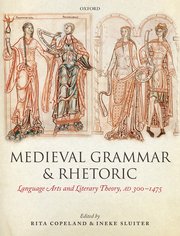
Medieval grammar and rhetoric Language arts and literary theory AD 300 1475 1st Edition by Rita Copeland, Ineke Sluiter ISBN 019965378X 978-0199653782
Original price was: $50.00.$35.00Current price is: $35.00.
Medieval grammar and rhetoric Language arts and literary theory AD 300 1475 1st Edition by Rita Copeland, Ineke Sluiter- Ebook PDF Instant Download/Delivery: 019965378X, 978-0199653782
Full download Medieval grammar and rhetoric Language arts and literary theory AD 300 1475 1st Edition after payment
Product details:
ISBN 10: 019965378X
ISBN 13: 978-0199653782
Author: Rita Copeland, Ineke Sluiter
Medieval Grammar and Rhetoric: Language Arts and Literary Theory, AD 300-1475 contributes to two fields, the history of the language arts and the history of literary theory. It brings together essential sources in the disciplines of grammar and rhetoric which were used to understand literary form and language and teach literary composition. Grammar and rhetoric, the language disciplines, formed the basis of any education from antiquity through the Middle Ages, no matter what future career a student would want to pursue. Because literature was also the subject matter of grammatical teaching, and because rhetorical teaching gave great attention to literary form, these were also the disciplines that would prepare students for an understanding of literary language and form. These arts constituted the abiding theoretical toolbox for anyone engaged in a life of letters.
The book brings together more than fifty primary texts from the medieval history of grammar and rhetoric, well over half of them never translated into English before. The volume establishes the ancient traditions on which the medieval arts are based, and gives substantial selections from the late antique source texts. All texts are presented in their historical and theoretical contexts, and carefully annotated in order to make them useful to readers, both specialists and non-specialists. For the first time, the long traditions of grammar and rhetoric are presented together in one historical survey, showing how they related to each other, and are placed in a coherent conceptual structure, their contributions to literary theory.
Table of contents:
Cover for
Medieval Grammar and Rhetoric
Introduction
Medieval Grammar and Rhetoric
Language Arts and Literary Theory, AD 300 -1475
Edited by Rita Copeland and Ineke Sluiter
Substantial selections from over fifty primary texts, over half never before translated into English
Clear chronological layout throughout, with titles, authors, and dates of each text provided with each entry and in header
Includes an interpretive general introduction, local historical introductions, essays, and headnotes
Extensive and clear annotation of texts, with cross-referencing
£227.50
Hardback
Published: 26 November 2009
986 Pages
246x189mm
ISBN: 9780198183419
Also Available As:
Paperback
Access for individuals in subscribing libraries/institutions
Purchasing information for libraries
Bookseller Code (AQ)
Description
Medieval Grammar and Rhetoric: Language Arts and Literary Theory, AD 300-1475 contributes to two fields, the history of the language arts and the history of literary theory. It brings together essential sources in the disciplines of grammar and rhetoric which were used to understand literary form and language and teach literary composition. Grammar and rhetoric, the language disciplines, formed the basis of any education from antiquity through the Middle Ages, no matter what future career a student would want to pursue. Because literature was also the subject matter of grammatical teaching, and because rhetorical teaching gave great attention to literary form, these were also the disciplines that would prepare students for an understanding of literary language and form. These arts constituted the abiding theoretical toolbox for anyone engaged in a life of letters.
The book brings together more than fifty primary texts from the medieval history of grammar and rhetoric, well over half of them never translated into English before. The volume establishes the ancient traditions on which the medieval arts are based, and gives substantial selections from the late antique source texts. All texts are presented in their historical and theoretical contexts, and carefully annotated in order to make them useful to readers, both specialists and non-specialists. For the first time, the long traditions of grammar and rhetoric are presented together in one historical survey, showing how they related to each other, and are placed in a coherent conceptual structure, their contributions to literary theory.
Table of Contents:
Part 1 Arts of Language, AD ca. 300-ca. 950
Introduction
Terentianus Maurus, De litteris and De syllabis, ca. 300
Aelius Donatus, Ars minor, Ars maior, Life of Virgil, ca. 300
Marius Victorinus, Commentary on the De inventione, before 355
Servius, Commentary on the Aeneid, ca. 400-420
Tiberius Claudius Donatus, Interpretationes Vergilianae, ca. 400
Martianus Capella, De nuptiis Philologiae et Mercurii, ca. 420-490
Priscian, Institutiones grammaticae and Institutio De Nomine Pronomine Verbo, ca. 520
Boethius, De topicis differentiis book 4, ca. 523
Cassiodorus, Expositio Psalmorum, ca. 540, and Institutiones, ca. 562
Isidore of Seville, Etymologiae, ca. 625
Virgilius Maro Grammaticus, Epistolae and Epitomae, ca. 650
Bede, De arte metrica and De schematibus et tropis, ca. 710
Alcuin, Ars grammatica and Disputatio de rhetorica et de virtutibus, ca. 790-800
Glosses on Priscian by Remigius and his Followers (ninth and tenth centuries)
Part 2 Dossiers on the Ablative Absolute and Etymology
Introduction
The Ablative Absolute Dossier
Etymology Dossier
Part 3 Sciences and Curricula of Language in the Twelfth Century
Introduction
Commentaries on Priscian, ca. 1080 to ca. 1150: Glosulae, Notae dunelmenses, William of Conches
Rupert of Deutz, De sancta trinitate et operibuseius, 1112-16: Grammar and Rhetoric
Thierry of Chartres, Commentaries on the De inventione and Ad Herennium, ca. 1130-1140
Thierry of Chartres, Prologue to the Heptateuchon;Prologues to Donatus, ca. 1140.
Petrus Helias, Summa super Priscianum, ca.1140-50
Dominicus Gundissalinus, De divisione philosophiae, ca. 1150-60
John of Salisbury, Metalogicon,1159
Grammatical Commentaries from “School, ” of Ralph of Beauvais ca. 1165-75
Alexander Neckam, A List of Textbooks (from Sacerdos ad altare), ca. 1210
Section 4 Pedagogies of Grammar and Rhetoric, ca. 1150-1280
Introduction
Prologues to Twelfth-Century School Commentaries on Horace’s Ars poetica, ca. 1150
Matthew of Vendôme, Ars versificatoria, ca. 1175
Alexander of Villa Dei, Doctrinale, 1199
Eberhard of Béthune, Graecismus, 1212
Geoffrey of Vinsauf, Poetria nova, ca. 1208-1213
Gervase of Melkley, Ars versificaria, ca. 1215-1216
Thomas of Chobham, Summa de arte praedicandi, ca.1220
John of Garland, Parisiana poetria, ca. 1231-1235
Tria Sunt (after 1256, before 1400) Part 5 Professional, Civic, and Scholastic Approaches to the Language Arts, ca.1225- ca.1272
Introduction
Henri d’Andeli, Bataille des sept arts, ca. 1230
Commentary on the Barbarismus (attributed to Robert Kilwardby), ca. 1250
Hermannus Alemannus, Al-Farabi’s Didascalia on Aristotle’s Rhetoric,1256
Brunetto Latini, Rettorica, ca. 1260
Thomas Aquinas, Preface to his Expositio of Aristotle’s Posterior Analytics,1270
Giles of Rome, commentary on Aristotle’s Rhetoric,ca. 1272
Part 6 Receptions of the Traditions: The Language Arts and Poetics in the Later Middle Ages, ca. 1369-ca. 1475
Introduction
Nicolaus Dybinus, Declaracio oracionis de beata Dorothea ca. 1369
John Gower, Confessio amantis, 1386-90
John Lydgate, Fall of Princes, 1431-9
A Middle English Treatise on the Seven Liberal Arts, ca. 1475
Select Bibliographies
Primary Sources
People also search for:
what is writing and rhetoric
rhetoric in the middle ages
how to use rhetoric in a sentence
medieval grammar
medieval rhetoric
Tags:
Rita Copeland,Ineke Sluiter,Medieval grammar,rhetoric Language,literary theory