
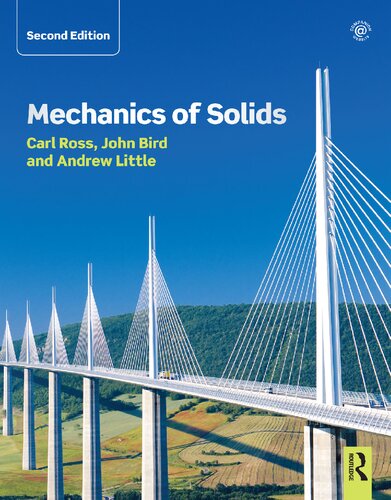
Mechanics of solids Second Edition by Ross, Bird, Andrew Little ISBN 978-1138904675 1138904678


Original price was: $50.00.$35.00Current price is: $35.00.
Mechanics of solids Second Edition by C. T. F. Ross, J. O. Bird, Andrew Little- Ebook PDF Instant Download/Delivery: 978-1138904675, 1138904678
Full download Mechanics of solids Second Edition after payment
Product details:
ISBN 10: 1138904678
ISBN 13: 978-1138904675
Author: C. T. F. Ross, J. O. Bird, Andrew Little
An introduction to the fundamental concepts of solid materials and their properties
The primary recommended text of the Council of Engineering Institutions for university undergraduates studying the mechanics of solids
New chapters covering revisionary mathematics, geometrical properties of symmetrical sections, bending stresses in beams, composites and the finite element method
Free electronic resources and web downloads support the material contained within this book
Mechanics of Solids provides an introduction to the behaviour of solid materials and their properties, focusing upon the fundamental concepts and principles of statics and stress analysis. Essential reading for first year undergraduates, the mathematics in this book has been kept as straightforward as possible and worked examples are used to reinforce key concepts. Practical stress and strain scenarios are also covered including stress and torsion, elastic failure, buckling, bending, as well as examples of solids such as thin-walled structures, beams, struts and composites. This new edition includes new chapters on revisionary mathematics, geometrical properties of symmetrical sections, bending stresses in beams, composites, the finite element method, and Rosss computer programs for smartphones, tablets and computers.
Table of contents:
1. Revisionary Mathematics
1.1 Introduction
1.2 Radians and Degrees
1.3 Measurement of Angles
1.4 Trigonometry Revision
1.5 Brackets
1.6 Fractions
1.7 Percentages
1.8 Laws of Indices
1.9 Simultaneous Equations
Revision Test 1
Multiple-Choice Questions Test 1
2. Further Revisionary Mathematics
2.1 Units, Prefixes and Engineering Notation
2.2 Metric-US/Imperial Conversions
2.3 Straight Line Graphs
2.4 Gradients, Intercepts and Equation of a Graph
2.5 Practical Straight Line Graphs
2.6 Introduction to Calculus
2.7 Basic Differentiation Revision
2.8 Revision of Integration
2.9 Definite Integrals
2.10 Simple Vector Analysis
Revision Test 2
Multiple-Choice Questions Test 2
3. Statics
3.1 Plane Pin-Jointed Trusses
3.2 Criterion for Sufficiency of Bracing
3.3 Mathematics Used in Statics
3.4 Equilibrium Considerations
3.5 Bending Moment and Shearing Force
3.6 Loads
3.7 Types of Beam
3.8 Bending Moment and Shearing Force Diagrams
3.9 Point of Contraflexure
3.10 Relationship Between Bending Moment, Shearing Force and Intensity of Load
3.11 Cables
3.12 Suspension Bridges
4. Stress and Strain
4.1 Introduction
4.2 Hooke’s Law
4.3 Load-Extension Relationships
4.4 Proof Stress
4.5 Ductility
4.6 Shear Stress and Shear Strain
4.7 Poisson’s Ratio
4.8 Hydrostatic Stress
4.9 Relationship Between Material Constants
4.10 Three-Dimensional Stress
4.11 Composite Materials
4.12 Thermal Strain
4.13 Compound Bars
4.14 Failure by Fatigue
4.15 Failure Due to Creep
5. Geometrical Properties of Symmetrical Sections
5.1 Introduction
5.2 Centroid
5.3 Second Moment of Area
5.4 Polar Second Moment of Area
5.5 Parallel Axis Theorem
5.6 Perpendicular Axis Theorem
5.7 Calculation of I Through Numerical Integration
5.8 Computer Program for Calculating y and Ixx
5.9 Use of EXCEL Spreadsheet in Calculating Properties
6. Bending Stresses in Beams
6.1 Introduction
6.2 Proof of σ/y = M/I = E/R
6.3 Sectional Modulus
6.4 Anticlastic Curvature
6.5 Composite Beams
6.6 Flitched Beams
6.7 Composite Ship Structures
6.8 Composite Structures
6.9 Combined Bending and Direct Stress
7. Beam Deflections Due to Bending
7.1 Introduction
7.2 Repeated Integration Method
7.3 Macaulay’s Method
7.4 Statically Indeterminate Beams
7.5 Moment-Area Method
7.6 Slope-Deflection Equations
8. Torsion
8.1 Introduction
8.2 Torque
8.3 Assumptions in Shaft Theory
8.4 Torsion Equations
8.5 Flanged Couplings
8.6 Keyed Couplings
8.7 Compound Shafts
8.8 Tapered Shafts
8.9 Close-Coiled Helical Springs
8.10 Torsion of Thin-Walled Non-Circular Sections
8.11 Torsion of Thin-Walled Rectangular Sections
8.12 Torsion of Thin-Walled Open Sections
8.13 Elastic-Plastic Torsion of Circular Shafts
Multiple-Choice Questions Test 3
Revision Test 3
9. Complex Stress and Strain
9.1 Introduction
9.2 Stress in Co-ordinates
9.3 Principal Stresses
9.4 Mohr’s Stress Circle
9.5 Combined Bending and Torsion
9.6 Two-Dimensional Strain Systems
9.7 Principal Strains
9.8 Mohr’s Circle of Strain
9.9 Plane Stress Relationships
9.10 Plane Strain Relationships
9.11 Pure Shear
9.12 Strain Rosettes
9.13 Program for Principal Stresses and Strains
9.14 Lamina Constitutive Laws
10. Membrane Theory for Thin-Walled Circular Cylinders and Spheres
10.1 Introduction
10.2 Conceptual Explorations (e.g., Moon Habitat)
10.3 Cylindrical Shells Under Internal Pressure
10.4 Spherical Shells Under Internal Pressure
10.5 Bending Stresses in Circular Cylinders
10.6 Cylinders with Hemispherical Ends
11. Energy Methods
11.1 Introduction
11.2 Rayleigh-Ritz Method
11.3 Virtual Work
11.4 Complementary Virtual Work
11.5 Castigliano’s First Theorem
11.6 Castigliano’s Second Theorem
11.7 Strain Energy – Axial Loading
11.8 Strain Energy – Beam Bending
11.9 Strain Energy – Torsion
11.10 Deflection of Curved Beams
11.11 Impact Loads
11.12 Resilience
11.13 Unit Load Method
11.14 Plastic Collapse
11.15 Residual Stresses in Beams
12. Theories of Elastic Failure
12.1 Introduction
12.2 Maximum Principal Stress Theory
12.3 Maximum Principal Strain Theory
12.4 Total Strain Energy Theory
12.5 Maximum Shear Stress Theory
12.6 Maximum Shear Strain Energy Theory
12.7 Yield Loci
12.8 Conclusions
13. Thick Cylinders and Spheres
13.1 Introduction
13.2 Hoop and Radial Stress Equations
13.3 Lamé Line
13.4 Compound Cylinders
13.5 Plastic Yielding of Tubes
13.6 Spherical Shells
13.7 Rotating Discs
13.8 Plastic Collapse of Discs
13.9 Rotating Rings
13.10 Case Study: “Trieste” Design
14. The Buckling of Struts
14.1 Introduction
14.2 Axially Loaded Struts
14.3 Elastic Instability
14.4 Boundary Conditions
14.5 Limitations of Euler Theory
14.6 Rankine-Gordon Formula
14.7 Geometrical Imperfections
14.8 Eccentric Loading
14.9 Initial Curvature
14.10 Perry-Robertson Formula
14.11 Dynamic Instability
15. Unsymmetrical Bending of Beams
15.1 Introduction
15.2 Symmetrical Beams with Asymmetrical Loading
15.3 Unsymmetrical Sections
15.4 Calculation of I
15.5 Principal Axes
15.6 Mohr’s Circle of Inertia
15.7 Stresses in Asymmetrical Sections
16. Shear Stresses in Bending and Shear Deflections
16.1 Introduction
16.2 Vertical Shear
16.3 Horizontal Shear
16.4 Shear Centre
16.5 Shear Centre in Closed Thin-Walled Tubes
16.6 Shear Deflections
16.7 Warping
17. Composites
17.1 Mechanical Property Comparison
17.2 Matrix Equations
17.3 Stiffness Matrix for Isotropic Materials
17.4 Compliance Matrix for Orthotropic Materials
17.5 Stiffness Matrix for Orthotropic Materials
17.6 Off-Axis Loading
17.7 Laminates
17.8 Failure Criteria
18. The Matrix Displacement Method
18.1 Introduction
18.2 Matrix Displacement Method
18.3 Structural Stiffness Matrix
18.4 Elemental Stiffness for Plane Rod
18.5 Continuous Beams
18.6 Trusses on Digital Devices
18.7 Beams on Digital Devices
18.8 Frames on Digital Devices
19. The Finite Element Method
19.1 Introduction
19.2 Triangular Element Stiffness
19.3 Three-Node Rod Element
20. Experimental Strain Analysis
20.1 Introduction
20.2 Electrical Resistance Strain Gauges
20.3 Types of Strain Gauge
20.4 Gauge Material
20.5 Gauge Adhesives
20.6 Water-Proofing
20.7 Other Strain Gauges
20.8 Gauge Circuits
20.9 Photoelasticity
20.10 Moire Fringes
20.11 Brittle Lacquer
20.12 Semiconductor Gauges
20.13 Acoustical Gauges
People also search for:
applied mechanics of solids
crandall mechanics of solids pdf
strength of materials mechanics of solids pdf
an introduction to the mechanics of solids
mechanics of solids and fluids
Tags: Ross, Bird, Andrew Little, Mechanics of solids