
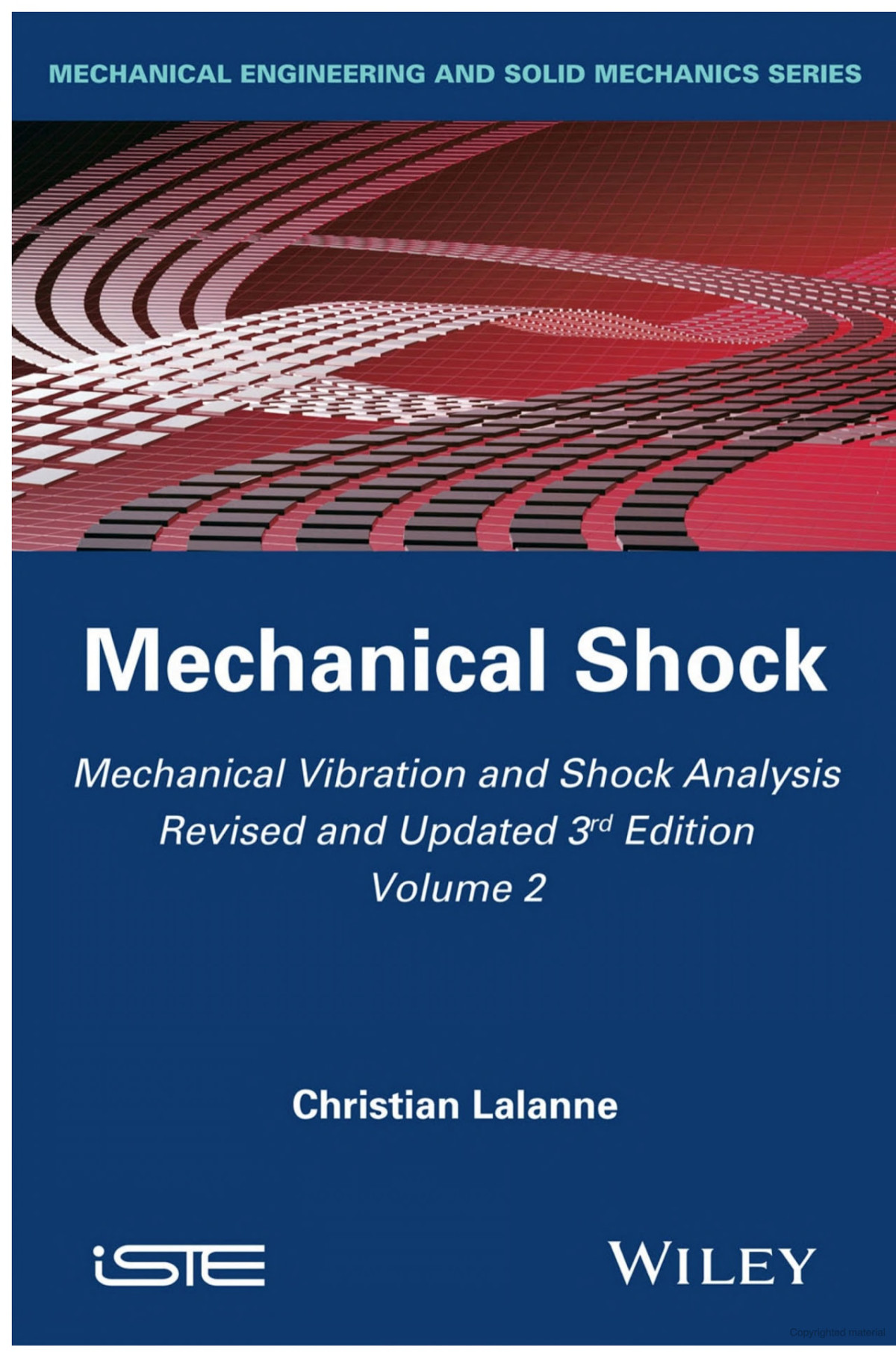
Mechanical Vibration and Shock Analysis Volume 2 Mechanical Shock 3rd Edition by Christian Lalanne ISBN 978-1848216457 1848216459

Original price was: $50.00.$35.00Current price is: $35.00.
Mechanical Vibration and Shock Analysis Volume 2 Mechanical Shock 3rd Edition by Christian Lalanne – Ebook PDF Instant Download/Delivery: 978-1848216457, 1848216459
Full download Mechanical Vibration and Shock Analysis Volume 2 Mechanical Shock 3rd Edition after payment
Product details:
ISBN 10: 1848216459
ISBN 13: 978-1848216457
Author: Christian Lalanne
Table of contents:
Chapter 1. Shock Analysis
-
Definitions
-
Shock
-
Transient Signal
-
Jerk
-
Simple (or Perfect) Shock
-
Half-Sine Shock
-
Versed Sine (or Haversine) Shock
-
Terminal Peak Sawtooth (TPS) Shock (or Final Peak Sawtooth FPS)
-
Initial Peak Sawtooth (IPS) Shock
-
Square Shock
-
Trapezoidal Shock
-
Decaying Sinusoidal Pulse
-
Bump Test
-
Pyroshock
-
-
Analysis in the Time Domain
-
Temporal Moments
-
Fourier Transform
-
Definition
-
Reduced Fourier Transform
-
Fourier Transforms of Simple Shocks
-
What Represents the Fourier Transform of a Shock?
-
Importance of the Fourier Transform
-
-
Energy Spectrum
-
Energy According to Frequency
-
Average Energy Spectrum
-
-
Practical Calculations of the Fourier Transform
-
General
-
Case: Signal Not Yet Digitized
-
Case: Signal Already Digitized
-
Adding Zeros to the Shock Signal Before the Calculation of Its Fourier Transform
-
Windowing
-
-
The Interest of Time-Frequency Analysis
-
Limit of the Fourier Transform
-
Short Term Fourier Transform (STFT)
-
Wavelet Transform
-
Chapter 2. Shock Response Spectrum
-
Main Principles
-
Response of a Linear One-Degree-of-Freedom System
-
Shock Defined by a Force
-
Shock Defined by an Acceleration
-
Generalization
-
Response to Simple Shocks
-
-
Definitions
-
Response Spectrum
-
Absolute Acceleration SRS
-
Relative Displacement Shock Spectrum
-
Primary (Initial) Positive SRS
-
Primary (Initial) Negative SRS
-
Secondary (Residual) SRS
-
Positive (Maximum Positive) SRS
-
Negative (Maximum Negative) SRS
-
Maximax SRS
-
-
Standardized Response Spectra
-
Definition
-
Half-Sine Pulse
-
Versed Sine Pulse
-
Terminal Peak Sawtooth Pulse
-
Initial Peak Sawtooth Pulse
-
Square Pulse
-
Trapezoidal Pulse
-
-
Choice of the Type of SRS
-
Comparison of the SRS of the Usual Simple Shapes
-
SRS of a Shock Defined by an Absolute Displacement of the Support
-
Influence of Amplitude and Duration on SRS
-
Difference Between SRS and Extreme Response Spectrum (ERS)
-
Algorithms for Calculation of the SRS
-
Subroutine for Calculation of the SRS
-
Choice of Sampling Frequency of the Signal
-
Example of Use of the SRS
-
Use of SRS for Systems with Several Degrees of Freedom
-
Damage Boundary Curve
Chapter 3. Properties of Shock Response Spectra
-
Shock Response Spectra Domains
-
Properties of SRS at Low Frequencies
-
Properties of SRS at High Frequencies
-
Damping Influence
-
Choice of Damping
-
Choice of Frequency Range
-
Choice of Number of Points and Their Distribution
-
Charts
-
Relation of SRS with Fourier Spectrum
-
Care to Be Taken in the Calculation of Spectra
-
Specific Case of Pyroshocks
-
Pseudo-Velocity Shock Spectrum
-
Use of SRS for Pyroshocks
-
Other Propositions of Spectra
Chapter 4. Development of Shock Test Specifications
-
Introduction
-
Simplification of the Measured Signal
-
Use of Shock Response Spectra
-
Other Methods
-
Interest Behind Simulation of Shocks on Shaker Using a Shock Spectrum
Chapter 5. Kinematics of Simple Shocks
-
Introduction
-
Half-Sine Pulse
-
Versed Sine Pulse
-
Square Pulse
-
Terminal Peak Sawtooth Pulse
-
Initial Peak Sawtooth Pulse
Chapter 6. Standard Shock Machines
-
Main Types
-
Impact Shock Machines
-
High Impact Shock Machines
-
Pneumatic Machines
-
Specific Testing Facilities
-
Programmers
Chapter 7. Generation of Shocks Using Shakers
-
Principle Behind Generation of a Signal with a Simple Shape
-
Advantages of Using Shakers
-
Limitations of Electrodynamic Shakers
-
Remarks on Electrohydraulic Shakers
-
Pre- and Post-Shocks
-
Incidence on Quality of Simulation
Chapter 8. Control of a Shaker Using a Shock Response Spectrum
-
Principle of Control Using a Shock Response Spectrum
-
Decaying Sinusoid
-
D.L. Kern and C.D. Hayes’ Function
-
ZERD Function
-
WAVSIN Waveform
-
SHOC Waveform
-
Comparison of Waveforms
-
Waveforms Based on Cosm(x) Window
-
Use of a Fast Swept Sine
-
Problems During Synthesis of Waveforms
-
Criticism of Control by SRS
-
Possible Improvements
-
Estimate of Feasibility of a Shock Specified by Its SRS
Chapter 9. Simulation of Pyroshocks
-
Simulations Using Pyrotechnic Facilities
-
Simulation Using Metal-to-Metal Impact
-
Simulation Using Electrodynamic Shakers
-
Simulation Using Conventional Shock Machines
Appendix. Similitude in Mechanics
-
Conservation of Materials
-
Conservation of Acceleration and Stress
Mechanical Shock Tests: A Brief Historical Background
Bibliography
Index
Summary of Other Volumes in the Series
People also search for:
mechanical vibration and shock analysis
lalanne mechanical vibration and shock analysis
mechanical vibration and shock analysis pdf
mechanical vibration and shock analysis fatigue damage
mechanical vibration examples
Tags: Christian Lalanne, Mechanical Vibration, Shock Analysis Volume