
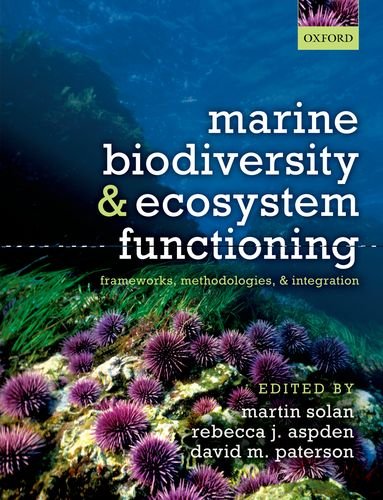
Marine biodiversity and ecosystem functioning frameworks methodologies and integration 1st Edition by Martin Solan, Rebecca Aspden, David Paterson ISBN 978-0199642267 0199642267


Original price was: $50.00.$35.00Current price is: $35.00.
Marine biodiversity and ecosystem functioning frameworks methodologies and integration 1st Edition by Martin Solan, Rebecca J. Aspden, David M. Paterson – Ebook PDF Instant Download/Delivery: 978-0199642267, 0199642267
Full download Marine biodiversity and ecosystem functioning frameworks methodologies and integration 1st Edition after payment
Product details:
ISBN 10: 0199642267
ISBN 13: 978-0199642267
Author: Martin Solan, Rebecca J. Aspden, David M. Paterson
The biological composition and richness of most of the Earth’s major ecosystems are being dramatically and irreversibly transformed by anthropogenic activity. Yet, despite the vast areal extent of our oceans, the mainstay of research to-date in the biodiversity-ecosystem functioning arena has been weighted towards ecological observations and experimentation in terrestrial plant and soil systems. This book provides a framework for examining the mechanistic processes transferable to marine systems.
Marine Biodiversity and Ecosystem Functioning is the first book to address the latest advances in biodiversity-function science using marine examples. It brings together contributions from the leading scientists in the field to provide an in-depth evaluation of the science, before offering a perspective on future research directions for some of the most pressing environmental issues facing society today and in the future.
Table of contents:
1. Marine biodiversity: its past development, present status, and future threats
Stephen Widdicombe and Paul J. Somerfield
1.1 Introduction
1.2 What is biodiversity?
1.3 Comparing marine and terrestrial biodiversity
1.4 The rise of marine biodiversity
1.5 The distribution of marine biodiversity
1.6 Human impacts on marine biodiversity
1.7 The relationship between global climate and marine biodiversity
1.8 Could marine biodiversity be facing large-scale climate-induced extinction?
1.9 Additional impacts of CO, on the marine environment
1.10 Hypoxia and ‘dead zones’
1.11 Summary
2. Biodiversity in the context of ecosystem function
Anne E. Magurran
2.1 Historical development of the concept
2.2 Biological diversity-meaning and measurement
2.3 Biodiversity in the context of function
2.4 Conclusions
3. Ecosystem function and co-evolution of terminology in marine science and management
David M. Paterson, Emma C. Defew, and Julia Jabour
3.1 Introduction
3.2 What’s in a name? Ecosystem function
3.2.1 Ecosystem function defined
3.3 Measuring ecosystem function
3.4 Ecological terms and the co-evolutionary model
3.5 Co-evolution, policy drivers, and opportunities
3.6 Conclusions
4. Ecological consequences of declining biodiversity: a biodiversity-ecosystem function (BEF) framework for marine systems
Shahid Naeem
4.1 The significance of marine biological diversity
4.1.1 Significance
4.1.2 A three-point framework for marine biodiversity
4.2 Marine biodiversity and ecosystem function
4.2.1 Daunting scales
4.2.2 Marine biodiversity
4.2.3 Marine ecosystem functioning
4.3 Marine biotic impoverishment
4.4 Marine BEF findings
4.5 The fundamental marine BEF relationship in abstraction
4.5.1 Where’s the inflection point?
4.5.2 The BEF curve for marine systems
4.6 Synthesis
4.6.1 A simple but telling marine BEF framework
4.6.2 Remember the humongous multipliers
4.6.3 Future directions
4.7 Conclusions
5. Lessons from the fossil record: the Ediacaran radiation, the Cambrian radiation, and the end-Permian mass extinction
Stephen Q. Dornbos, Matthew E. Clapham, Margaret L. Fraiser, and Marc Laflamme
5.1 Introduction
5.2 Strengths and limitations of the geological record
5.3 Ediacaran ecosystems
5.3.1 Productivity-biodiversity relationship
5.3.2 Influence of bioturbation on ecosystem functioning
5.3.3 Species richness-functional diversity relationship
5.4 Cambrian ecosystems
5.4.1 Productivity-biodiversity relationship
5.4.2 Influence of bioturbation on ecosystem functioning
5.4.3 Species richness-functional diversity relationship
5.5 The end-Permian mass extinction and its aftermath
5.5.1 Environmental changes during the late Paleozoic to early Mesozoic
5.5.2 Permian-Triassic marine nutrient levels and primary productivity
5.5.3 Productivity-biodiversity-biomass relationship
5.5.4 Discussion
5.6 Conclusions
6. The analysis of biodiversity-ecosystem function experiments: partitioning richness and density-dependent effects
Lisandro Benedetti-Cecchi and Elena Maggi
6.1 Introduction
6.2 Partitioning richness and abundance effects
6.3 Empirical example
6.3.1 Experimental layout
6.3.2 Fitting the mixed-effect model and evaluating contrasts
6.4 Results
6.5 Conclusions
7. The importance of body size, abundance, and food-web structure for ecosystem functioning
Mark C. Emmerson
7.1 Introduction
7.2 Historical context and the evolution of an idea
7.2.1 Integrating body mass, abundance, and food-web structure into biodiversity and ecosystem functioning studies
7.3 The relevance of body mass to biodiversity-ecosystem functioning research
7.4 Abundance, body mass, and species diversity patterns
7.5 Conclusions
8. Effects of biodiversity-environment conditions on the interpretation of biodiversity-function relations
Jasmin A. Godbold
8.1 Introduction
8.2 Methods of analysis
8.2.1 Compilation of publications
8.2.2 Calculation of effect sizes
8.2.3 Extraction of data
8.2.4 Statistical Analysis
8.3 Are alternative drivers of change more important than species richness for ecosystem properties?
8.3.1 Summary of studies focusing on relationship between species richness and ecosystem properties
8.3.2 Effects of species richness and/or additional drivers of change on ecosystem properties
8.3.3 Distinguishing the effects of biodiversity, the abiotic and/or biotic environment on ecosystem properties
8.4 Conclusions
9. Extending the approaches of biodiversity and ecosystem functioning to the deep ocean
Roberto Danovaro
9.1 Deep-sea ecosystems: characteristics, biodiversity, and functioning
9.2 Approaches to the investigation of deep-sea biodiversity and ecosystem functioning
9.2.1 Biodiversity metrics
9.2.2 Functional diversity
9.2.3 Deep-sea ecosystem functioning
9.2.4 Variables used for measuring ecosystem efficiency
9.3 Relationships between biodiversity and ecosystem functioning in the deep sea
9.4 Relationships between biodiversity and ecosystem functioning in different deep-sea ecosystems
9.5 Conclusions and perspectives
10. Incorporating extinction risk and realistic biodiversity futures: implementation of trait-based extinction scenarios
Martin Solan, Finlay Scott, Nicholas K. Dulvy, Jasmin A. Godbold, and Ruth Parker
10.1 Introduction
10.2 How to implement non-random extinction scenarios
10.3 Case study: implications of regional biodiversity loss on carbon cycling in the
shelf sea sediments of the North Sea
10.3.1 Study sites and data collection
10.3.2 Benthic bioturbation characterization
10.3.3 Modelling
10.3.4 Estimating non-linear changes in ecosystem functioning
10.4 Results and discussion
10.5 Conclusions and recommendations
11. Biodiversity and ecosystem functioning: an ecosystem-level approach
David Raffaelli and Alan M. Friedlander
11.1 The need to work at seascape scales
11.2 Building a credible evidence base
11.3 Case study 1: The Ythan estuary, Scotland
11.3.1 Biodiversity in the two periods
11.3.2 Ecological functioning in the two periods
11.4 Case study 2: Hawaii and the northern Line Islands, central Pacific
11.4.1 Hawaii
11.4.2 Northern Line Islands
11.5 Effects of fishing on fish assemblage structure
11.5.1 Hawaii
11.5.2 Northern Line Islands
11.6 Implications for ecosystem function
11.7 Conclusions
12. Multitrophic biodiversity and the responses of marine ecosystems to global change
J. Emmett Duffy, John J. Stachowicz, and John F. Bruno
12.1 Introduction
12.2 How and why biodiversity is changing in oceans and estuaries
12.3 Lessons learned: different designs for different questions
12.4 Biodiversity and ecosystem functioning in the Anthropocene
13. Reality check: issues of scale and abstraction in biodiversity research, and potential solutions
Tasman P. Crowe, Matthew E. S. Bracken, and Nessa E. O’Connor
13.1 Introduction
13.2 At which spatial and temporal scales have most biodiversity-ecosystem function (BEF) studies been conducted to date?
13.3 What important ecological processes or patterns may be lost in abstracting BEF experimental systems from natural ecosystems?
13.4 Does the reduced temporal/spatial scale or compromised ecological realism of marine BEF studies affect our ability to extrapolate results to other systems?
13.5 Relative merits of different approaches to overcoming limitations of BEF studies
13.5.1 Empirical research to elucidate ecological concepts
13.5.2 Empirical research for direct application to management/conservation
13.6 Conclusions
14. Why bother going outside: the role of observational studies in understanding biodiversity-ecosystem function relationships
Simon F. Thrush and Andrew M. Lohrer
14.1 The role of observation in the design, execution, and interpretation of BEF relationships
14.2 The heterogeneous nature of seafloor landscapes
14.3 Observing the nature of functions
14.4 Scaling laws and relevance to BEF
14.5 A more integrative approach to empirical research in biodiversity-ecosystem function studies
15. Implementing an ecosystem approach: predicting and safeguarding marine biodiversity futures
Alison R. Holt, Caroline Hattam, Stephen Mangi, Anton Edwards, and Scot Mathieson
15.1 Introduction
15.1.1 Taking an ecosystem approach
15.2 Ecosystem services, function, and biodiversity
15.2.1 Taking a systems perspective
15.2.2 Linking ecology and economics
15.3 An economic framework for ecosystem services
15.3.1 Valuation of ecosystem services
15.3.2 Valuation methods
15.4 A framework for implementing an ecosystem approach
15.5 Challenges for the future
15.5.1 Science needs
15.5.2 Policy needs
People also search for:
marine biodiversity and ecosystem
7 biodiversity and conservation
5 biodiversity
3 biodiversity
2 biodiversity
Tags: Martin Solan, Rebecca Aspden, David Paterson, Marine biodiversity, ecosystem functioning