
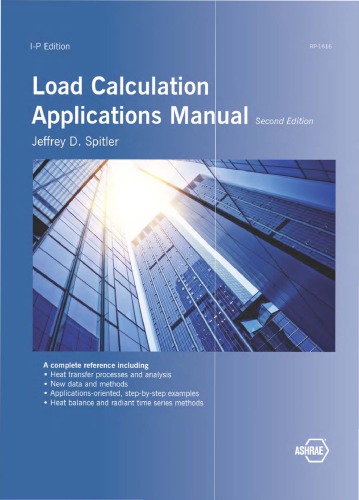
Load calculation applications manual Second Edition by American Society of Heating Refrigerating and Air Conditioning Engineers ISBN 978-1933742427 1933742429


Original price was: $50.00.$35.00Current price is: $35.00.
Load calculation applications manual Second Edition by American Society of Heating Refrigerating and Air-Conditioning Engineers – Ebook PDF Instant Download/Delivery: 978-1933742427, 1933742429
Full download Load calculation applications manual Second Edition after payment
Product details:
ISBN 10: 1933742429
ISBN 13: 978-1933742427
Author: American Society of Heating Refrigerating and Air-Conditioning Engineers
Guidance to help designers improve the performance and efficiency of design as it relates to load calculations is contained in a book from ASHRAE.
Load Calculation Applications Manual focuses on two methods for calculating cooling loads in non-residential buildings – the heat balance method and the radiant time series method (RTSM).
Author Jeffrey Spitler noted that understanding these methods is crucial when answering three primary design questions – what is the required equipment size; how do the heating/cooling requirements vary spatially within the building; and what are the relative sizes of the various contributors to the heating/cooling load?
”Cooling load calculations are performed primarily to answer the first and second questions, providing a basis for specifying the required airflow to individual spaces within the building,” Spitler said. ”Answers to the third question help designers make choices to improve the performance or efficiency of the design.”
The new manual features in-depth examples, as well as bringing together the latest data for building materials, windows, weather and internal heat gains, according to Spitler. The accompanying CD contains spreadsheets that compute the factors needed by the RSTM and compute cooling loads with the RSTM.
The manual is the fourth in a series of load calculation manuals published by ASHRAE, including the first and second editions of Cooling and Heating Load Calculation Manual as well as Cooling and Heating Load Calculation Principles.
ASHRAE, founded in 1894, is an international organization of some 50,000 persons. ASHRAE fulfills its mission of advancing heating, ventilation, air conditioning, and refrigeration to serve humanity and promote a sustainable world through research, standards writing, publishing, and continuing education.
The ASHRAE Handbooks are the design standard for control of built environments with volumes on Systems and Equipment, HVAC Applications, Refrigeration and Fundamentals. Each is updated every four years. In addition to publishing design guidance for engineers, architects, and facility managers, we also publish a series of texts for classroom use.
Some of the areas we publish in include:
-Energy Modeling and Auditing
-High Performance Building Design
-Psychrometrics
-Indoor Air Quality and Environmental Quality
-Data Center Energy Efficiency
-Noise & Vibration Control
-Humidity Control
-HVAC for Healthcare Facilities
Table of contents:
Chapter One
Introduction.
Chapter Two
Fundamentals of Heat Transfer and Thermodynamics
Chapter Three
Thermal Property Data
Chapter Four
Environmental Design Conditions
Chapter Five
Infiltration
Chapter Six
Internal Heat Gain
Chapter Seven
Fundamentals of the Radiant Time Series Method
Chapter Eight
Application of the RTSM-Detailed Example
Chapter Nine
Air Systems, Loads, IAQ, and Psychrometrics
Chapter Ten
Heating Load Calculations
Chapter Eleven
Heat Balance Method
Appendix A
Psychrometric Processes-Basic Principles
Appendix B
Spreadsheet Implementation of the RTSM
Appendix C
Calculation of CTSFs and RTFS
Appendix D
Solar Radiation and Heat Gain
Appendix E
Treatment of Thermal Bridges
Appendix F
Treatment of Uncontrolled Spaces
Appendix G
Correction Factor for High-Conductance Surface Zones
People also search for:
why are heat load calculations necessary
what are electrical load calculations
what are heat load calculations
what are load calcs
can bus load calculation
Tags: American Society of Heating Refrigerating and Air Conditioning Engineers, Load calculation, applications manual