
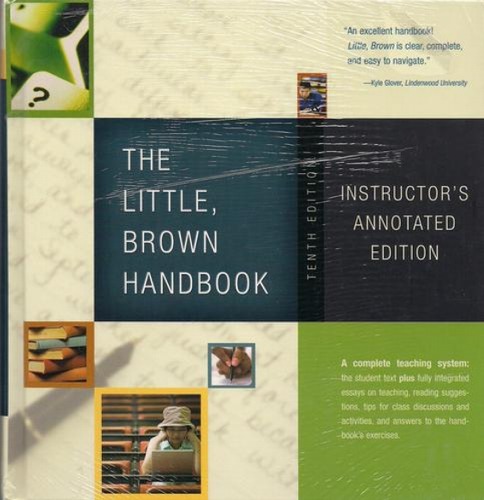
Little Brown Handbook The 10th Edition MyCompLab Series Instructor s Annot 10th Edition by Ramsey Fowler, Jane Aaron ISBN 978-0205585748 0205585744
Original price was: $50.00.$35.00Current price is: $35.00.
Little Brown Handbook The 10th Edition MyCompLab Series Instructor s Annot 10th Edition by H. Ramsey Fowler, Jane E. Aaron- Ebook PDF Instant Download/Delivery: 978-0205585748, 0205585744
Full download Little Brown Handbook The 10th Edition MyCompLab Series Instructor s Annot 10th Edition after payment
Product details:
ISBN 10: 0205585744
ISBN 13: 978-0205585748
Author: H. Ramsey Fowler, Jane E. Aaron
The most trusted and authoritative name in handbooks, The Little, Brown Compact Handbook is an easy-to-use reference that will answer any question you may have in grammar, writing, or research. This edition offers the latest information on writing with computers, writing online, analyzing visuals, and researching effectively on the Internet. With clear explanations, a wealth of examples, and quick reference checklists and boxes, The Little, Brown Compact Handbook will makes it easy to find what you need and use the information you find.
Table of contents:
Part 1 The Writing Process
Assessing the Writing Situation
a. Understanding how writing happens
b. Analyzing the writing situation
c. Discovering and limiting a subject
d. Considering the audience
e. Defining a purpose
Developing and Shaping Ideas
a. Discovering ideas
b. Developing a thesis
c. Organizing ideas
- Sample Essay
Drafting and Revising
a. Writing the first draft
b. Revising the first draft
c. Examining a sample revision
d. Editing the revised draft
e. Preparing and proofreading the final draft
f. Examining a final draft
g. Giving and receiving comments
h. Preparing a writing portfolio
Writing and Revising Paragraphs
a. Maintaining paragraph unity
b. Achieving paragraph coherence
c. Developing the paragraph
d. Writing special kinds of paragraphs
e. Linking paragraphs in the essay
Designing Documents
a. Designing academic papers and other documents
b. Considering principles of design
c. Using the elements of design
d. Using illustrations
e. Considering readers with disabilities
Part 2 Reading and Writing in College
Writing in Academic Situations
a. Becoming an academic writer
b. Analyzing audience
c. Determining purpose
d. Choosing structure and content
e. Using academic language
Studying Effectively and Taking Exams
a. Managing your time
b. Listening and taking notes in class
c. Reading for comprehension
d. Preparing for and taking exams
- Sample Essay Exams
Forming a Critical Perspective
a. Thinking and reading critically
b. Viewing images critically
c. Writing critically
- Sample Critique of a Text
- Sample Critique of an Image
Reading Arguments Critically
a. Recognizing the elements of argument
b. Testing claims
c. Weighing evidence
d. Discovering assumptions
e. Watching language, hearing tone
f. Judging reasonableness
g. Recognizing fallacies
Writing an Argument
a. Finding a subject
b. Conceiving a thesis statement
c. Analyzing your purpose and your audience
d. Using reason
e. Using evidence
f. Reaching your readers
g. Organizing your argument
h. Revising your argument
i. Examining a sample argument
Reading and Using Visual Arguments
a. Reading visual arguments critically
b. Using visual arguments effectively
Part 3 Grammatical Sentences
Understanding Sentence Grammar
a. Understanding the basic sentence
b. Expanding the basic sentence with single words
c. Expanding the basic sentence with word groups
d. Compounding words, phrases, and clauses
e. Changing the usual word order
f. Classifying sentences
Case of Nouns and Pronouns
a. Compound subjects and complements
b. Compound objects
c. We or us with a noun
d. Appositives
e. Pronoun after than or as in a comparison
f. Subjects and objects of infinitives
g. Who vs. whom
h. Case before a gerund
Verbs
- Verb Forms
a. Regular and irregular verbs
b. Sit and set; lie and lay; rise and raise
c. Omitted -s and -ed endings
d. Helping verbs
e. Verb plus gerund or infinitive
f. Verb plus particle
- Tense
g. Appropriate tense for meaning
h. Sequence of tenses
- Mood
i. Subjunctive verb forms
- Voice
j. Active vs. passive voice
Agreement
a. Agreement between subject and verb
b. Agreement between pronoun and antecedent
Adjectives and Adverbs
a. Adjectives only with nouns and pronouns
b. Adjectives after linking verbs
c. Adjectives with objects; adverbs with verbs
d. Comparative and superlative forms
e. Double negatives
f. Overuse of nouns as modifiers
g. Present and past participles as adjectives
h. A, an, the, and other determiners
Part 4 Clear Sentences
Sentence Fragments
a. Tests for sentence completeness; revision of fragments
b. Subordinate clause
c. Verbal or prepositional phrase
d. Other fragments
e. Acceptable uses of incomplete sentences
Comma Splices and Fused Sentences
- Comma Splices
a. Main clauses not joined by coordinating conjunction
b. Main clauses related by a conjunctive adverb or transitional expression
- Fused Sentences
c. Main clauses with no conjunction or punctuation
Pronoun Reference
a. Clear reference to one antecedent
b. Clear placement of pronoun and antecedent
c. Reference to specific antecedent
d. Indefinite use of it and they
e. Indefinite use of you
f. Clear use of it
g. Appropriate use of relative pronouns
Shifts
a. Person and number
b. Tense and mood
c. Subject and voice
d. Indirect and direct quotations and questions
Misplaced and Dangling Modifiers
- Misplaced Modifiers
a. Clear placement of modifiers
b. Limiting modifiers
c. Squinting modifiers
d. Separation of subjects, verbs, and objects
e. Separation of parts of infinitives or verb phrases
f. Position of adverbs
g. Order of adjectives
- Dangling Modifiers
h. Dangling modifiers
Mixed and Incomplete Sentences
- Mixed Sentences
a. Mixed grammar
b. Mixed meaning (faulty predication)
- Incomplete Sentences
c. Compound constructions
d. Comparisons
e. Careless omissions
Part 5 Effective Sentences
Emphasizing Ideas
a. Using subjects and verbs effectively
b. Using sentence beginnings and endings
c. Arranging parallel elements effectively
d. Repeating ideas
e. Separating ideas
f. Being concise
Using Coordination and Subordination
a. Coordinating to relate equal ideas
b. Subordinating to distinguish main ideas
c. Choosing clear connectors
Using Parallelism
a. Using parallelism for coordinate elements
b. Using parallelism to increase coherence
Achieving Variety
a. Varying sentence length and structure
b. Varying sentence beginnings
c. Inverting the normal word order
d. Mixing types of sentences
Part 6 Punctuation
- Chart
End Punctuation
a. The period
b. The question mark
c. The exclamation point
The Comma
a. Main clauses linked by coordinating conjunction
b. Introductory elements
c. Nonessential elements
d. Absolute phrases
e. Phrases expressing contrast
f. Series and coordinate adjectives
g. Dates, addresses, place names, long numbers
h. With quotations
i. To prevent misreading
j. Misuse and overuse
The Semicolon
a. Main clauses not joined by a coordinating conjunction
b. Main clauses related by a conjunctive adverb or transitional expression
c. Long or internally punctuated main clauses
d. Long or internally punctuated series items
e. Misuse and overuse
The Apostrophe
a. Possessive case
b. Misuse with noun plurals, verbs, and personal pronouns
c. Contractions
d. Plurals of abbreviations, dates, and words or characters named as words
Quotation Marks
- Chart
a. Direct quotations
b. Quotation within a quotation
c. Dialog
d. Titles of songs, short stories, etc.
e. Words used in a special sense
f. Overuse
g. Placement with other punctuation marks
Other Punctuation Marks
a. The colon
b. The dash
c. Parentheses
d. Brackets
e. The ellipsis mark
f. The slash
Part 7 Mechanics
Capitals
a. First word of a sentence
b. Titles of works
c. Pronoun I and interjection O
d. Proper nouns and adjectives
e. Titles before proper names
f. Misuses of capitals
Underlining or Italics
a. Underlining vs. italics
b. Titles of books and periodicals
c. Names of ships, aircraft, spacecraft, trains
d. Foreign words and phrases
e. Words, letters, and numbers named as words
f. For emphasis
g. In online communication
Abbreviations
a. Titles before and after proper names
People also search for:
the little brown handbook price in pakistan
the little brown handbook 12th edition
the little brown handbook 14th edition answers
the little brown handbook 10th edition
little brown handbook the 14th edition
Tags: Ramsey Fowler, Jane Aaron, Little Brown