
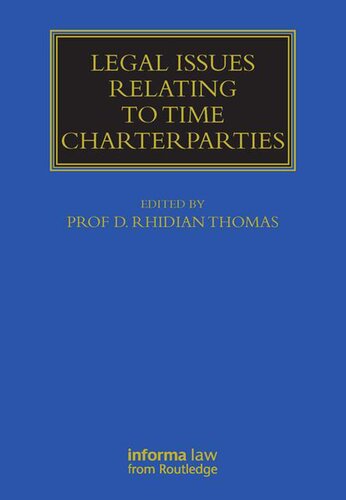
Legal Issues Relating to Time Charterparties 1st Edition by Rhidian Thomas ISBN 978-1843117452 1843117452


Original price was: $50.00.$35.00Current price is: $35.00.
Legal Issues Relating to Time Charterparties 1st Edition by Rhidian Thomas – Ebook PDF Instant Download/Delivery: 978-1843117452, 1843117452
Full download Legal Issues Relating to Time Charterparties 1st Edition after payment
Product details:
ISBN 10: 1843117452
ISBN 13: 978-1843117452
Author: Rhidian Thomas
Legal Issues Relating to Time Charterparties addresses all the major questions and issues that arise in connection with time charterparties, examining them in a logical manner, progressively tracing the subject from the creation to the termination of the contract. All the salient legal aspects of time charterparties are examined, with the law analysed in its commercial context, particularly in relation to the various ways in which time charterparties may be used in shipping and international trade.
Table of contents:
CHAPTER 1:
STANDARD FORMS THE BIMCO EXPERIENCE
by Grant Hunter
Introduction
Objectives..
The documentary process
Market research
Types of form
The drafting process
Subcommittee composition
Drafting work
Project timescale
Key documentary issues
Box layout
Core clauses
Trade specific clauses
Liability regime
Protective clauses
Publication
Marketing
Availability of provisions to entire shipping industry
Information technology and IDEA
Paper versus pixel
BIMCO time charterparties
BALTIME 1939 (as revised 2001)
NYPE 93
KIND
General
Period and Delivery (Clause 1)
Trading Areas (Clause 2)
Cargo Restrictions etc. (Clause 3)
Redelivery (Clause 4)
Bunkers (Clause 6)
Vessel’s Gear (Clause 7)
Hire (Clause 8)
Off-hire (Clause 9)
N
Owners’ Obligations (Clause 11)
Master (Clause 12)
Charterers’ Obligations (Clause 13)
Owners’ Requirements (Clause 14)
Charterers’ Requirements (Clause
Sundry Matters (Clause 16)
15)
Liabilities
Bills of Lading (Clause 17)
Responsibilities (Clause 18)
Exceptions (Clause 19)
Insurances (Clause 20)
War Risks (Clause 21)
Law and Arbitration (Clause 22)
Commission (Clause 23)
Notices (Clause 24)
SUPPLYTIME 2005
CHAPTER 2:
CONSTRUING TERMS IN TIME CHARTERPARTIES BEGINNING OF A NEW ERA OR BUSINESS AS USUAL?
Conclusion
by Dr. Baris Soyer
Introduction
Lord Hoffmann’s restatement and emerging issues.
Common sense approach to interpretation
Dumping the old intellectual baggage of legal interpretation
(a) Of the same kind
(b) The expression of one is the exclusion of the other.
(c) Typed or hand-written conditions taking precedence over standard printed conditions
(d) Construing the contract as a whole and giving effect to all parts of the contract
Factual matrix the limits of contextual construction in time charterparties
Previous negotiations and modifications on standard charterparty contracts: part
of the matrix?
(a ) The scope of the rule
(b) Justification of the rule and its role in construing charterparties
(c) Earlier drafts and deletions
Protecting “reasonable expectations” of parties?
An economic perspective.
Contract efficiency and literalism
Economic reasons for restricting the scope of factual matrix
Impact of judicial intervention on contract efficiency
Conclusion
CHAPTER 3: ASCERTAINING THE CHARTER PERIOD by Paul Herring
Introduction
Why is it important?
Damages
Illegitimate last voyages
Tolerances
Last voyage clauses
Without guarantee
CHAPTER 4: SAFE PORT CLAUSES by Professor Howard Bennett
Introduction
A promissory obligation
The meaning of safety
(a) The scope of safety
(b) A question of judgement
(c) Proof of unsafety: subsequent events
Abnormal events
The timing and nature of the charterer’s promise of safety
The charterer’s secondary obligation
Alternative wordings
(a) Due diligence clauses
(b) Safe berth clauses
(c) Narrowing the scope of safety
Third party instructions
The impact on safe port undertakings of other charterparty terms
Named ports
Implied safe port obligations
Rejecting the nomination of a (possibly) unsafe port
Remedies for breach of contract by nominating an unsafe port
Conclusion
CHAPTER 5: SEAWORTHINESS AND THE HONGKONG FIR DECISION by Mark Hamsher
Introduction
An outline of the unhappy voyage of the Hongkong Fir
Summary of time lost
The freight market
Mr Justice Salmon’s views on the crew
The decision of Mr Justice Salmon in the English High Court
The decision of the Court of Appeal
Is the approach of the judges in the Hongkong Fir still valid today?
CHAPTER 6: INDEMNITIES IN TIME CHARTERS by David Foxton QC Introduction
Indemnity clauses in current form charterparties
The conceptual basis of the owner’s right to an indemnity
The interrelationship with other charterparty terms
Limitations on the right of indemnity: acts “manifestly tortious”.
Indemnity against what? The importance of causation and foreseeability
Particular contexts in which claims for an indemnity have been made
(a) Where the bills of lading expose the owner to a liability which is inconsistent with the terms of the charterparty
(b) An indemnity against the consequences of delivering cargo without production of the bills of lading
(c) Port risks
(d) Cargo risks
(e) Navigation risks
CHAPTER 7: TIME CHARTERPARTY HIRE: ISSUES RELATING TO CONTRACTUAL
REMEDIES FOR DEFAULT AND OFF-HIRE CLAUSES
by Professor D. Rhidian Thomas
Introduction
Contractual remedies for payment defaults
Introduction
A sample of relevant charterparty clauses
Contractual remedies of withdrawal and suspension
The legal effect of withdrawal and suspension
Loss of the contractual rights of withdrawal and suspension
Qualifying the right of withdrawal/suspension and/or protecting against unfairness
The wider legal and commercial implications of exercising the contractual remedies
Impact of the contractual power to withdraw on the characterisation of the payment
obligation
The ambit of off-hire clauses
Introduction
The nature of off-hire clauses
A sample of standard off-hire clauses
BALTIME 1939 (As Revised 2001) cl. 11
NYRE 1946 cl. 15
NYPE 93 cl. 17
GENTIME cl. 9
BPTIME 3 cl. 19
SOLUTIONS 4
cl. 21
The province of off-hire clauses
Preventing the full working of the vessel
Off-hire clauses and external causes
Conclusion
CHAPTER 8: ASSIGNEES OF HIRE: HOW FAR CAN THEY IGNORE CHARTERER’S CLAIMS AGAINST OWNERS? by Professor Andrew Tettenborn
Introduction
Scope of the problem
The deduction of charterer’s claims from amounts payable to the assignee
A sub-issue: set-offs and liens over sub-hire
Hire and deductions: possible strategies
Off-hire time and charterers’ repayment claims
Conclusion
CHAPTER 9: TIME CHARTERPARTIES AND BILLS OF LADING by Emeritus Professor Francis Reynolds QC
Introduction
Significance of time charters in these contexts
A. Master to sign bills of lading as presented
Early cases on this and similar formulae
Later developments
Implied indemnity
When can the master refuse to sign?
Clausing
Surroundings to this
Liability in tort
Result of signature of bills which there was no duty to sign
Signature by charterer himself
Doubtful indemnities
B. Bills of lading referring to a charterparty: incorporation of charterparty terms
Incorporation in general
Why incorporate time charterparty terms?
Words of incorporation
Right to sue and lien for time charter hire
Liens on sub-freights
C. Impact of the Carriage of Goods by Sea Act 1992 in this area
How does the Act operate when the contract “springs up”?
Indorsement of bill of lading to charterer Contracts (Rights of Third
Parties) Act 1999
CHAPTER 10: CLAUSES PARAMOUNT IN TIME CHARTERS
by Professor Yvonne Baatz
Introduction
Are the rules incorporated into the charterparty?
Which rules are incorporated?
What is the impact of the rules incorporated into the charterparty?
(i) The seaworthiness obligation
(ii) Care of cargo
(iii) The exceptions
(iv) The time bar
(v) Deviation
(vi) Article IV rule 6 dangerous goods
Conclusion
CHAPTER 11: WAR, TERROR, PIRACY AND FRUSTRATION IN A TIME CHARTER CONTEXT by Professor Keith Michel.
Introduction
The development of war risks cover.
Judicial definitions of war and war related risks
Terrorism and piracy differences of definition
Changed threats and new risks
“War risks” in a time charter context
The impact of international regulation..
The regulatory framework, port safety, employment and indemnity.
“War risks” clauses
Cancellation
Alternative methods of performance
Compliance with third part instructions
Mutual exceptions clauses
War, related risks and the doctrine of frustration
Conclusion
CHAPTER 12: TERMINATION OF RIGHTS UNDER TIME CHARTERS by John D. Kimball
Introduction
Cancelling clauses
What rights and obligations do cancelling clauses create?
When must the option to cancel be exercised?
Termination by reason of a ship’s condition
When is a ship “ready” to tender a valid notice of readiness?
Termination of a time charter for unseaworthiness
Termination by reason of frustration of the charter
Termination of time charters for late payment of charter hire
CHAPTER 13: THE ALLOCATION OF CARGO CLAIMS BETWEEN OWNERS AND CHARTERERS IN NYPE CHARTERPARTIES by Dr Theodora Nikaki
Introduction
Cargo claims and Clause 8 of NYPE 1946 charterparties
Cargo claims arising out of improper cargo handling
Cargo claims arising out of unseaworthiness caused by improper cargo loading or stowage
The Inter-Club Agreement 1996
The background
The legal nature of the ICA 1996
Types of cargo claim covered by ICA 1996
Preconditions for the application of ICA 1996
The rules on the apportionment of cargo claims
Conclusions
CHAPTER 14: CONTAINERISATION, SLOT CHARTERS, AND THE LAW by Christopher Hancock QC
Introduction: why slot charters?
What type of charter is a slot charter?
(1) Duration
(2) Control
(3) Mode of payment
(4) Responsibility to cargo owners
The contractual relationships involved
(1) Owner and slot charterers A, B and C
(2) Owner and bill of lading holder
(3) Slot charterer and bill of lading holder
(1) The relationship between the slot charterers themselves
(2) The relationship between the bill of lading holder and slot charterers other than the charterer with whom that bill of lading holder has a contract
The approach of the English courts
Slot charters and arrest
Slot charters and limitation
Conclusion
CHAPTER 15: DAMAGES FOR BREACH OF TIME CHARTER: SOME RECENT
DEVELOPMENTS by Andrew Taylor
Introduction
General principles of damages
Damages for loss of fixture: The Achilleas
The time for assessment of damages: The Golden Victory.
Conclusion
Afterword
CHAPTER 16: THE EFFECTIVENESS OF LIENS AS A SELF-HELP REMEDY?
by Professor Richard W. Williams….
Introduction
What is a lien?
Legal difficulties
(i) The necessity for the goods owner to have agreed to the lien
(ii) Incorporation of the time charter lien clause into the bill of lading
(iii) The significance of the lien between the shipowner and the time charterer inter se
(iv) Indirect enforcement of sums due under the time charter by the exercise of a lien on freight
(v) For what amounts can the lien be exercised?
Practical difficulties
Liens on sub-freights
Legal and practical difficulties
Conclusion
People also search for:
legal issues relating to time charterparties
legal concerns meaning
legal issues in event planning
legal issues for events
legal timeshare
Tags: Rhidian Thomas, Legal Issues Relating, Time Charterparties