
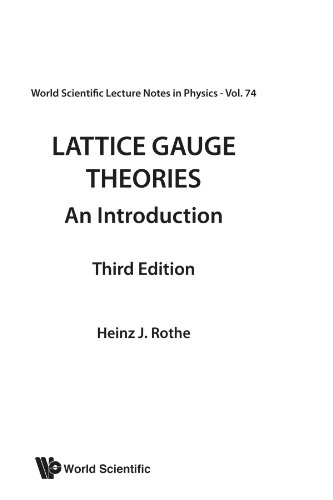
Lattice Gauge Theories An Introduction 3rd Edition by Heinz Rothe ISBN 978-9812560629 9812560629

Original price was: $50.00.$35.00Current price is: $35.00.
Lattice Gauge Theories An Introduction 3rd Edition by Heinz J. Rothe- Ebook PDF Instant Download/Delivery: 978-9812560629, 9812560629
Full download Lattice Gauge Theories An Introduction 3rd Edition after payment
Product details:
ISBN 10: 9812560629
ISBN 13: 978-9812560629
Author: Heinz J. Rothe
This book provides a broad introduction to gauge field theories formulated on a space-time lattice, and in particular of QCD. It serves as a textbook for advanced graduate students, and also provides the reader with the necessary analytical and numerical techniques to carry out research on his own. Although the analytic calculations are sometimes quite demanding and go beyond an introduction, they are discussed in sufficient detail, so that the reader can fill in the missing steps. The book also introduces the reader to interesting problems which are currently under intensive investigation. Whenever possible, the main ideas are exemplified in simple models, before extending them to realistic theories. Special emphasis is placed on numerical results obtained from pioneering work. These are displayed in numerous figures.
Table of contents:
1. INTRODUCTION
2. THE PATH INTEGRAL APPROACH TO QUANTIZATION
2.1 The Path Integral Method in Quantum Mechanics
2.2 Path Integral Representation of Bosonic Green Functions in Field Theory
2.3 The Transfer Matrix
2.4 Path Integral Representation of Fermionic Green Functions
2.5 Discretizing Space-Time. The Lattice as a Regulator of a Quantum Field Theory
3. THE FREE SCALAR FIELD ON THE LATTICE
4. FERMIONS ON THE LATTICE
4.1 The Doubling Problem
4.2 A Closer Look at Fermion Doubling
4.3 Wilson Fermions
4.4 Staggered Fermions
4.5 Technical Details of the Staggered Fermion Formulation
4.6 Staggered Fermions in Momentum Space
4.7 Ginsparg-Wilson Fermions
5. ABELIAN GAUGE FIELDS ON THE LATTICE AND COMPACT QED
5.1 Preliminaries
5.2 Lattice Formulation of QED
6. NON-ABELIAN GAUGE FIELDS ON THE LATTICE COMPACT QCD
7. THE WILSON LOOP AND THE STATIC QUARK-ANTIQUARK POTENTIAL
7.1 A Look at Non-Relativistic Quantum Mechanics
8. THE QQ POTENTIAL IN SOME SIMPLE MODELS
8.1 The Potential in Quenched QED
8.2 The Potential in Quenched Compact
QED2
9. THE CONTINUUM LIMIT OF LATTICE QCD
9.1 Critical Behaviour of Lattice QCD and the Continuum Limit
9.2 Dependece of the Coupling Constant on the Lattice Spacing and the Renormalization Group 8-Function
10. LATTICE SUM RULES
10.1 Energy Sum Rule for the Harmonic Oscillator
10.2 The SU(N) Gauge Action on an Anisotropic Lattice
10.3 Sum Rules for the Static qğ-Potential
10.4 Determination of the Electric, Magnetic and Anomalous
Contribution to the go-Potential
10.5 Sum Rules for the Glueball Mass
11. THE STRONG COUPLING EXPANSION
11.1 The qğ-Potential to Leading Order in Strong Coupling.
11.2 Beyond the Leading Approximation
11.3 The Lattice Hamiltonian in the Strong Coupling Limit and the String Picture of Confinement
12. THE HOPPING PARAMETER EXPANSION
12.1 Path Integral Representation of Correlation Functions in Terms of Bosonic Variables
12.2 Hopping Parameter Expansion of the Fermion Propagator in an External Field
12.3 Hopping Parameter Expansion of the Effective Action
12.4 The HPE and the Pauli Exclusion Principle
13. WEAK COUPLING EXPANSION (I). THE 3-THEORY
13.1 Introduction
13.2 Weak Coupling Expansion of Correlation Functions in the 3-Theory
13.3 The Power Counting Theorem of Reisz
14. WEAK COUPLING EXPANSION (II). LATTICE QED
14.1 The Gauge Fixed Lattice Action
14.2 Lattice Feynman Rules
14.3 Renormalization of the Axial Vector Current in
One-Loop Order
14.4 The ABJ Anomaly
15. WEAK COUPLING EXPANSION (III). LATTICE QCD
15.1 The Link Integration Measure
15.2 Gauge Fixing and the Faddeev-Popov Determinant
15.3 The Gauge Field Action
15.4 Propagators and Vertices
15.5 Relation Between A, and the A-Parameter of Continuum QCD
15.6 Universality of the Axial Anomaly in Lattice QCD
16. MONTE CARLO METHODS
16.1 Introduction
16.2 Construction Principles for Algorithms. Markov chains
16.3 The Metropolis Method
16.4 The Langevin Algorithm
16.5 The Molecular Dynamics Method
16.6 The Hybrid Algorithm.
16.7 The Hybrid Monte Carlo Algorithm
16.8 The Pseudofermion Method
16.9 Application of the Hybrid Monte Carlo Algorithm to Systems with Fermions
17. SOME RESULTS OF MONTE CARLO CALCULATIONS
17.1 The String Tension and the qğ-Potential in the SU(3)
Gauge Theory
17.2 The qğ-Potential in Full QCD
17.3 Chiral Symmetry Breaking
17.4 Glueballs
17.5 Hadron Mass Spectrum
17.6 Instantons
17.7 Flux Tubes in the qỹ and qqq-Systems
17.8 The Dual Superconductor Picture of Confinement
17.9 Center Vortices and Confinement
18. PATH-INTEGRAL REPRESENTATION OF THE THERMODYNAMICAL PARTITION FUNCTION FOR SOME SOLVABLE BOSONIC AND FERMIONIC SYSTEMS
18.1 Introduction
18.2 Path-Integral Representation of the Partition Function in Quantum Mechanics
18.3 Sum Rule for the Mean Energy
18.4 Test of the Energy Sum Rule. The Harmonic Oscillator
18.5 The Free Relativistic Boson Gas in the Path Integral Appoach
18.6 The Photon Gas in the Path Integral Approach
18.7 Functional Methods for Fermions. Basics
18.8 Path Integral Representation of the Partition Function for a Fermionic System valid for Arbitrary Time-Step
18.9 A Modified Fermion Action Leading to Fermion Doubling.
18.10 The Free Dirac Gas. Continuum Approach
18.11 Dirac Gas of Wilson Fermions on the Lattice
19. FINITE TEMPERATURE PERTURBATION THEORY OFF AND ON THE LATTICE
19.1 Feynman Rules For Thermal Green Functions in the A-Theory
19.2 Generation of a Dynamical Mass at T≠0
19.3 Perturbative Expansion of the Thermodynamical Potential
19.4 Feynman Rules for QED and QCD at non-vanishing Temperature and Chemical Potential in the Continuum
19.5 Temporal Structure of the Fermion Propagator at T≠0 and μ≠0 in the Continuum
19.6 The Electric Screening Mass in Continuum QED in One-Loop Order
19.7 The Electric Screening Mass in Continuum QCD in One-Loop Order
19.8 Lattice Feynman Rules for QED and QCD at T ≠ 0 and μ≠ 0.
19.9 Particle-Antiparticle Spectrum of the Fermion Propagator at T≠ 0 and 70. Naive vs. Wilson Fermions
19.10 The Electric Screening Mass for Wilson Fermions in Lattice QED to One-Loop Order
19.11 The Electric Screening Mass for Wilson Fermions in Lattice QCD to One-Loop Order
19.12 The Infrared Problem
20. NON-PERTURBATIVE QCD AT FINITE TEMPERATURE
20.1 Thermodynamics on the Lattice
20.2 The Wilson Line or Polyakov Loop
20.3 Spontaneous Breakdown of the Center Symmetry and the Deconfinement Phase Transition
20.4 How to Determine the Transition Temperature
20.5 A Two-Dimensional Model. Test of Theoretical Concepts
20.6 Monte Carlo Study of the Deconfinement Phase Transition in the Pure SU(3) Gauge Theory
20.7 The Chiral Phase Transition
20.8 Some Monte Carlo Results on the High Temperature Phase of QCD
20.9 Some Possible Signatures for Plasma Formation
People also search for:
hamiltonian formulation of wilson’s lattice gauge theories
simulating lattice gauge theories on a quantum computer
rothe lattice gauge theories
deep learning lattice gauge theories
quantum simulation of lattice gauge theories
Tags: Heinz Rothe, Lattice Gauge, Theories An Introduction