
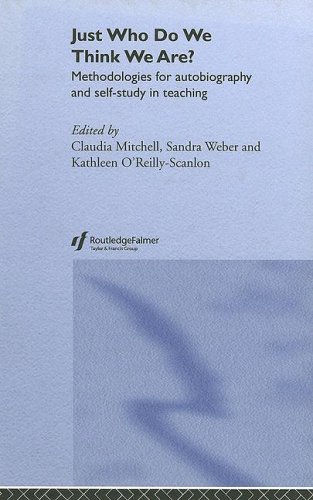
Just Who Do We Think We Are Methodologies For Self Study in Education 1st Edition by Claudia Mitchell, Kathleen O Reilly-Scanlon, Sandra Weber ISBN 978-0415298728 0415298725
Original price was: $50.00.$35.00Current price is: $35.00.
Just Who Do We Think We Are Methodologies For Self Study in Education 1st Edition by Claudia Mitchell, Kathleen O’Reilly-Scanlon, Sandra Weber- Ebook PDF Instant Download/Delivery: 978-0415298728, 0415298725
Full download Just Who Do We Think We Are Methodologies For Self Study in Education 1st Edition after payment
Product details:
ISBN 10: 0415298725
ISBN 13: 978-0415298728
Author: Claudia Mitchell, Kathleen O’Reilly-Scanlon, Sandra Weber
Drawing upon diverse and specific examples of self-study, described here by the practitioners themselves, this unique book formulates a methodological framework for self-study in education.
This collection brings together a diverse and international range of self-studies carried out in teacher education, each of which has a different perspective to offer on issues of method and methodology, including:
* memory work
* fictional practice
* collaborative autobiography
* auto-ethnography
* phenomenology
* image-based approaches.
Such ethical issues likely to arise from self-study as informed consent, self-disclosure and crises of representation are also explored with depth and clarity.
As method takes centre stage in educational and social scientific research, and self-study becomes a key tool for research, training, practice and professional development in education, Just Who Do We Think We Are? provides an invaluable resource for anyone undertaking this form of practitioner research.
Table of contents:
1. Just who do we think we are and how do we know this? Re-visioning pedagogical spaces for studying self in teaching – Claudia Mitchell and Sandra Weber
Part 1: Self study through memory and the body
2. Clothing and body in self-study: The pedagogy of shoes – Sandra Weber
3. Heavy fuel: Memoir, biography and narrative – Victoria Perselli
4. Drawing as a research tool for self-study: An embodied method of exploring memories of childhood bullying – Catherine Derry
1. Just who do we think we are and how do we know this? Re-visioning pedagogical spaces for studying self in teaching – Claudia Mitchell and Sandra Weber
Part 1: Self study through memory and the body
2. Clothing and body in self-study: The pedagogy of shoes – Sandra Weber
3. Heavy fuel: Memoir, biography and narrative – Victoria Perselli
4. Drawing as a research tool for self-study: An embodied method of exploring memories of childhood bullying – Catherine Derry
Part 2: Self-study through literary and artistic inquiry
5. The monochrome frame: mural-making as a methodology for understanding ‘self’ – Max Biddulph
6. Using pictures at an exhibition to explore my teaching practices – Mary Lynn Hamilton
7. Self study through an exploration of artful and artless experiences – Linda Szabad-Smyth
8. Apples of change: Arts-based methodology as a poetic and visual sixth sense – C.T. Patrick Diamond and Christine van Halen-Faber
9. Inquiry through poetry: The genesis of my self-study – Lynn Butler-Kisber
10. Truth in fiction: Seeing our rural selves – Tony Kelly
Part 3: Reflection, life history and self-study
11. ‘It was good to find out why’: Teaching Drama planning through a self-study lens – Linda Lang
12. Speak for yourselves: Capturing the complexity of critical reflection – Vicki Kubler LaBoskey
13. Just where do I think I’m going?: Working with marginalized and disaffected youth and self-study – Katherine Childs
14. Pathlamp: A self-study guide for teacher research – Carol A. Mullen and William A. Kealy
15. Teaching about teaching: The role of self-study – Amanda Berry and John Loughran
Part 4: (Re) positioning the self in and through self-study
16. The Sand Diaries: Visions, vulnerability and self-study – Anastasia Kamanos Gamelin
17. A queer path across the straight furrows of my field: A series of reflections – Mary Phillips Manke
18. Self-study through narrative interpretation: Probing lived experiences of educational privilege
5. The monochrome frame: mural-making as a methodology for understanding ‘self’ – Max Biddulph
6. Using pictures at an exhibition to explore my teaching practices – Mary Lynn Hamilton
7. Self study through an exploration of artful and artless experiences – Linda Szabad-Smyth
8. Apples of change: Arts-based methodology as a poetic and visual sixth sense – C.T. Patrick Diamond and Christine van Halen-Faber
9. Inquiry through poetry: The genesis of my self-study – Lynn Butler-Kisber
10. Truth in fiction: Seeing our rural selves – Tony Kelly
People also search for:
just who do we think
just who do we think we are
just who the hell do you think we are
do you think what i’m thinking
who thinks or who think
Tags: Claudia Mitchell, Kathleen O Reilly-Scanlon, Sandra Weber, We Are Methodologies, Self Study