
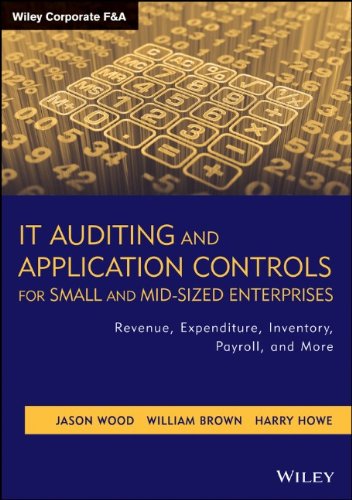
IT Auditing and Application Controls for Small and Mid Sized Enterprises Revenue Expenditure Inventory Payroll and More 1st Edition by Jason Wood, William Brown, Harry Howe ISBN 978-1118072615 1118072615
Original price was: $50.00.$35.00Current price is: $35.00.
IT Auditing and Application Controls for Small and Mid Sized Enterprises Revenue Expenditure Inventory Payroll and More 1st Edition by Jason Wood, William Brown, Harry Howe – Ebook PDF Instant Download/Delivery: 978-1118072615, 1118072615
Full download IT Auditing and Application Controls for Small and Mid Sized Enterprises Revenue Expenditure Inventory Payroll and More 1st Edition after payment
Product details:
ISBN 10: 1118072615
ISBN 13: 978-1118072615
Author: Jason Wood, William Brown, Harry Howe
Essential guidance for the financial auditor in need of a working knowledge of IT
If you’re a financial auditor needing working knowledge of IT and application controls, Automated Auditing Financial Applications for Small and Mid-Sized Businesses provides you with the guidance you need. Conceptual overviews of key IT auditing issues are included, as well as concrete hands-on tips and techniques. Inside, you’ll find background and guidance with appropriate reference to material published by ISACA, AICPA, organized to show the increasing complexity of systems, starting with general principles and progressing through greater levels of functionality.
Provides straightforward IT guidance to financial auditors seeking to develop quality and efficacy of software controls
Offers small- and middle-market business auditors relevant IT coverage
Covers relevant applications, including MS Excel, Quickbooks, and report writers
Written for financial auditors practicing in the small to midsized business space
The largest market segment in the United States in quantity and scope is the small and middle market business, which continues to be the source of economic growth and expansion. Uniquely focused on the IT needs of auditors serving the small to medium sized business, Automated Auditing Financial Applications for Small and Mid-Sized Businesses delivers the kind of IT coverage you need for your organization.
Table of contents:
Chapter 1: Why Is IT Auditing Important to the Financial Auditor and the Financial Statement Audit?
Management’s Assertions and the IT Audit
Objectives of Data Processing for Small and Medium‐Sized Enterprises (SMEs)
Special Challenges Facing SMEs
Research Confirming the Risks Associated with SMEs
A Framework for Evaluating Risks and Controls, Compensatory Controls, and Reporting Deficiencies
Summary: The Road Ahead
Chapter 2: General Controls for the SME
General Controls: Scope and Outcomes
The “COSO Process”—Putting It All Together: Financial Statements, Assertions, Risks, Control Objectives, and Controls
Summary
Chapter 3: Application‐Level Security
Key Considerations
Initial Security Setup
Security Role Design
Password Configuration
Segregation of Duties
Personnel, Roles, and Tasks
Access Reviews
Human Error
Summary
Chapter 4: General Ledger and the IT Audit
The General Ledger: A Clearinghouse of Financial Information
Chart of Accounts for QuickBooks
SME Risks Specific to the General Ledger and the Chart of Accounts
Assertions Underlying the Financial Statements and General Ledger Controls
IT Controls, the Transaction Level, and the General Ledger
Summary
Chapter 5: The Revenue Cycle
Risk Exposures and Subprocesses
Application Controls, Revenue Cycle Risks, and Related Audit Procedures
Summary
Chapter 6: The Expenditure Cycle
Risk Exposures and Subprocesses
Application Controls, Expenditure Cycle Risks, and Related Audit Procedures
Summary
Chapter 7: The Inventory Cycle
Risk Exposures and Subprocesses
Application Controls, Inventory Cycle Risks, and Related Audit Procedures
Summary
Chapter 8: The Payroll Cycle
Risk Exposures and Subprocesses
Application Controls, Payroll Cycle Risks, and Related Audit Procedures
Summary
Chapter 9: Risk, Controls, Financial Reporting, and an Overlay of COSO on COBIT
PCAOB Warnings: Insufficient Evidence to Support Opinions
How We Got Here: A Historical Perspective
Risk
Risk and Fraud
Controls
Financial Reporting
PCAOB Guidance on IT Controls
Integrating COSO, COBIT, and the PCAOB
Summary
Chapter 10: Integrating the IT Audit into the Financial Audit
Risks, Maturity, and Assessments
Cross‐Referencing COBIT to the PCAOB and COSO
Plan and Organize
Program Development and Change
Computer Operations and Access to Programs and Data
Monitor and Evaluate
Summary
Chapter 11: Spreadsheet and Desktop Tool Risk Exposures
Specific Types of Risks and Exposures
Research on Errors in Spreadsheets
Compliance Dimensions of Spreadsheet Risk Exposures
Spreadsheet Auditing Tools
Governance of Spreadsheets and Desktop Tools
Control Considerations
Auditing Controls and Creating a Baseline
Life after the Baseline: Maintaining Spreadsheets and Desktop Tools
Summary
Chapter 12: Key Reports and Report Writers Risk Exposures
How Reports Are Used
Original Reports within the Application
Modified or Customized Reports within the Application
Reports Using Third‐Party Packages
Analyzing and Validating Reports
Summary
Chapter 13: IT Audit Deficiencies: Defining and Evaluating IT Audit Deficiencies
A Framework for Audit Deficiencies
Types of IT Audit Failures and Illustrative Cases
Use of Compensatory Controls
Ideas for Addressing Segregation‐of‐Duties Issues
People also search for:
application audit meaning
auditing it applications
what is an it auditor
it application controls testing
d and i audit
Tags: Jason Wood, William Brown, Harry Howe, IT Auditing, Application Controls, Mid Sized, Enterprises Revenue