
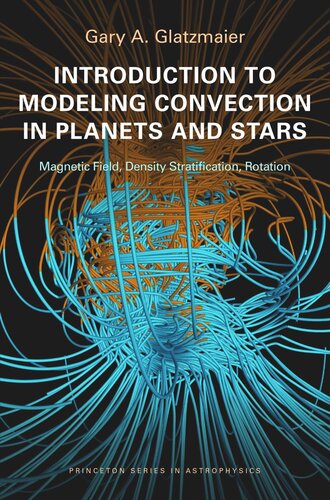
Introduction to Modeling Convection in Planets and Stars Magnetic Field Density Stratification Rotation 1st Edition by Gary Glatzmaier ISBN 978-0691141725 069114172X


Original price was: $50.00.$35.00Current price is: $35.00.
Introduction to Modeling Convection in Planets and Stars Magnetic Field Density Stratification Rotation 1st Edition by Gary A. Glatzmaier – Ebook PDF Instant Download/Delivery: 978-0691141725, 069114172X
Full download Introduction to Modeling Convection in Planets and Stars Magnetic Field Density Stratification Rotation 1st Edition after payment
Product details:
ISBN 10: 069114172X
ISBN 13: 978-0691141725
Author: Gary A. Glatzmaier
This book provides readers with the skills they need to write computer codes that simulate convection, internal gravity waves, and magnetic field generation in the interiors and atmospheres of rotating planets and stars. Using a teaching method perfected in the classroom, Gary Glatzmaier begins by offering a step-by-step guide on how to design codes for simulating nonlinear time-dependent thermal convection in a two-dimensional box using Fourier expansions in the horizontal direction and finite differences in the vertical direction. He then describes how to implement more efficient and accurate numerical methods and more realistic geometries in two and three dimensions. In the third part of the book, Glatzmaier demonstrates how to incorporate more sophisticated physics, including the effects of magnetic field, density stratification, and rotation.
Featuring numerous exercises throughout, this is an ideal textbook for students and an essential resource for researchers.
Describes how to create codes that simulate the internal dynamics of planets and stars
Builds on basic concepts and simple methods
Shows how to improve the efficiency and accuracy of the numerical methods
Describes more relevant geometries and boundary conditions
Demonstrates how to incorporate more sophisticated physics
Table of contents:
PART I. THE FUNDAMENTALS
Chapter 1
A Model of Rayleigh-Bénard Convection
1.1 Basic Theory
1.2 Boussinesq Equations
1.3 Model Description
Supplemental Reading
Exercises
Chapter 2
Numerical Method
2.1 Vorticity-Streamfunction Formulation
2.2 Horizontal Spectral Decomposition
2.3 Vertical Finite-Difference Method
2.4 Time Integration Scheme
2.5 Poisson Solver
Supplemental Reading
Exercises
Chapter 3
Linear Stability Analysis
3.1 Linear Equations
3.2 Linear Code
3.3 Critical Rayleigh Number
3.4 Analytic Solutions
Supplemental Reading
Exercises
Computational Projects
Chapter 4
Nonlinear Finite-Amplitude Dynamics
4.1 Modifications to the Linear Model
4.2 A Galerkin Method
4.3 Nonlinear Code
4.4 Nonlinear Simulations
Supplemental Reading
Exercises
Computational Projects
Chapter 5 Postprocessing
Computing and Storing Results
Displaying Results
Analyzing Results
Supplemental Reading
Exercises
Computational Projects
Chapter 6 Internal Gravity Waves
6.1
Linear Dispersion Relation
6.2 Code Modifications and Simulations
6.3
Wave Energy Analysis
Supplemental Reading
Exercises
Computational Projects
Chapter 7 Double-Diffusive Convection
7.1
Salt-Fingering Instability
7.2
Semiconvection Instability
7.3
Oscillating Instabilities
7.4
Staircase Profiles
7.5
Double-Diffusive Nonlinear Simulations
Supplemental Reading
Exercises
Computational Projects
PART II. ADDITIONAL NUMERICAL METHODS
Chapter 8 Time Integration Schemes
Predictor-Corrector Schemes
Fourth-Order Runge-Kutta Scheme
Semi-Implicit Scheme
Infinite Prandtl Number: Mantle Convection
Supplemental Reading
Exercises
Computational Projects
Chapter 9 Spatial Discretizations
Fully Finite-Difference
Nonuniform Grid
Coordinate Mapping
Fully Spectral: Chebyshev-Fourier
Parallel Processing
Supplemental Reading
Exercises
Computational Projects
Chapter 10 Boundaries and Geometries
10.1 Absorbing Top and Bottom Boundaries
10.2 Permeable Periodic Side Boundaries
10.3 2D Annulus Geometry
10.4 Spectral-Transform Method
10.5 3D and 2.5D Cartesian Box Geometry
10.6 3D and 2.5D Spherical-Shell Geometry
Supplemental Reading
Exercises
Computational Projects
PART III. ADDITIONAL PHYSICS
Chapter 11 Magnetic Field
11.1 Magnetohydrodynamics
11.2 Magnetoconvection with a Vertical Background Field
11.3 Linear Analyses: Magnetic
11.4 Nonlinear Simulations: Magnetic
11.5 Magnetoconvection with a Horizontal Background Field
11.6 Magnetoconvection with an Arbitrary Background Field
Supplemental Reading
Exercises
Computational Projects
Chapter 12 Density Stratification
12.1 Anelastic Approximation
12.2 Reference State: Polytropes
12.3 Numerical Method: Anelastic
12.4 Linear Analyses: Anelastic
12.5 Nonlinear Simulations: Anelastic
Supplemental Reading
Exercises
Computational Projects
Chapter 13 Rotation
13.1 Coriolis, Centrifugal, and Poincaré Forces
13.2 2D Rotating Equatorial Box
13.3 2D Rotating Equatorial Annulus: Differential Rotation
13. 2.5D Rotating Spherical Shell: Inertial Oscillations
13.5 3D Rotating Spherical Shell: Dynamo Benchmarks
3D Rotating Spherical Shell: Dynamo Simulations
Concluding Remarks
Supplemental Reading
Exercises
Computational Projects
People also search for:
introduction to modeling convection
introduction to modeling convection in planets and stars
convection explained simply
introduction to model theory
introduction to convection
modeling convection
Tags: Gary Glatzmaier, Introduction to Modeling, Convection in Planets, Field Density