
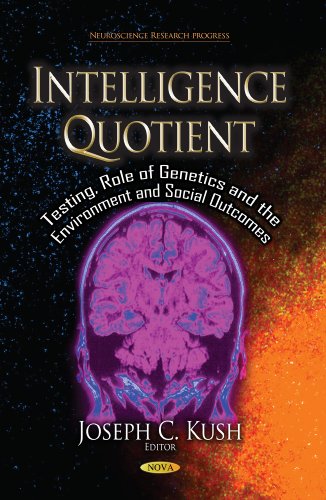
Intelligence Quotient Testing Role of Genetics and the Environment and Social Outcomes 1st Edition by Joseph Kush ISBN 1626187282 978-1626187283

Original price was: $50.00.$35.00Current price is: $35.00.
Intelligence Quotient Testing Role of Genetics and the Environment and Social Outcomes 1st Edition by Joseph C. Kush – Ebook PDF Instant Download/Delivery: 1626187282, 978-1626187283
Full download Intelligence Quotient Testing Role of Genetics and the Environment and Social Outcomes 1st Edition after payment
Product details:
ISBN 10: 1626187282
ISBN 13: 978-1626187283
Author: Joseph C. Kush
This is an edited collection that examines advances in the study of IQ tests and the variables that influence test performance. The book contains contributions from a number of prominent scholars who are internationally recognised for their expertise in the area of human intelligence. Additionally, the compilation presents a unique combination of theoretical knowledge and practical advice and will be an excellent resource for graduate students, university professors and experienced clinicians. A particular emphasis is given to the role of IQ tests, as part of a diagnostic battery, in the identification of cognitive and psychological disorders. Individual chapters cover a broad range of topics related to IQ including, the underlying structure of contemporary IQ tests, race and genomics, the relationship between IQ and achievement, measures of mental chronometry, evolutionary adaptedness, IQ and dopamine receptor genes, Ashkenazi Jews, assessment practices for gifted children and pre-school students, and errors in measurement when assessing intellectual disabilities. Topics are covered in a comprehensive and up-to-date manner, yet accessible to both novice and expert professionals. A working knowledge of psychometric theory is helpful but not necessary. The book avoids any attempt to make a claim regarding exact estimates of the genetic or environmental influences on measures of IQ, fully recognising the complex interplay between these factors. However, the value of IQ tests in predicting scholastic achievement, diagnosing cognitive diseases, and assessing individual differences is acknowledged and affirmed, when recommendations offered by the authors are implemented within thoughtful and data-supported practices.
Table of contents:
Chapter 1. The Utilization of Inspection Time as a Supplement to Standardized Tests of Intelligence: Arriving Somewhere but not Here – Joseph C. Kush, Duquesne University, Pittsburgh, PA, USA
Chapter 2. IQ and the D₂ Dopamine Receptor Gene in Children of Alcoholics – Ernest P. Noble, Alcohol Research Center, Department of Psychiatry & Biobehavioral Sciences, Semel Institute for Neuroscience & Human Behavior, Los Angeles, CA, USA, and others
Chapter 3. Human General Intelligence as a Domain General Psychological Adaptation – Kevin MacDonald, Department of Psychology, California State University–Long Beach, CA, USA
Chapter 4. Subtests, Factors, and Constructs: What is Being Measured by Tests of Intelligence? – Marley W. Watkins and Christina M. Ravert, Baylor University, Waco, TX, USA
Chapter 5. Race, Genomics, and Intelligence: Slight Return – Joseph L. Graves Jr., Associate Dean for Research & Professor of Biological Sciences, Joint School for Nanosciences & Nanoengineering, North Carolina A&T State University & UNC Greensboro, NC, USA
Chapter 6. Multi-Group Latent Growth Curve Modeling: The Influence of School Readiness Profiles on Student Achievement Growth – Timothy R. Konold and Monika Townsend, University of Virginia, USA
Chapter 7. Error in the Measurement of Low IQ: Implications for the Diagnosis of Intellectual Disability in Court Cases – Simon Whitaker, Mental Health and Learning Disability Division, University of Huddersfield, West Yorkshire, UK
Chapter 8. Using R for the Analysis of Cognitive Ability and Behavior Genetic Data – A. Alexander Beaujean and Jason Parkin, Baylor Psychometric Laboratory, Baylor University, Waco, TX, USA, and others
Chapter 9. Contribution of Intellectual, Psychological, Developmental and Socio-Economic Data to Highlight Specific Profiles of Highly Gifted Children – Isabelle Simoes Loureiro, Laurent Lefebvre, and Laurence Vaivre-Douret, University of Mons, Belgium, and others
Chapter 10. Preschoolers’ Attachment Representations and Parenting as Predictors of Intellectual Capacities: A Person-Oriented Approach – Marie Stievenart, Jean Christophe Meunier and Isabelle Roskam, Psychological Sciences Research Institute, Belgium
People also search for:
intelligence quotient test definition
intelligence quotient testing
intelligence quotient importance
intelligence quotient real life examples
intelligence quotient test adalah
Tags:
Joseph Kush,Intelligence Quotient,Testing Role of Genetics