
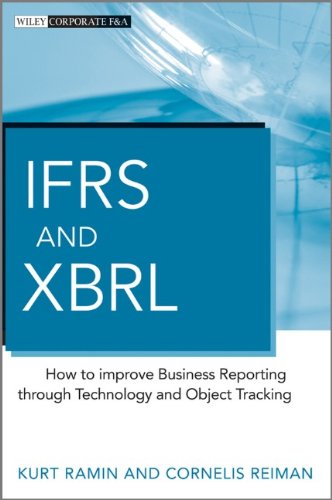
IFRS and XBRL how to improve business reporting through technology and object tracking 1st Edition by Cornelis Reiman, Kurt Ramin ISBN 978-1118369739 978-1118369739

Original price was: $50.00.$35.00Current price is: $35.00.
IFRS and XBRL how to improve business reporting through technology and object tracking 1st Edition by Cornelis A. Reiman, Kurt P. Ramin- Ebook PDF Instant Download/Delivery: 978-1118369739, 978-1118369739
Full download IFRS and XBRL how to improve business reporting through technology and object tracking 1st Edition after payment
Product details:
ISBN 10: 978-1118369739
ISBN 13: 978-1118369739
Author: Cornelis A. Reiman, Kurt P. Ramin
Table of contents:
PART I: INTERNATIONAL FINANCIAL REPORTING STANDARDS (IFRS)
Tips for readers
Chapter 1: Introduction to and objectives of IFRS
Chapter 2: How important are IFRS to business and global acceptance?
IFRS and legal objectives
Convergence of IFRS and US GAAP
Reconciliation to US GAAP
IOSCO, regulators and enforcement
Chapter 3: Governance and accountability of the IFRS Foundation
History, structure and finance
The monitoring board and IFRS Foundation trustees
IASB members, due process and IFRS Interpretations Committee
IFRS Advisory Council
Chapter 4: Framework, standards and interpretations of IFRS
Framework
International Financial Reporting Standards
IFRS for Small and Medium-sized Enterprises versus Private companies
Interpretations to Standards
Chapter 5: IFRS Practice Statement Management Commentary
Chapter 6: Future plans
Chapter 7: New presentation formats
Model financial statements
New financial statement presentation
Chapter 8: Contents of IFRS book
Chapter 9: Glossary for IFRS
Chapter 10: Index to IFRS book
PART II: IFRS DISCLOSURES, OTHER REPORTING STANDARDS AND ASSURANCE
Tips for readers
Chapter 1: IFRS disclosure
Summary of disclosures
Disclosure checklists
IFRS disclosure examples
Chapter 2: Other reporting standards
International Public Sector Accounting Standards (IPSAS)
Statistics-based standards
International Valuation Standards Council (IVSC)
Valuation Resource Group
IEEE
ISO
AccountAbility
Other standards
OneReport
Taxation
PART III: XBRL – USING TECHNOLOGY TO IMPLEMENT STANDARDS
Tips for readers
Chapter 1: XBRL
XML – the technical basis of XBRL
Benefits of XBRL
Users of XBRL – worldwide
Chapter 2: XBRL and IFRS
Overview
The IFRS taxonomy
IFRS Foundation and translation
Support materials
Future steps
Chapter 3: Organising and collecting data
FASB codification and XBRL taxonomy
Illustrative financial statements
XBRL for integrated reporting
Content analysis
Chapter 4: Using systems to organise and collect data
ERP systems and spreadsheets
SAP, Oracle and Cloud
Chapter 5: Opportunities to integrate and track data objects
Growing interest among stakeholders
PART IV: TRACKING OBJECTS – A PARADIGM SHIFT IN BUSINESS REPORTING
Tips for readers
Chapter 1: Introduction
Chapter 2: Developments in new reporting models
Chapter 3: Recognition and de-recognition
Chapter 4: Discussing measurement
Chapter 5: A comprehensive business reporting model
Chapter 6: Future reporting: the object and value supply chain
Chapter 7: Integrated reporting
Integrated reporting
Landscape of integrated reporting
Chapter 8: Object tracking
Object recognition
Data management
Tagging
Tracking
PART V: THE NEED FOR INCREASED ACCEPTANCE OF IFRS
Tips for readers
Preamble
Chapter 1: The need for increased acceptance of IFRS
National accounting standards versus IFRS
Partial acceptance of IFRS
Chapter 2: The need for increased acceptance of XBRL
Chapter 3: Additional issues
Chapter 4: Conclusion
People also search for:
xbrl implementation guides
xbrl implementation challenges
ifrs and gaap convergence
what is xbrl and how does it work
xbrl accounting
Tags: Cornelis Reiman, Kurt Ramin, IFRS and XBRL, improve business, through technology