
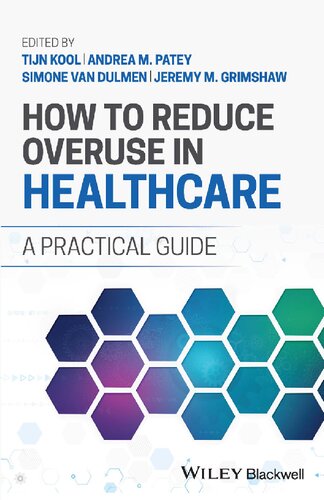
How to Reduce Overuse in Healthcare A Practical Guide Team IRA 1st Edition by Tijn Kool, Andrea Patey, Simone van Dulmen, Jeremy Grimshaw ISBN 978-1119862741 1119862741


Original price was: $50.00.$35.00Current price is: $35.00.
How to Reduce Overuse in Healthcare A Practical Guide Team IRA 1st Edition by Tijn Kool, Andrea M. Patey, Simone van Dulmen, Jeremy M. Grimshaw I – Ebook PDF Instant Download/Delivery: 978-1119862741, 1119862741
Full download How to Reduce Overuse in Healthcare A Practical Guide Team IRA 1st Edition after payment
Product details:
ISBN 10: 1119862741
ISBN 13: 978-1119862741
Author: Tijn Kool, Andrea M. Patey, Simone van Dulmen, Jeremy M. Grimshaw
HOW TO REDUCE OVERUSE IN HEALTHCARE
Reduce low-value care with this practical guide
Low-value care harms patients, overburdens healthcare professionals, threatens healthcare systems and damages the climate. How to Reduce Overuse in Healthcare: a practical guide is designed to provide practical guidance and tools for healthcare providers, their professional societies and policy makers developing programs to de-implement low-value or unnecessary care. This guide provides a five-step evidence and theory-based framework for developing and evaluating programs such as Choosing Wisely to reduce low-value care and improve patient outcomes.
How to Reduce Overuse in Healthcare: a practical guide readers will also find:
An author team involved in the leading Choosing Wisely international network
Detailed analysis of how to identify potential low-value care areas, select interventions and more
Practical, real-world examples at the end of each chapter illustrating examples of overuse and de-implementation
How to Reduce Overuse in Healthcare: a practical guide describes the state of the art in de-implementation for healthcare professionals, healthcare administrators and policy makers looking to reduce low-value care in a more effective and evidence-based way.
Table of contents:
Chapter 1. Why Should We Reduce Medical Overuse?
-
It Started with Quality Improvement
-
Then Came a Focus on Overuse
-
Overuse as a Global Healthcare Quality Concern
-
What Can Be Done to Address Overuse?
-
Choosing Wisely
-
What Can You Expect in the Following Chapters?
-
References
Chapter 2. Why Does Overuse Exist?
-
A Multifactorial Challenge on Different Levels
-
Healthcare Professional Factors
-
Patient Factors
-
Preference for Acquiring Something
-
Clinical Care Context Factors
-
Absence of an Open Culture
-
Absence of Clear Leadership
-
Healthcare Organisation Factors
-
Insufficient Time
-
Lack of Coordination Amongst Healthcare Providers
-
Healthcare System Factors
-
Payment System that Rewards Volume
-
Influence of the Pharmaceutical and Medical Device Industry
-
Healthcare Insurance Policy
-
Key Points
-
References
Chapter 3. Why Is It So Hard to Change Behaviour and How Can We Influence It?
-
The Challenge of Behaviour Change
-
Is the Behaviour a Routine?
-
Is the Behaviour Rewarding?
-
Do Habits or Routines Play a Role in Sustaining the Behaviour?
-
Four Crucial Questions Before Supporting Behaviour Change
-
Why Is It So Difficult to Change the Behaviour of Healthcare Professionals?
-
Designing Interventions to Change Behaviour
-
Summary
-
Sources of Information for Supporting Practice Change
-
References
Chapter 4. How Can We Reduce Overuse: The Choosing Wisely De-Implementation Framework
-
Introduction
-
The Choosing Wisely De-Implementation Framework
-
Phase 0: Identification of Potential Areas of Low-Value Healthcare
-
Phase 1: Identification of Local Priorities
-
Phase 2: Identification of Barriers and Enablers
-
Phase 3: Evaluation of the Implementation
-
Phase 4: Spread of Effective Implementation Programs
-
Key Points
-
References
Chapter 5. How Can You Engage Patients in De-Implementation Activities?
-
What Is Patient Engagement and Why Is It Relevant?
-
Making a Patient Engagement Plan
-
The Level of Engagement
-
Area 1 – Agenda Setting and Prioritisation
-
Area 2 – Design and Conduct of De-Implementation Activities
-
Area 3 – Spread
-
Important Considerations
-
Key Points
-
Sources of Information (General Resources, Planning Tools, Patient Engagement Methods, Evaluation Tools)
-
References
Chapter 6. Identifying Potential Areas of Low-Value Healthcare (Phase 0)
-
How to Identify Low-Value Care
-
Resources to Identify Low-Value Care
-
Recommendation Lists
-
Clinical Practice Guidelines
-
Health Technology Assessments
-
Evidence Syntheses and Systematic Reviews
-
From Identification to Measurement
-
Key Points
-
Sources of Further Information
-
References
Chapter 7. Measuring Low-Value Care and Choosing Your Local Priority (Phase 1)
-
Choosing Your Local Priority
-
Measuring Low-Value Care
-
Baseline Measurements
-
Estimating Improvement Potential
-
Evaluating De-Implementation Effects
-
Measuring Unintended Consequences
-
Measurement Methods and Data Source
-
SMART Targets
-
Providing Data and Feedback to Stakeholders
-
Key Points
-
References
Chapter 8. Identifying Target Behaviours and Potential Barriers to Change (Phase 2a)
-
The Importance of Fully Understanding the Problem
-
Getting Started
-
Identifying Who Needs to Do What Differently
-
Using the AACTT Framework
-
Identifying Drivers, Barriers, and Enablers
-
Collecting Data (Interviews, Focus Groups, Surveys)
-
Analysing the Data
-
Narrowing Down the Drivers or Barriers
-
Key Points
-
Useful Resources
-
References
-
Appendix: Sample Interview Guide
Chapter 9. Selecting De-Implementation Strategies and Designing Interventions (Phase 2b)
-
Preparation Before Selecting Strategies
-
Ten General Principles for Developing Interventions
-
Key Points
-
Sources
-
References
Chapter 10. Evaluating De-Implementation Interventions (Phase 3)
-
Why Should We Evaluate?
-
Outcomes
-
Types of Evaluations
-
Randomised Evaluations
-
Non-Randomised Evaluations
-
Selecting the Most Appropriate Method
-
How and Why Does the Intervention Work?
-
Value for Money
-
Key Points
-
References
Chapter 11. Preserving Results and Spreading Interventions (Phase 4)
-
Why Are Sustainability and Spread Important?
-
What Is Sustainability?
-
Factors Influencing Sustained Change (Process, Staff, Organisation)
-
How Can You Facilitate Sustainability?
-
Assessing Sustainability
-
Sustainability and Culture
-
Spreading Successful Interventions
-
Scaling Strategy
-
De-Implementation Intervention
-
Adopters and Organisations
-
External Context
-
Key Points
-
References
Chapter 12. Training the Next Generation of Healthcare Providers
-
Introduction
-
High-Value Care Competencies
-
Teaching Students and Trainees
-
Educational Changes to Curriculum
-
Faculty Role Modelling and Supportive Learning
-
Assessing Outcomes
-
Enablers of Educational Change
-
Aligning Professional Development and Quality Improvement
-
Key Points
-
Sources
-
References
Chapter 13. Examples from Clinical Practice
-
Introduction
-
References
Chapter 14. Starting Tomorrow
People also search for:
overuse in healthcare
overuse of healthcare services
overuse of health insurance
reducing overuse in healthcare advancing choosing wisely
overuse of our healthcare system
Tags: Tijn Kool, Andrea Patey, Simone van Dulmen, Jeremy Grimshaw, How to Reduce, A Practical Guide