
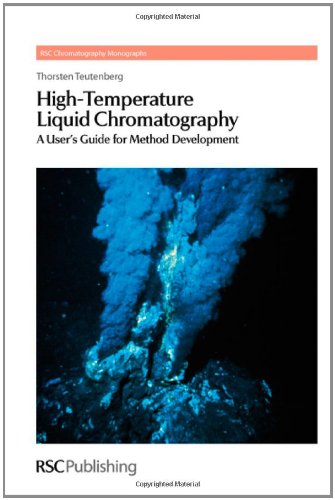
High Temperature Liquid Chromatography A User s Guide for Method Development 1st Edition by Thorsten Teutenberg ISBN 978-1849730136 184973013X


Original price was: $50.00.$35.00Current price is: $35.00.
High Temperature Liquid Chromatography A User s Guide for Method Development 1st Edition by Thorsten Teutenberg- Ebook PDF Instant Download/Delivery: 978-1849730136, 184973013X
Full download High Temperature Liquid Chromatography A User s Guide for Method Development 1st Edition after payment
Product details:
ISBN 10: 184973013X
ISBN 13: 978-1849730136
Author: Thorsten Teutenberg
High-temperature liquid chromatography has attracted much interest in recent years but has not yet recognized its full potential in the chromatographic community. There is a widespread reluctance in industry to use temperature to speed up the separation process, influence the selectivity of a separation or implement novel detection techniques. However, the technology has now matured and could revolutionize chromatography as we see it today. Better equipment, such as heating systems able to generate faster heating rates, is becoming more readily available. Also, columns based on silica gel, which can withstand higher temperatures for an extended period, are now being introduced. Nevertheless, further technological and methodical efforts are needed to establish the method in a regulated environment like the pharmaceutical industry. This is the only text to cover all the practical aspects, as well as the underlying theoretical principles, of setting up an HPLC system for high temperature operation. It is not intended solely for academics but will also benefit the researcher interested in more practical considerations. The author is a recognized expert and has conducted several studies with partners from industry to validate the method. Many real examples from these studies have been included in the book. The aim is to support practitioners in the creation of their own protocols without the need to rely solely on trial and error. The book starts with a brief definition of high temperature liquid chromatography before going on to cover: system set up; the heating system; mobile phase considerations; suitable stationary phases; method development using temperature programming; analyte stability, and special hyphenation techniques using superheated water as a mobile phase. In each chapter, experimental data is used to illustrate the main statements and the advantages over conventional HPLC are evaluated. The book concludes with a critical outlook on further developments and applications underlining the necessary advances needed to make high temperature HPLC more robust.
Table of contents:
Chapter 1
A Brief Definition of High-Temperature Liquid Chromatography
1.1 What is High-Temperature Liquid Chromatography?
1.2 What is a Suitable Temperature Range for High-Temperature Liquid Chromatography?
1.3 Why should High Temperatures be used in Liquid Chromatography?
1.4 What are the Principal Requirements of High-Temperature Liquid Chromatography?
Chapter 2
System Set-up for High-Temperature Liquid Chromatography
2.1 The Heating System
2.2 The Column
2.3 The Detector
2.4 The Back-Pressure Regulator
Chapter 3
The Heating System
3.1 Preheating of the Mobile Phase
3.1.1 Thermal Mismatch Broadening
3.1.2 Viscous Heat Dissipation
3.1.3 Technical Implementation of Eluent Preheating
3.1.4 Experimental Verification of Eluent Preheating Efficiency
3.2 Column Heating
3.2.1 Air-Bath Ovens
3.2.2 Water-Jacket Ovens
3.2.3 Block-Heating Ovens
3.3 Post-Column Cooling of the Mobile Phase
3.4 Temperature Programming
3.5 A Critical Comparison between Different Ovens
3.5.1 Air-Bath Ovens
3.5.2 Water-Jacket Ovens
3.5.3 Block-Heating Ovens
3.5.4 Summary
Chapter 4
Mobile Phase Considerations
4.1 Influence of Temperature on Vapour Pressure
4.1.1 Prevention of a Phase Transition using a Back-Pressure Regulator
4.1.2 Prevention of a Phase Transition using a Restriction Capillary
4.2 Influence of Temperature on Viscosity
4.2.1 Practical Implications The Restriction Capillary
4.2.2 Practical Implications Column Pressure Kinetic Aspects and
4.3 Influence of Temperature on Static Permittivity
4.4 The Water-THF System
4.5 The Dortmund Data Bank
Chapter 5 Suitable Stationary Phases
5.1 Column Bleed
5.2 Investigation of Column Degradation at High Temperatures
5.3 Silica-Based Stationary Phases
5.4 Zirconium Dioxide Stationary Phases
5.5 Titanium Dioxide Stationary Phases
5.6 Polymeric Stationary Phases
5.7 Other Materials
5.7.1 Graphitized Carbon Column
5.7.2 Thermo-Responsive Stationary Phases
5.8 General Conclusions
Chapter 6
Method Development using Temperature as an Active Variable
6.1 Special Requirements of the Heating System
6.2 Special Requirements of the Column Hardware
6.3 Mobile Phase Considerations
6.4 Influence of Temperature on Resolution
6.4.1 Influence of Temperature on Retention
6.4.2 Influence of Temperature on Selectivity
6.4.3 Influence of Temperature on Efficiency
6.5 Method Development
6.5.1 Isothermal and Isocratic Separations
6.5.2 Temperature Gradient and Isocratic Separation
6.5.3 Simultaneous Temperature and Solvent Gradient Separation
6.5.4 Detector Optimization
Chapter 7
Analyte Stability
7.1 Evaluation of Analyte Stability using UV Detection
7.2 Influence of the Stationary Phase on Analyte Stability
7.3 Definition of Critical Criteria for Analyte Stability
Chapter 8
Special Hyphenation Techniques
8.1 Flame Ionization Detection
8.2
LC-NMR
8.3 Isotope Ratio Mass Spectrometry
8.4
LC Taste
8.5 Drug Screening
Chapter 9
Critical Outlook and Future Prospects
9.1 Pellicular Particles
9.2 Capillary and Nano HPLC
9.3 Comprehensive Two-Dimensional Liquid Chromatography
People also search for:
a ims application developer
9 application
application 5
ims 3.0 software
4i application
Tags: Thorsten Teutenberg, High Temperature, Liquid Chromatography