
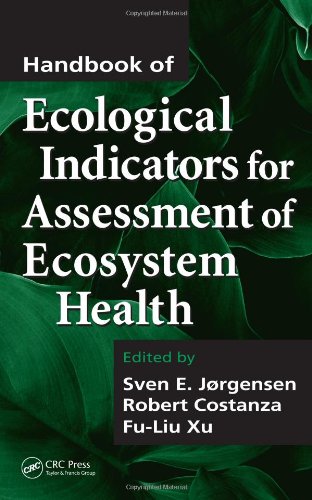
Handbook of ecological indicators for assessment of ecosystem health 1st Edition by Sven Jorgensen, Fu-Liu Xu, Robert Costanza ISBN 9781566706650 1566706653


Original price was: $50.00.$35.00Current price is: $35.00.
Handbook of ecological indicators for assessment of ecosystem health 1st Edition by Sven E. Jorgensen, Fu-Liu Xu, Robert Costanza – Ebook PDF Instant Download/Delivery: 9781566706650, 1566706653
Full download Handbook of ecological indicators for assessment of ecosystem health 1st Edition after payment
Product details:
ISBN 10: 1566706653
ISBN 13: 9781566706650
Author: Sven E. Jorgensen, Fu-Liu Xu, Robert Costanza
The field of ecosystem health explores the interactions between natural systems, human health, and social organization. As decision makers require a sound, modular approach to environmental management and sustainable development, ecosystem health assessment indicators are increasingly used across any number of applications. The Handbook of Ecological Indicators for Assessment of Ecosystem Health provides a comprehensive account and guidebook to ecological indicators for evaluating the health of a wide variety of ecosystems.
The book presents a conceptual framework for selecting, evaluating, and validating ecological indicators of ecosystem health, such as thermodynamics, resilience estimates, exergy, and emergy indicators. This framework is applied in a series of chapters on major ecosystem types, including coastal areas, forests, wetlands, fisheries, and agricultural land. The authors take into account biodiversity, energy needs, ecological economics, and natural capital in their measurement of ecological health. Using material synthesized from a variety of books, journals, and private research, the book presents first-hand accounts of the indicators, used in several different types of ecosystems. Case studies highlight the advantages and disadvantages of each method as well.
The Handbook of Ecological Indicators for Assessment of Ecosystem Health explains what is needed to apply the methods and indicators, including theoretical background and modeling techniques, to evaluate the state of a given ecosystem. It will be useful for a wide range of environmental managers, natural resource managers, land use planners, and policy makers in government and non-governmental organizations worldwide.
Table of contents:
Chapter 1
Introduction
SEE. Jorgensen
1.1 The Role of Ecosystem Health Assessment in Environmental Management
1.2 The Conceptual Flow in This Volume
References
Chapter 2
Application of Indicators for the Assessment of Ecosystem Health S.E. Jørgensen, F.-L. Xu, F. Salas, and J.C. Marques
2.1 Criteria for the Selection of Ecological Indicators for EHA
2.2 Classification of Ecosystem Health Indicators
2.2.1 Level 1
2.2.2 Level 2
2.2.3 Level 3
2.2.4 Level 4
2.2.5 Level 5
2.2.6 Level 6
2.2.7 Level 7
2.2.8 Level 8
2.3 Indices Based on Indicator Species..
2.3.1 Bellan’s Pollution Index.
2.3.2 Pollution Index Based on Ampiphoids.
2.3.3 AMBI
2.3.4 Bentix
2.3.5 Macrofauna Monitoring Index
2.3.6 Benthic Response Index
2.3.7 Conservation Index
2.4 Indices Based on Ecological Strategies.
2.4.1 Nematodes/Copepods Index
2.4.2 Polychaetes/Amphipods Index.
2.4.3 Infaunal Index.
2.4.4 Feldman Index
2.5 Indices Based on the Diversity Value.
2.5.1 Shannon-Wiener Index
2.5.2 Pielou Evenness Index
2.5.3 Margalef Index…
2.5.4 Berger-Parker Index.
2.5.5 Simpson Index..
2.5.6 Deviation from the Log-Normal Distribution
2.5.7 K-Dominance Curves
2.5.8 Average Taxonomic Diversity
2.5.9 Average Taxonomic Distinctness
2.6 Indicators Based on Species Biomass and Abundance.
2.6.1 ABC Method.
2.7 Indicators Integrating All Environment Information..
2.7.1 Trophic Index..
2.7.2 Coefficient of Pollution..
2.7.3 Benthic Index of Environmental Condition.
2.7.4 B-PLACE.
2.7.5 Biotic Integrity (IBI) for Fishes
2.7.6 Fish Health Index (FHI).
2.7.7 Estuarine Ecological Index (EBI)…
2.7.8 Estuarine Fish Importance Rating (FIR)
2.8 Presentation and Definition of Level 7 and 8 Indicators Holistic Indicators…
2.9 An Overview of Applicable Ecological Indicators for EHA
2.10 EHA: Procedures
2.10.1 Direct Measurement Method (DMM)
2.10.2 Ecological Model Method (EMM)
2.10.3 Ecosystem Health Index Method (EHIM).
2.11 An Integrated, Consistent Ecosystem Theory That Can Be Applied as the Theoretical Basis for EHA
References
Appendix A
Chapter 3
Application of Ecological Indicators to Assess Environmental Quality in Coastal Zones and Transitional Waters: Two Case Studies. J.C. Marques, F. Salas, J.M. Patrício, and M.A. Pardal
3.1 Introduction
3.2 Brief Review on the Application of Ecological Indicators in Ecosystems of Coastal and Transitional Waters
3.2.1 Indicators Based on Species Presence vs. Absence
3.2.2 Biodiversity as Reflected in Diversity Measures.
3.2.3 Indicators Based on Ecological Strategies
3.2.4 Indicators Based on Species Biomass and Abundance
3.2.5 Indicators Accounting for the Whole Environmental Information
3.2.6 Thermodynamically Oriented and Network Analysis-Based Indicators.
3.3 How to Choose the Most Adequate Indicator?
3.4 Case Studies: Subtidal Benthic Communities in the Mondego Estuary (Atlantic Coast of Portugal) and Mar Menor (Mediterranean Coast of Spain)
3.4.1 Study Areas and Type of Data Utilized
3.4.2 Selected Ecological Indicators.
3.4.3 Summary of Results.
3.4.3.1 Mondego Estuary
3.4.3.2 Mar Menor
3.5 Was the Use of the Selected Indicators Satisfactory in the Two Case Studies?
3.5.1 Application of Indicators Based on the Presence vs. Absence of Species: AMBI
3.5.2 Indices Based on Ecologic Strategies: Polychaetes/Amphipods Ratio.
3.5.3 Biodiversity as Reflected in Diversity Measures: Margalef and Shannon-Wienner Indices.
3.5.4 Indicators Based on Species Biomass and Abundance: W statistic
3.5.5 Thermodynamically Oriented and Network Analysis-Based Indicators: Exergy Index, Specific Exergy and Ascendancy.
3.5.5.1 Exergy and Specific Exergy
3.5.5.2 Ascendancy
3.5.6 Brief Conclusions
References
Chapter 4
Development and Application of Ecosystem Health Indicators in the North American Great Lakes Basin
H. Shear, P. Bertram, C. Forst, and P. Horvatin
4.1 Introduction
4.1.1 Background on the Great Lakes Basin.
4.1.2 Indicator Selection
4.1.3 Definition of the Selected Indicators
4.2 General Considerations…
4.2.1 Ecological Description of the Great Lakes Basin..
4.2.1.1 Toxic Contaminants
4.2.1.2 Land Use
4.2.1.3 Invasive Species
4.2.1.4 Habitat Status Including Wetlands
4.2.1.5 Lake Ecology.
4.2.1.6 Nutrients
4.2.2 Data Collection Methods..
4.3 Results….
4.3.1 State Indicators Complete.
4.3.1.1 Hexagenia
4.3.1.2 Wetland Dependent Bird Diversity and Abundance.
4.3.1.3 Area, Quality and Protection of Alvar Communities.
4.3.2 State Indicators Incomplete
4.3.2.1 Native Freshwater Mussels.
4.3.3 Pressure Indicators Complete.
4.3.3.1 Phosphorus Concentrations and Loadings.
4.3.3.2 Contaminants in Colonial Nesting Waterbirds.
4.3.3.3 Contaminants in Edible Fish Tissue.
4.3.4 Pressure Indicators Incomplete
4.3.4.1 Mass Transportation
4.3.4.2 Escherichia Coli and Fecal Coliform Levels in Nearshore Recreational Waters.
4.3.5 Response Indicators – Incomplete
4.3.5.1 Citizen/Community Place-Based Stewardship Activities
4.4 Discussion
4.4.1 Land Use..
4.4.2 Habitat Degradation
4.4.3 Climate Change…..
4.4.4 Toxic Contamination
4.4.5 Indicator Development
4.5 Conclusions….
References
Chapter 5
Application of Ecological and Thermodynamic Indicators for the Assessment of Lake Ecosystem Health.
F.-L. Xu
5.1 Introduction
5.1.1 Ecosystem Type and Problem.
5.1.2 The Chapter’s Focus
5.2 Methodologies.
5.2.1 A Theoretical Frame.
5.2.2 Development of Indicators…
5.2.2.1 The Procedure for Developing Indicators.
5.2.2.2 Lake Data for Developing Indicators
5.2.2.3 Responses of Lake Ecosystems to Chemical Stresses
People also search for:
routledge handbook of ecological economics
routledge handbook of ecological and environmental restoration
handbook of ecological economics book
handbook of ecological and ecosystem engineering
handbook of ecological restoration pdf
Tags: Sven Jorgensen, Fu-Liu Xu, Robert Costanza, Handbook of ecological, ecosystem health