
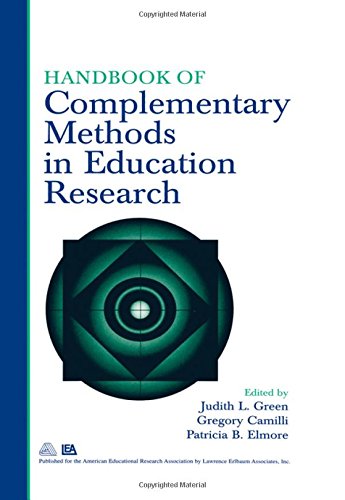
Handbook of Complementary Methods in Education Research 3rd Edition by Judith L Green, Gregory Camilli, Patricia Elmore ISBN 978-0805859331 0805859330
Original price was: $50.00.$35.00Current price is: $35.00.
Handbook of Complementary Methods in Education Research 3rd Edition by Judith L Green, Gregory Camilli, Patricia B. Elmore – Ebook PDF Instant Download/Delivery: 978-0805859331, 0805859330
Full download Handbook of Complementary Methods in Education Research 3rd Edition after payment
Product details:
ISBN 10: 0805859330
ISBN 13: 978-0805859331
Author: Judith L Green, Gregory Camilli, Patricia B. Elmore
Published for the American Educational Research Association by Routledge.
The Handbook of Complementary Methods in Education Research is a successor volume to AERA’s earlier and highly acclaimed editions of Complementary Methods for Research in Education. More than any book to date (including its predecessors), this new volume brings together the wide range of research methods used to study education and makes the logic of inquiry for each method clear and accessible. Each method is described in detail, including its history, its research design, the questions that it addresses, ways of using the method, and ways of analyzing and reporting outcomes. Key features of this indispensable book include the following: Foundations Section-Part I is unique among research books. Its three chapters examine common philosophical, epistemological, and ethical issues facing researchers from all traditions, and frames ways of understanding the similarities and differences among traditions. Together they provide a tripartite lens through which to view and compare all research methods. Comprehensive Coverage-Part II (the heart of the book) presents 35 chapters on research design and analysis. Each chapter includes a brief historical overview of the research tradition, examines the questions that it addresses, and presents an example of how the approach can be used. Programs of Research-Part III examines how research programs connected to eight specific lines of inquiry have evolved over time. These chapters examine phenomena such as classroom interaction; language research; issues of race, culture, and difference; policy analysis; program evaluation; student learning; and teacher education. Complementary Methods-As the title suggests, a central mission of this book is to explore the compatibility of different research methods. Which methods can be productively brought together and for what purposes? How and on what scale can they be made compatible and what phenomena are they best suited to explore? Flexibility-The chapters in Parts II and III are largely independent. Therefore, selected portions of the book can be used in courses devoted to specific research methods and perspectives or to particular areas of education. Likewise, established researchers interested in acquiring new techniques or greater expertise in a given methodology will find this an indispensable reference volume. This handbook is appropriate for any of the following audiences: faculty teaching and graduate students studying education research, education researchers and other scholars seeking an accessible overview of state-of-the-art knowledge about specific methods, policy analysts and other professionals needing to better understand research methods, and academic and research libraries serving these audiences.
Table of contents:
-
L.A. Shepard, Preface
-
J.L. Green, G. Camilli, P.B. Elmore, Introduction to the Handbook: What’s Complementary About Complementary Methods
-
A. Skukauskaite, E. Grace, On Reading and Using the Volume: Notes to Students
Part I: Foundations
4. E. Bredo, Philosophies of Educational Research
5. G.J. Kelly, Epistemology and Educational Research
6. K.A. Strike, The Ethics of Educational Research
Part II: Introduction to Design & Analysis
7. C. Bazerman, Analyzing the Multidimensionality of Texts in Education
8. T. Barone, Arts-Based Educational Research
9. R.K. Yin, Case Study Methods
10. K.M. Borman, C. Clarke, B. Cotner, R. Lee, Cross-Case Analysis
11. A.C. Porter, Curriculum Assessment
12. K.H. Kim, P.M. Bentler, Data Modeling: Structural Equation Modeling
13. F. Erickson, Definition and Analysis of Data From Videotape: Some Research Procedures and Their Rationales
14. A.H. Schoenfeld, Design Experiments
15. H-Z. Ho, S.L. O’Farrell, S. Hong, S. You, Developmental Research: Theory, Method, Design, and Statistical Analysis
16. D. Bloome, C. Clark, Discourse-In-Use
17. H. Braun, Empirical Bayes
18. J.P. Shaffer, Estimation
19. K.M. Anderson-Levitt, Ethnography
20. J. Nespor, Finding Patterns With Field Notes
21. R.J. Shavelson, N.M. Webb, Generalizability Theory
22. J.L. Rury, Historical Research in Education
23. A. Henry, Historical Studies: Groups/Institutions
24. M.E. Brenner, Interviewing in Educational Research
25. L. Crocker, Introduction to Measurement Theory
26. S. Embretson, X. Yang, Item Response Theory
27. D.M. Harrison, S.W. Raudenbush, Linear Regression and Hierarchical Linear Models
28. G.V. Glass, Meta-Analysis: The Quantitative Synthesis of Research Findings
29. C.A. Chinn, The Microgenetic Method: Current Work and Extensions to Classroom Research
30. M.L. Smith, Multiple Methodology in Education Research
31. F.M. Connelly, D.J. Clandinin, Narrative Inquiry
32. N.C. Burbules, B.R. Warnick, Philosophical Inquiry
33. M. Cochran-Smith, K. Donnell, Practitioner Inquiry: Blurring the Boundaries of Research and Practice
34. J.R. Levin, Probability and Hypothesis Testing
35. W.R. Shadish, J.K. Luellen, Quasi-Experimental Design
36. T.D. Cook, V. Sinha, Randomized Experiments in Educational Research
37. M. Eisenhart, Representing Qualitative Data
38. B. Thompson, Research Synthesis: Effect Sizes
39. H. Wainer, P.F. Velleman, Statistical Graphics: A Guidepost for Scientific Discovery
40. M. Berends, Survey Methods in Educational Research
41. J. Chromy, Survey Sampling
Part III: Programs of Research
42. C. Genishi, T. Glupczynski, Language and Literacy Research: Multiple Methods and Perspectives
43. L.M. McNeil, E.M. Coppola, Official and Unofficial Stories: Getting at the Impact of Policy on Educational Practice
44. M.E. Goertz, Policy Analysis: Studying Policy Implementation
45. S. Kushner, C. Adelman, Program Evaluation: A Democratic Practice
46. L.A. Rex, S.C. Steadman, M.K. Graciano, Researching the Complexity of Classroom Interaction
47. J.A. Banks, Researching Race, Culture, and Difference: Epistemological Challenges and Possibilities
48. J.G. Greeno, Theoretical and Practical Advances Through Research on Learning
49. S. Noffke, K. Zeichner, Programs of Research in Teacher Education
People also search for:
handbook of complementary methods in education research pdf
handbook of compliant mechanisms
handbook on complementarity
handbook of competence and motivation
handbook of combinatorics
Tags: Judith L Green, Gregory Camilli, Patricia Elmore, Handbook of Complementary, Education Research