
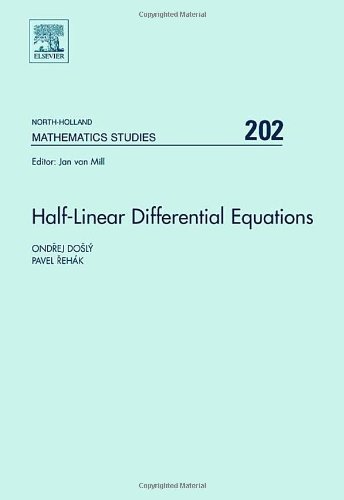
Half Linear Differential Equations 1st Edition by Ondřej Doślý, Pavel Řehák ISBN 978-0080461236 1280634123


Original price was: $50.00.$35.00Current price is: $35.00.
Half Linear Differential Equations 1st Edition by Ondřej Doślý, Pavel Řehák – Ebook PDF Instant Download/Delivery: 978-0080461236, 1280634123
Full download Half Linear Differential Equations 1st Edition after payment
Product details:
ISBN 10: 1280634123
ISBN 13: 978-0080461236
Author: Ondřej Doślý, Pavel Řehák
The book presents a systematic and compact treatment of the qualitative theory of half-lineardifferential equations. It contains the most updated and comprehensive material and represents the first attempt to present the results of the rapidly developing theory of half-linear differential equations in a unified form. The main topics covered by the book are oscillation and asymptotic theory and the theory of boundary value problems associated with half-linear equations, but the book also contains a treatment of related topics like PDE’s with p-Laplacian, half-linear difference equations and various more general nonlinear differential equations.- The first complete treatment of the qualitative theory of half-linear differential equations.- Comparison of linear and half-linear theory.- Systematic approach to half-linear oscillation and asymptotic theory.- Comprehensive bibliography and index.- Useful as a reference book in the topic.
Table of contents:
1 Basic Theory
1.1 Existence and uniqueness
1.1.1 First order half-linear system and other forms of half-linear equations
1.1.2 Half-linear trigonometric functions
1.1.3 Half-linear Prüfer transformation
1.1.4 Half-linear Riccati transformation
1.1.5 Existence and uniqueness theorem
1.1.6 An alternative approach to the existence theory
1.2 Sturmian theory
1.2.1 Picone’s identity
1.2.2 Energy functional
1.2.3 Roundabout theorem
1.2.4 Sturmian separation and comparison theorems
1.2.5 More on the proof of the separation theorem
1.2.6 Disconjugacy on various types of intervals
1.2.7 Transformation of independent variable
1.2.8 Reciprocity principle
1.2.9 Sturmian theory for Mirzov’s system
1.2.10 Leighton-Wintner oscillation criterion
1.3 Differences between linear and half-linear equations
1.3.1 Wronskian identity
1.3.2 Transformation formula
1.3.3 Fredholm alternative
1.4 Some elementary half-linear equations
1.4.1 Equations with constant coefficients
1.4.2 Euler type half-linear differential equation
1.4.3 Kneser type oscillation and nonoscillation criteria.
1.5 Notes and references
2 Methods of Oscillation Theory
2.1 Variational principle
2.1.1 Formulation of variational principle
2.1.2 Wirtinger inequality
2.1.3 Applications
2.2 Technical Riccati
2.2.1 Preliminaries
2.2.2 More general Riccati transformation
2.2.3 Riccati inequality.
2.2.4 Half-linear Hartman-Wintner theorem
2.2.5 Positive solution of generalized Riccati equation
2.2.6 Modified Riccati inequality
2.2.7 Applications
2.3 Comparison theorems
2.3.1 Hille-Wintner comparison theorems.
2.3.2 Leighton comparison theorems
2.3.3 Multiplied coefficient comparison
2.3.4 Telescoping principle.
2.3.5 Comparison theorem with respect to p
2.4 Notes and references
3 Oscillation and Nonoscillation Criteria
3.1 Criteria of classical type
3.1.1 Hille-Nehari type criteria
3.1.2 Other criteria
3.2 Criteria by averaging technique
3.2.1 Coles type criteria
3.2.2 Generalized Kamenev criterion
3.2.3 Generalized H-function averaging technique Philos type criterion.
3.3 Further extensions of Hille-Nehari type criteria
3.3.1 Q, H type criteria
3.3.2 Hille-Nehari type weighted criteria and extensions
3.4 Notes and references
4 Nonoscillatory Solutions
4.1 Asymptotic of nonoscillatory solutions
4.1.1 Integral conditions and classification of solutions
4.1.2 The case c negative.
4.1.3 Uniqueness in M.
4.1.4 The case c positive
4.1.5 Generalized Fubini’s theorem and its applications.
4.2 Primcipal solution
4.2.1 Principal solution of linear equations.
4.2.2 Mirzov’s construction of principal solution
4.2.3 Construction of Elbert and Kusano.
4.2.4 Comparison theorem for eventually minimal solutions of Riccati equations
4.2.5 Sturmian property of the principal solution
4.2.6 Principal solution of reciprocal equation
4.2.7 Integrals associated with eventually minimal solution of Riccati equation
4.2.8 Limit characterization of the principal solution
4.2.9 Integral characterization of the principal solution
4.2.10 Another integral characterization
4.2.11 Oscillation criteria and (non) principal solution
4.3 Half-linear differential equations and Karamata functions
4.3.1 Existence of regularly varying solutions
4.3.2 Existence of slowly varying solutions
4.4 Notes and references
5 Various Oscillation Problems
5.1 Conjugacy and disconjugacy
5.1.1 Lyapunov inequality
5.1.2 Vallée-Poussin type inequality.
5.1.3 Focal point criteria
5.1.4 Lyapunov-type focal points and conjugacy criteria
5.1.5 Further related results
5.2 Perturbation principle
5.2.1 General idea
5.2.2 Singular Leighton’s theorem.
5.2.3 Leighton-Wintner type oscillation criterion
5.2.4 Hille-Nehari type oscillation criterion.
5.2.5 Hille-Nehari type nonoscillation criterion.
5.2.6 Perturbed Euler equation
5.2.7 Linearization method in half-linear oscillation theory
5.3 Nonoscillation domains and (almost) periodicity
5.3.1 Disconjugacy domain and nonoscillation domain
5.3.2 Equations with periodic coefficients
5.3.3 Equations with almost periodic coefficients
5.4 Strongly and conditionally oscillatory equation
5.4.1 Strong (non) oscillation criteria
5.4.2 Oscillation constant
5.5 Function sequence technique.
5.5.1 Function sequences and Riccati integral equation
5.5.2 Modified approaches
5.6 Distance between zeros of oscillatory solutions.
5.6.1 Asymptotic formula for distribution of zeros
5.6.2 Quickly oscillating solution
5.6.3 Slowly oscillating solution
5.7 Half-linear Sturm-Liouville problem
5.7.1 Basic Sturm-Liouville problem
5.7.2 Regular problem with indefinite weight
5.7.3 Singular Sturm-Liouville problem
5.7.4 Singular eigenvalue problem associated with radial p-Laplacian
5.7.5 Rotation index and periodic potential
5.8 Energy functional and various boundary conditions
5.8.1 Disfocality.
5.8.2 Nonexistence of coupled points
5.8.3 Comparison theorems of Leighton-Levin type
5.9 Miscellaneous
5.9.1 Extended Hartman-Wintner criterion
5.9.2 Half-linear Milloux and Armellini-Tonelli-Sansone theorems
5.9.3 Interval oscillation criteria
5.10 Notes and references
6 BVP’s for Half-Linear Differential Equations
6.1 Eigenvalues, existence, and nonuniqueness problems
6.1.1 Basic boundary value problem
6.1.2 Variational characterization of eigenvalues
6.1.3 Existence and (non) uniqueness below the first eigenvalue
6.1.4 Homotopic deformation along p and Leray-Schauder degree
6.1.5 Multiplicity nonresonance results
6.2 Fredholm alternative for one-dimensional p-Laplacian.
6.2.1 Resonance at the first eigenvalue
6.2.2 Resonance at higher eigenvalues
6.3 Boundary value problems at resonance
6.3.1 Ambrosetti-Prodi type result
6.3.2 Landesman-Lazer solvability condition
6.3.3 Fučík spectrum
6.4 Notes and references
7 Partial Differential Equations with p-Laplacian
7.1 Eigenvalues and comparison principle
7.1.1 Dirichlet BVP with p-Laplacian.
7.1.2 Second eigenvalue of p-Laplacian
7.1.3 Comparison and antimaximum principle for p-Laplacian
7.1.4 Fučík spectrum for p-Laplacian
7.2 Boundary value problems at resonance
7.2.1 Resonance at the first eigenvalue in higher dimension
7.2.2 Resonance at the first eigenvalue multiplicity results
7.2.3 Landesman-Lazer result in higher dimension.
7.3 Oscillation theory of PDE’s with p-Laplacian
7.3.1 Picone’s identity for equations with p-Laplacian.
7.3.2 Nonexistence of positive solutions in RN
7.3.3 Oscillation criteria
7.3.4 Equations involving pseudolaplacian
7.4 Notes and references
8 Half-Linear Difference Equations
8.1 Basic information.
8.1.1 Linear difference equations
8.1.2 Discretization, difficulties versus eases
8.2 Half-linear discrete oscillation theory.
8.2.1 Discrete roundabout theorem and Sturmian theory
8.2.2 Methods of half-linear discrete oscillation theory
8.2.3 Refinements of Riccati technique
8.2.4 Discrete oscillation criteria
8.2.5 Hille-Nehari discrete nonoscillation criteria
8.2.6 Some discrete comparison theorems
8.3 Half-linear dynamic equations on time scales
8.3.1 Essentials on time scales, basic properties
8.3.2 Oscillation theory of half-linear dynamic equations
8.4 Notes and references
9 Related Differential Equations and Inequalities
9.1 Quasilinear differential equations
9.1.1 Quasilinear equations with constant coefficients
9.1.2 Existence, uniqueness and singular solutions
9.1.3 Asymptotic of nonoscillatory solutions
9.1.4 Sufficient and necessary conditions for oscillation
9.1.5 Generalized Riccati transformation and applications
9.1.6 (Half-)linearization technique.
9.1.7 Singular solutions of black hole and white hole type
9.1.8 Curious doubly singular equations
9.1.9 Coupled quasilinear systems.
9.2 Forced half-linear differential equations
9.2.1 Two oscillatory criteria
9.2.2 Forced super-half-linear oscillation
9.3 Half-linear differential equations with deviating arguments
9.3.1 Oscillation of equation with nonnegative second coefficient
9.3.2 Oscillation of equation with nonpositive second coefficient
9.3.3 Existence and asymptotic behavior of nonoscillatory solutions.
9.4 Higher order half-linear differential equations
9.4.1 p-biharmonic operator
9.4.2 Higher order half-linear eigenvalue problem
9.5 Inequalities related to half-linear differential equations
9.5.1 Inequalities of Wirtinger and Hardy type
9.5.2 Inequalities of Opial type
9.6 Notes and references
People also search for:
semi linear partial differential equation
semi linear partial differential equation example
half-life differential equation
half-linear differential equation
half differential
Tags: Ondřej Doślý, Pavel Řehák, Half Linear, Differential Equations