
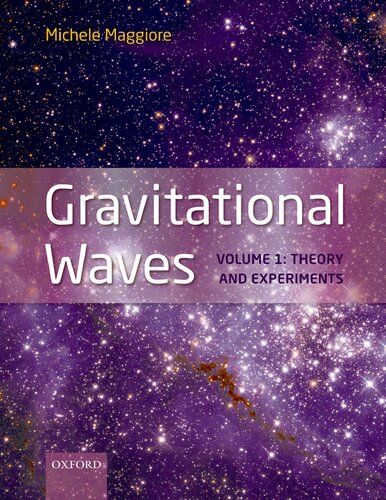
Gravitational Waves Volume 1 Theory and Experiments 1st Edition by Michele Maggiore ISBN 978-0198570745 0198570740

Original price was: $50.00.$35.00Current price is: $35.00.
Gravitational Waves Volume 1 Theory and Experiments 1st Edition by Michele Maggiore – Ebook PDF Instant Download/Delivery: 978-0198570745, 0198570740
Full download Gravitational Waves Volume 1 Theory and Experiments 1st Edition after payment
Product details:
ISBN 10: 0198570740
ISBN 13: 978-0198570745
Author: Michele Maggiore
The aim of this book is to become THE reference text for gravitational-wave physics, covering in detail both the experimental and the theoretical aspects. It is he only existing book on gravitational waves, and it will likely remain unique for its broadeness and scope. It brings the reader to the forefront of present-day research, both theoretical and experimental, assuming no previous knowledge of
gravitational-wave physics.
Part I of this volume is devoted to the theory of gravitational waves. Here we have rederived – in a coherent way – most of the results that we present, clarifying or streamlining existing derivations.
Part II is devoted to a description of experimental GW physics. We discuss in great detail exisiting and planned experiments, as well as
data analysis techniques
Table of contents:
Part I: Gravitational-wave theory
1 The geometric approach to GWs
1.1 Expansion around flat space
1.2 The transverse-traceless gauge
1.3 Interaction of GWs with test masses
1.3.1 Geodesic equation and geodesic deviation
1.3.2 Local inertial frames and freely falling frames
1.3.3 TT frame and proper detector frame
1.4 The energy of GWs
1.4.1 Separation of GWs from the background
1.4.2 How GWs curve the background
1.4.3 The energy-momentum tensor of GWs
1.5 Propagation in curved space-time
1.5.1 Geometric optics in curved space
1.5.2 Absorption and scattering of GWs
1.6 Solved problems
1.1. Linearization of the Riemann tensor in curved space
P(1) 1.2. Gauge transformation of hue and Rμύρσ
Further reading
2 The field-theoretical approach to GWs
2.1 Linearized gravity as a classical field theory
2.1.1 Noether’s theorem
2.1.2 The energy-momentum tensor of GWS
2.1.3 The angular momentum of GWs
2.2 Gravitons
2.2.1 Why a spin-2 field?
2.2.2 The Pauli-Fierz action
2.2.3 From gravitons to gravity
2.2.4 Effective field theories and the Planck scale
2.3 Massive gravitons
2.3.1 Phenomenological bounds
2.3.2 Field theory of massive gravitons
2.4 Solved problems
2.1. The helicity of gravitons
2.2. Angular momentum and parity of graviton states
Further reading
3 Generation of GWs in linearized theory
3.1 Weak-field sources with arbitrary velocity
3.2 Low-velocity expansion
3.3 Mass quadrupole radiation
3.3.1 Amplitude and angular distribution
3.3.2 Radiated energy
3.3.3 Radiated angular momentum
3.3.4 Radiation reaction on non-relativistic sources
3.3.5 Radiation from a closed system of point masses
3.4 Mass octupole and current quadrupole
3.5 Systematic multipole expansion
3.5.1 Symmetric-trace-free (STF) form
3.5.2 Spherical tensor form
3.6 Solved problems
3.1. Quadrupole radiation from an oscillating mass
3.2. Quadrupole radiation from a mass in circular orbit
3.3. Mass octupole and current quadrupole radiation from a mass in circular orbit
3.4. Decomposition of Skl.m into irreducible representa-tions of SO(3)
3.5. Computation of f d (TER, B2)ni… Nia E2,B2 Im
Further reading
4 Applications
4.1 Inspiral of compact binaries
4.1.1 Circular orbits. The chirp amplitude
4.1.2 Elliptic orbits. (I) Total power and frequency spectrum of the radiation emitted
4.1.3 Elliptic orbits. (II) Evolution of the orbit under back-reaction
4.1.4 Binaries at cosmological distances
4.2 Radiation from rotating rigid bodies
4.2.1 GWs from rotation around a principal axis
4.2.2 GWs from freely precessing rigid bodies
4.3 Radial infall into a black hole
4.3.1 Radiation from an infalling point-like mass
4.3.2 Tidal disruption of a real star falling into a black hole. Coherent and incoherent radiation
4.4 Radiation from accelerated masses
4.4.1 GWs produced in elastic collisions
4.4.2 Lack of beaming of GWs from accelerated masses
4.5 Solved problems
4.1. Fourier transform of the chirp signal
4.2. Fourier decomposition of elliptic Keplerian motion
Further reading
5 GW generation by post-Newtonian sources
5.1 The post-Newtonian expansion
5.1.1 Slowly moving, weakly self-gravitating sources
5.1.2 PN expansion of Einstein equations
5.1.3
Newtonian limit
5.1.4 The 1PN order
5.1.5 Motion of test particles in the PN metric
5.1.6 Difficulties of the PN expansion
5.1.7 The effect of back-reaction
5.2 The relaxed Einstein equations
5.3 The Blanchet-Damour approach
5.3.1 Post-Minkowskian expansion outside the source
5.3.2 PN expansion in the near region
5.3.3 Matching of the solutions
5.3.4 Radiative fields at infinity
5.3.5
Radiation reaction
5.4 The DIRE approach
5.5 Strong-field sources and the effacement principle
5.6 Radiation from inspiraling compact binaries
5.6.1 The need for a very high-order computation
5.6.2 The 3.5PN equations of motion
5.6.3 Energy flux and orbital phase to 3.5PN order
5.6.4
The waveform
Further reading
6 Experimental observation of GW emission in compact binaries
6.1 The Hulse-Taylor binary pulsar
6.2 The pulsar timing formula
6.2.1 Pulsars as stable clocks
6.2.2 Roemer, Shapiro and Einstein time delays
6.2.3 Relativistic corrections for binary pulsars
6.3 The double pulsar, and more compact binaries
Further reading
Part II: Gravitational-wave experiments
7 Data analysis techniques
7.1 The noise spectral density
7.2 Pattern functions and angular sensitivity
7.3 Matched filtering
7.4 Probability and statistics
7.4.1 Frequentist and Bayesian approaches
7.4.2 Parameters estimation
7.4.3 Matched filtering statistics
7.5 Bursts
7.5.1 Optimal signal-to-noise ratio
7.5.2 Time-frequency analysis
7.5.3 Coincidences
7.6 Periodic sources
7.6.1 Amplitude modulation
7.6.2 Doppler shift and phase modulation
7.6.3 Efficient search algorithms
7.7 Coalescence of compact binaries
7.7.1 Elimination of extrinsic variables
7.7.2 The sight distance to coalescing binaries
7.8 Stochastic backgrounds
7.8.1 Characterization of stochastic backgrounds
7.8.2 SNR for single detectors
7.8.3 Two-detector correlation
Further reading
3 Resonant-mass detectors
8.1 The interaction of GWs with an elastic body
8.1.1 The response to bursts
8.1.2 The response to periodic signals
8.1.3 The absorption cross-section
8.2 The read-out system: how to measure extremely small displacements
8.2.1 The double oscillator
8.2.2 Resonant transducers
8.3 Noise sources
8.3.1 Thermal noise
8.3.2 Read-out noise and effective temperature
8.3.3 Back-action noise and the quantum limit
8.3.4 Quantum non-demolition measurements
8.3.5 Experimental sensitivities
8.4 Resonant spheres
8.4.1 The interaction of a sphere with GWS
8.4.2 Spheres as multi-mode detectors
Further reading
9 Interferometers
9.1 A simple Michelson interferometer
9.1.1 The interaction with GWs in the TT gauge
9.1.2 The interaction in the proper detector frame
9.2 Interferometers with Fabry-Perot cavities
9.2.1 Electromagnetic fields in a FP cavity
9.2.2 Interaction of a FP cavity with GWS
9.2.3 Angular sensitivity and pattern functions
9.3 Toward a real GW interferometer
9.3.1 Diffraction and Gaussian beams
9.3.2 Detection at the dark fringe
9.3.3 Basic optical layout
9.3.4 Controls and locking
9.4 Noise sources
9.4.1 Shot noise
9.4.2 Radiation pressure
9.4.3 The standard quantum limit
9.4.4 Displacement noise
9.5 Existing and planned detectors
9.5.1 Initial interferometers
9.5.2 Advanced interferometers
People also search for:
maggiore gravitational waves volume 2
michele maggiore gravitational waves volume 1 pdf
michele maggiore gravitational waves volume 1 theory and experiments
maggiore gravitational waves volume 1
michele maggiore gravitational waves volume 2
Tags: Michele Maggiore, Gravitational Waves Volume, Theory and Experiments