
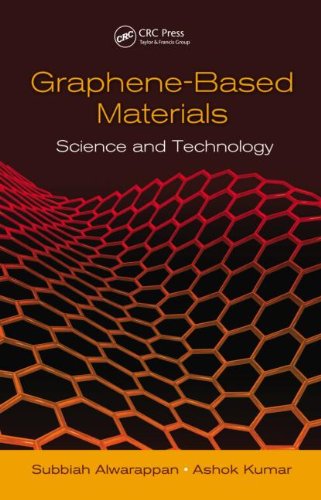
Graphene Based Materials Science and Technology 1st Edition by Subbiah Alwarappan, Ashok Kumar ISBN 978-1439884270 1439884277


Original price was: $50.00.$35.00Current price is: $35.00.
Graphene Based Materials Science and Technology 1st Edition by Subbiah Alwarappan, Ashok Kumar- Ebook PDF Instant Download/Delivery: 978-1439884270, 1439884277
Full download Graphene Based Materials Science and Technology 1st Edition after payment
Product details:
ISBN 10: 1439884277
ISBN 13: 978-1439884270
Author: Subbiah Alwarappan, Ashok Kumar
Continuously studied since its discovery, graphene offers truly unique opportunities, because unlike most semiconductor systems, its 2D electronic states are not buried deep under the surface and it can be easily accessed directly by tunneling or by other local probes. An in-depth analysis of recent advances in graphene research, Graphene-Based Materials: Science and Technology discusses synthesis, properties, and their important applications in several fields. It examines methods for synthesis of graphene as well as surface characterization, properties, and application in biosensors and energy storage.
The book begins with a brief review of the history of graphene and a discussion of its important properties. It then presents the different methods of graphene synthesis available and a brief overview of a few important characterization techniques that distinguishes graphene from its allotropes. The authors detail the applications of graphene in high-speed electronics, field-effect transistors, biosensors, gas-sensors, ultra-capacitors, photonics, optoelectronics, and drug delivery. They conclude with coverage of the toxicity properties of graphene and the future of graphene research.
Written by experts with more than a decade of experience in nanotechnology research, the book incorporates the latest literature and findings in the field. Its emphasis on applications, especially biomedical/electrochemical and energy storage applications, sets it apart from other books on this topic. It provides those working in graphene and related materials a resource that helps initiate new thinking.
Table of contents:
1 Graphene: An Introduction
1.1 Graphene: History and Background.
1.2 Graphene Properties
1.2.1 Electrical Transport Property
1.2.2 Quantum Hall Effect
1.2.3 Optical Properties.
1.2.4 Mechanical Properties
1.2.5 Thermal Properties.
References
2 Graphene Synthesis
2.1 Introduction
2.2 Mechanical Exfoliation
2.3 Alternatives to Mechanical Exfoliation
2.3.1 Chemical Method…
2.3.2 Total Organic Synthesis.
2.3.3 Depositions..
2.3.3.1 Overview..
2.3.3.2 Chemical Vapor Deposition.
2.3.3.3 Plasma-Enhanced Chemical
Vapor Deposition
2.3.4 Thermal Decomposition..
2.3.5 Thermal Decomposition on Other Substrates…
2.3.6 Unzipping Multiwall Carbon Nanotubes
2.3.7 Electrochemical Synthesis
2.3.8 Other Available Methods.
References
3 Surface Characterization of Graphene.
3.1 Graphene Characterization..
3.1.1 Optical Imaging of Graphene Layers.
3.1.2 Fluorescence Quenching Technique.
3.1.3 Atomic Force Microscopy.
3.1.4 Transmission Electron Microscopy
3.1.5 Raman Spectroscopy
3.1.6 Electrochemical Characterization.
References
4 Graphene-Based Materials in Gas Sensors
4.1 Graphene-Based Materials as Gas Sensors.
4.1.1 Improving Graphene’s Gas Sensing by the Insertion of Dopants or Defects……
4.1.1.1 CO on Graphene.
4.1.1.2 NO on Graphene
4.1.1.3 NO₂ on Graphene
4.1.1.4 NH3 on Graphene
4.1.2 Density of States of the Molecule-Graphene System…
4.1.3 The I-V Curves of Molecules on Graphene…
4.1.4 Concerns for Practical Application..
4.2 Graphene as a Membrane for Gas Separation
References
5 Graphene-Based Materials in Biosensing and Energy Storage Applications..
5.1 Electrochemical Biosensors Based on Graphene…
5.1.1 Graphene-Based Enzymatic Biosensors
5.1.2 Graphene-DNA Biosensors
5.1.3 Graphene Sensors for Heavy Metal Ion Detection….
5.1.4 Graphene for the Rapid Sequencing of DNA Molecules.
5.2 Graphene for Energy Storage Applications
5.2.1 Transparent Electrodes Based on Graphene
5.2.2 Ultracapacitors Based on Graphene..
5.2.3 N-Doped Graphene for Oxygen Reduction in Fuel Cells
References
6 Graphene-Based Materials for Photonic and Optoelectronic Applications
6.1 Introduction.
6.2 Linear Optical Absorption.
6.3 Saturable Absorption.
6.4 Luminescence.
6.5 Transparent Conductors.
6.6 Photovoltaic Devices
6.7 Light-Emitting Devices
6.8 Photodetectors.
6.9 Touch Screens..
6.10 Flexible Smart Windows and Bistable Displays..
6.11 Saturable Absorbers and Ultrafast Lasers
6.12 Optical Limiters.
6.13 Optical Frequency Converters
6.14 Terahertz Devices.
References
People also search for:
is graphene a metamaterial
is graphene a natural material
is graphene a solid
graphene biomedical
graphene buy
Tags: Subbiah Alwarappan, Ashok Kumar, Graphene Based Materials, Science and Technology