
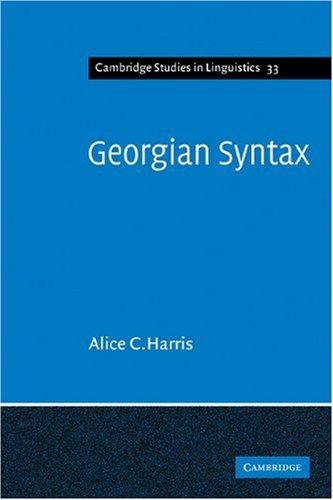
Georgian Syntax A Study in Relational Grammar 1st Edition by Alice Harris ISBN 978-0521109710 052110971X
Original price was: $50.00.$35.00Current price is: $35.00.
Georgian Syntax A Study in Relational Grammar 1st Edition by Alice Harris- Ebook PDF Instant Download/Delivery: 978-0521109710, 052110971X
Full download Georgian Syntax A Study in Relational Grammar 1st Edition after payment
Product details:
ISBN 10: 052110971X
ISBN 13: 978-0521109710
Author: Alice Harris
Georgian has sometimes been described as a language that is ‘totally irregular’, where the notions of ‘subject’, ‘object’ and ‘indirect object’ have no relevance. Although it is often cited in work on general linguistics, language universals and language typology, no systematic account of the syntax of this morphologically complex language has been available for Western linguists. Dr Harris’s work fills this important need, and indeed her book provides one of the best and most thorough studies available in English of the syntax of a non-Indo-European language. Working in the framework of relational grammar – a framework that is attracting great interest – Dr Harris shows that Georgian does have constructions found in better-known languages, and the study of individual languages to the development of linguistic theory.
Table of contents:
INTRODUCTION
1. Posing the problems
2. The approach taken: theoretical framework
3. Results of the investigation
4. Some necessary preliminaries
I SYNTACTIC TESTS FOR TERMHOOD
1. Tav-Reflexivization
2. Tavis-Reflexivization
3. Person Agreement
4. Unemphatic Pronoun Drop
5. Summary
2 CASE MARKING IN SERIES I AND II
1. The case marking differential
2. Evidence for the analysis of case in Series II
3. Case as a test for termhood
Appendix: Constituent screeves of Georgian Series
3 OBJECT CAMOUFLAGE
1. The facts to be considered
2. An analysis
3. Interaction with some rules previously considered
4. An alternative analysis
5. Object Camouflage as a test for termhood
4 OBJECT RAISING
1. A description of the data in Georgian
2. An analysis
3. Facts concerning the nominative-nominal
4. Facts concerning the infinitive
5. Facts concerning the tuis-nominal
6. Object Raising as a test of direct-objecthood
5 CAUSATIVE CLAUSE UNION
1. An analysis of organic causatives
2. Initial grammatical relations
3. Derived grammatical relations
4. The tuis-nominal
5. Theoretical implications
6 VERSION: RULES THAT CREATE INDIRECT OBJECTS
1. An analysis
2. Benefactive Version
3. Stative verbs
4. Why not generate version objects directly?
5. Coreferential Version Object Deletion
6. On so-called four-person verbs
7. Version as relation-changing rules
8. Summary
7 PASSIVIZATION
1. The passive from the viewpoint of language universals
2. Indirect objects in passives
3. Theoretical issues
4. Interaction with other rules
5. Conclusion
8 INVERSION
1. The problem: the case marking differential in Series III
2. The proposal: a rule of inversion
3. Preliminary arguments
4. Inversion verbs
5. Additional arguments
6. The form of the rule
7. Interaction with other rules
8. Summary
Appendix A: Additional arguments for inversion verbs
Appendix B: Transitive inversion verbs with no overt subject
9 WHY PATTERN A IS NOT REDUCIBLE TO PATTERN B
1. An analysis of A as a special instance of B
2. Arguments against the proposed analysis
3. Conclusion
10 NON-FINITE VERB FORMS
1. Masdars: gerundives or ‘derived nominals’?
2. Infinitive or ‘future participle in the adverbial case’?
3. The marking of nominals governed by non-finite verb forms
4. The nature of the nominals governed by non-finite verb form
II RETIRED TERM MARKING
1. Motivating retired termhood
2. Correlations between grammatical relations and final marking
3. Alternative analyses
4. Implications of this analysis
12 TRANSITIVITY
1. Analysis
2. Causative Clause Union
3. Retired Term Marking
4. Conclusion and extension
5. Transitive and intransitive
Appendix: Real and apparent exceptions to transitivity
13 SYNTHETIC PASSIVES
1. Identification of direct, analytic passive and synthetic passive constructions
2. Some syntactic-semantic characteristics
3. A proposal that accounts for the differences
4. Arguments for the initial grammatical relations proposed for synthetic passives
5. Arguments for the final grammatical relations proposed for synthetic passives
6. Conclusion and extension
Appendix: On four ‘passives’ in Georgian
14 REFLEXIVIZATION
1. A review of the facts
2. A proposal
3. An alternative proposal
15 NUMBER AGREEMENT
1. Polypersonalism
2. First refinement: failure of third person to trigger Number Agreement
3. Second refinement: statement on final termhood
4. Third refinement: first subjects
5. Last refinement: relational hierarchy
6. The applicability of rule (18)
7. Alternative analyses of Number Agreement
8. Conclusions
16 THE NATURE OF THE GEORGIAN VERB CLASSES
1. Hypothesis A: The Ergative Hypothesis
2. Hypothesis B: The Unaccusative Hypothesis
3. Inversion and the Georgian verb classes
4. The semantics of Class
5. Comparison and conclusions
6. Theoretical implications
Appendix A: Sample lists of verb classes
Appendix B: Ambivalent exceptions
EPILOGUE
1. The grammatical relations ‘subject’, ‘direct object’ and ‘indirect object’
2. Simplifications in case marking
3. Retired term marking
4. Rule interaction
5. Characteristics of grammatical relations
Notes
References
Index
People also search for:
5 georgian court roslyn ny
5 georgian court roslyn
writing in georgian
georgian language structure
old georgian script
Tags: Alice Harris, Georgian Syntax, A Study in Relational