
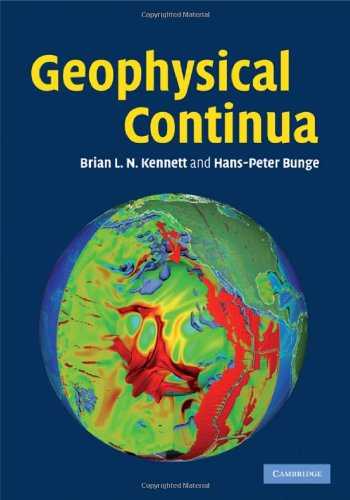
Geophysical Continua Deformation in the Earth s Interior Mps Siam Series on Optimizatio 1st Edition by Kennett, Bunge ISBN 9780521865531 0511409990


Original price was: $50.00.$35.00Current price is: $35.00.
Geophysical Continua Deformation in the Earth s Interior Mps Siam Series on Optimizatio 1st Edition by B. L. N. Kennett, H.-P. Bunge – Ebook PDF Instant Download/Delivery: 9780521865531, 0511409990
Full download Geophysical Continua Deformation in the Earth s Interior Mps Siam Series on Optimizatio 1st Edition after payment
Product details:
ISBN 10: 0511409990
ISBN 13: 9780521865531
Author: B. L. N. Kennett, H.-P. Bunge
Geophysical Continua presents a systematic treatment of deformation in the Earth from seismic to geologic time scales, and demonstrates the linkages between different aspects of the Earth’s interior that are often treated separately. A unified treatment of solids and fluids is developed to include thermodynamics and electrodynamics, in order to cover the full range of tools needed to understand the interior of the globe. The emphasis throughout the book is on relating seismological observations with interpretations of earth processes. Physical principles and mathematical descriptions are developed that can be applied to a broad spectrum of geodynamic problems. Incorporating illustrative examples and an introduction to modern computational techniques, this textbook is designed for graduate-level courses in geophysics and geodynamics. It is also a useful reference for practising Earth Scientists.
Table of contents:
1. Introduction
1.1 Continuum Properties
Deformation and Strain
The Stress-Field
Constitutive Relations
1.2 Earth Processes
1.3 Elements of Earth Structure
Mantle
Core
1.4 State of the Earth
Part I: Continuum Mechanics in Geophysics
2. Description of Deformation
2.1 Geometry of Deformation
Deformation of a Vector Element
Successive Deformations
Deformation of an Element of Volume
Deformation of an Element of Area
Homogeneous Deformation
2.2 Strain
Stretch
Principal Fibres and Principal Stretches
The Decomposition Theorem
Pure Rotation
Tensor Measures of Strain
2.3 Plane Deformation
2.4 Motion
2.5 The Continuity Equation
Appendix: Properties of the Deformation Gradient Determinant
3. The Stress-Field Concept
3.1 Traction and Stress
3.2 Local Equations of Linear Motion
Symmetry of the Stress Tensor
Stress Jumps
3.3 Principal Basis for Stress
3.4 Virtual Work Rate Principle
3.5 Stress from a Lagrangian Viewpoint
4. Constitutive Relations
4.1 Constitutive Relation Requirements
Simple Materials
Material Symmetry
Functional Dependence
4.2 Energy Balance
4.3 Elastic Materials
4.4 Isotropic Elastic Material
Effect of Rotation
Coaxiality of the Cauchy Stress Tensor and the Eulerian Triad
Principal Stresses
Some Isotropic Work Functions
4.5 Fluids
4.6 Viscoelasticity
4.7 Plasticity and Flow
5. Linearised Elasticity and Viscoelasticity
5.1 Linearisation of Deformation
5.2 The Elastic Constitutive Relation
Isotropic Response
Nature of Moduli
Interrelations Between Moduli
An Example of Linearisation
Elastic Constants
The Uniqueness Theorem
5.3 Integral Representations
The Reciprocal Theorem
The Representation Theorem
5.4 Elastic Waves
Isotropic Media
Green’s Tensor for Isotropic Media
Interfaces
5.5 Linear Viscoelasticity
5.6 Viscoelastic Behaviour
5.7 Damping of Harmonic Oscillations
6. Continuum Under Pressure
6.1 Effect of Radial Stratification
Hydrostatic Pressure
Thermodynamic Relations
6.2 Finite Strain Deformation
6.3 Expansion of Helmholtz Free Energy and Equations of State
6.4 Incremental Stress and Strain
Perturbations in Stress
Perturbations in Boundary Conditions
6.5 Elasticity Under Pressure
7. Fluid Flow
7.1 The Navier-Stokes Equation
Heat Flow
The Prandtl Number
7.2 Non-Dimensional Quantities
The Reynolds Number
Stokes Flow
Compressibility
The Péclet Number
7.3 Rectilinear Shear Flow
7.4 Plane Two-Dimensional Flow
7.5 Thermal Convection
The Rayleigh and Nusselt Numbers
The Boussinesq Approximation
Onset of Convection
Styles of Convection
7.6 The Effects of Rotation
Rapid Rotation
The Rossby and Ekman Numbers
Geostrophic Flow
The Taylor-Proudman Theorem
Ekman Layers
8. Continuum Equations and Boundary Conditions
8.1 Conservation Equations
Conservation of Mass
Conservation of Momentum
Conservation of Energy
8.2 Interface Conditions
8.3 Continuum Electrodynamics
Maxwell’s Equations
Electromagnetic Constitutive Equations
Electromagnetic Continuity Conditions
Energy Equation for the Electromagnetic Field
Electromagnetic Disturbances
Magnetic Fluid Dynamics
8.4 Diffusion and Heat Flow
Equilibrium Heat Flow
Time-Varying Problems
Part II: Earth Deformation
9. From the Atomic Scale to the Continuum
9.1 Transport Properties and Material Defects
Grains and Crystal Defects
General Transport Properties
Atomic Diffusion
9.2 Lattice Vibrations
9.3 Creep and Rheology
Crystal Elasticity
Deformation Behaviour
9.4 Material Properties at High Temperatures and Pressures
Shock-Wave Techniques
Pressure Concentration by Reduction of Area
9.5 Computational Methods
Electronic Structure Calculations
Atomistic Simulations
Simulation of Crystal Structures
Finite Temperature
Influence of Defects
10. Geological Deformation
10.1 Microfabrics
Crystal Defects
Development of Microstructure
Formation of Crystallographically Preferred Orientations
10.2 Macroscopic Structures
Multiple Phases of Deformation
Folding and Boudinage
Fractures and Faulting
Development of Thrust Complexes
11. Seismology and Earth Structure
11.1 Seismic Waves
Reflection and Refraction
Attenuation Effects
11.2 Seismic Sources
11.3 Building the Response of the Earth to a Source
Displacements as a Normal Mode Sum
Free Oscillations of the Earth
11.4 Probing the Earth
Seismic Phases
Normal Mode Frequencies
Comparison with Observations
Imaging Three-Dimensional Structure
11.5 Earthquakes and Faulting
12. Lithospheric Deformation
12.1 Definitions of the Lithosphere
12.2 Thermal and Mechanical Structure
Thermal Conduction in the Oceanic Lithosphere
Mechanical Deformation
Estimates of the Elastic Thickness of the Lithosphere
Strength Envelopes and Failure Criteria
12.3 Plate Boundaries and Force Systems
Nature of Plate Boundaries
Plate Boundary Forces
12.4 Measures of Stress and Strain
Stress Measurements
Strain Measurements
12.5 Glacial Rebound
12.6 Extension and Convergence
Extension
Convergence
13. The Influence of Rheology: Asthenosphere to the Deep Mantle
13.1 Lithosphere and Asthenosphere
Seismic Imaging
Seismic Attenuation
Seismic Anisotropy
Asthenospheric Flow
The Influence of a Low-Viscosity Zone
13.2 Subduction Zones and Their Surroundings
Configuration of Subduction Zones
Flow Around the Slab
Temperatures in and Around the Subducting Slab
Subduction and Orogeny
13.3 The Influence of Phase Transitions
13.4 The Deeper Mantle
Viscosity Variations in the Mantle and the Geoid
The Lower Boundary Layer
14. Mantle Convection
14.1 Convective Forces
Boundary Layer Theory
Basic Equations
Boundary Conditions
Non-Dimensional Treatment
Computational Convection
14.2 Convective Planform
14.3 Thermal Structure and Heat Budget
Thermal Boundary Layers and the Geotherm
Plates
Hot Spots and Plumes
14.4 Circulation of the Mantle
Present-Day and Past Plate Motion Models
Implications of Plate Motion Models for Mantle Circulation
Mantle Circulation Models
14.5 Mantle Rheology
Temperature Dependence
Strain Dependence
14.6 Coupled Lithosphere-Mantle Convection Models
14.7 Thermochemical Convection
15. The Core and the Earth’s Dynamo
15.1 The Magnetic Field at the Surface and at the Top of the Core
15.2 Convection and Dynamo Action
Basic Equations
Boundary Conditions
Interaction of the Flow with the Magnetic Field
Deviations from the Reference State
Non-Dimensional Treatment
15.3 Numerical Dynamos
15.4 Evolution of the Earth’s Core
Energy Balance
Thermal and Compositional Effects
Inner Core Growth in a Well-Mixed Core
People also search for:
geophysical continua deformation
geology deformation
geologic deformation
geometric deformation
geophysical defined
Tags: Kennett, Bunge, Geophysical Continua, the Earth, Mps Siam