
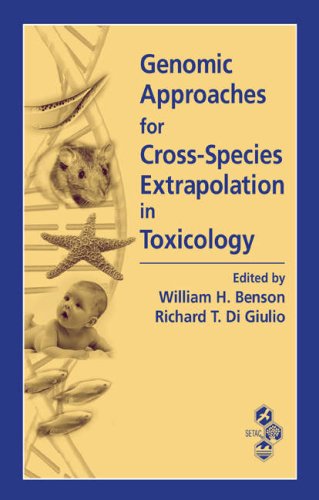
Genomic Approaches for Cross Species Extrapolation in Toxicology 1st Edition by William Benson, Richard Di Giulio ISBN 142004334X 978-1420043341

Original price was: $50.00.$35.00Current price is: $35.00.
Genomic Approaches for Cross Species Extrapolation in Toxicology 1st Edition by William H. Benson, Richard T. Di Giulio – Ebook PDF Instant Download/Delivery: 142004334X, 978-1420043341
Full download Genomic Approaches for Cross Species Extrapolation in Toxicology 1st Edition after payment
Product details:
ISBN 10: 142004334X
ISBN 13: 978-1420043341
Author: William H. Benson, Richard T. Di Giulio
The latest tools for investigating stress response in organisms, genomic technologies provide great insight into how different organisms respond to environmental conditions. However, their usefulness needs to be tested, verified, and codified. Genomic Approaches for Cross-Species Extrapolation in Toxicology provides a balanced discussion drawn from the experience of thirty-five scientists and professionals from diverse fields including environmental toxicology and chemistry, biomedical toxicology, molecular biology, genetics, physiology, bioinformatics, computer science, and statistics. The book introduces genomic, transcriptomic, proteomic, and metabolomic technologies. It describes the advantages and challenges associated with these approaches compared to traditional methodologies, particularly from the perspective of cross-species extrapolation within human and environmental toxicology, and explores solutions that will facilitate the incorporation of these technologies into predictive toxicology. The book goes on to identify and prioritize species of animals that can serve as surrogates for environmental and human health in comparative toxicogenomic studies. The chapter authors elucidate similarities and differences among species, relate stressor-mediated responses to adverse outcomes, and extend this science into innovative approaches to risk assessment and regulatory decision-making.
Table of contents:
Chapter 1 “Omics” Approaches in the Context of Environmental Toxicology
Jon C. Cook, Nancy D. Denslow, Taisen Iguchi, Elwood A. Linney, Ann Miracle, Joseph R. Shaw, Mark R. Viant, and Timothy R. Zacharewski
1.1 Introduction
1.2 Overview of Omics Technologies
1.3 Discovery-Driven versus Hypothesis-Driven Research: A Need for Balance
1.4 Advantages, Challenges, and Solutions of Omics Technologies
1.4.1 Advantages of Genomics Approaches
1.4.2 Challenges of Genomics Approaches
1.4.3 Solutions Offered for Genomics Approaches
1.4.4 Validation of Genomics
1.4.5 Potential of Genomics Approaches for Ecotoxicology
1.4.6 Transcriptomics
1.4.6.1 Emerging Transcriptomics Resources
1.4.7 Proteomics
1.4.8 Metabolomics — Molecular Phenotype and Metabolic Trajectories
1.4.9 Experimental Considerations for Metabolomics
1.4.10 Annotation of Cellular Metabolome
1.5 Pathway Mapping — The Future of Omics Technologies
1.6 Example of Cross-Species Extrapolation Using Transcriptomics
1.7 Recommendations
1.8 Future
References
Chapter 2 Selection of Surrogate Animal Species for Comparative Toxicogenomics
Nancy D. Denslow, John K. Colbourne, David Dix, Jonathan H. Freedman, Caren C. Helbing, Sean Kennedy, and Phillip L. Williams
2.1 Introduction
2.2 Brief Review on Studies Using Comparative Genomics
2.3 Selection Criteria for Surrogate Species
2.3.1 Toxicologic Information
2.3.1.1 Weighting Selection Criteria Based on Three Research Needs
2.3.1.2 Genome Information
2.4 Selection of Surrogate Species
2.5 Discussion
2.5.1 Mammalian Models
2.5.1.1 Core Biological Studies and Human Health
2.5.1.2 Ecotoxicology and Risk Assessment
2.5.2 Aquatic Models for Human and Ecological Health
2.5.2.1 Core Biology and Human Health Models
2.5.2.2 Ecotoxicology and Risk Assessment
2.5.3 Amphibian Models
2.5.3.1 Core Biology and Human Health Models
2.5.3.2 Ecotoxicology and Risk Assessment
2.5.4 Ciona
2.5.5 Avian Models
2.5.5.1 Core Biological Studies and Human Health
2.5.5.2 Ecotoxicology and Risk Assessment
2.5.6 Nematode Models
2.5.7 A Community-Based Approach for Promoting Daphnia as a Model for Ecotoxicogenomics
2.5.7.1 The Daphnia Genomics Consortium (DGC)
2.5.7.2 Community Resources
2.5.7.3 The Daphnia Genome Project
2.6 Conclusions
References
Appendix A
Appendix B
Appendix C
Chapter 3 Species Differences in Response to Toxic Substances: Shared Pathways of Toxicity – Value and Limitations of Omics Technologies to Elucidate Mechanism or Mode of Action
David Eaton, Evan Gallagher, Mike Hooper, Dan Schlenk, Patricia Schmeider, and Claudia Thompson
3.1 What Omics Approaches Would Be of Greatest Value in Predictive Toxicology That Utilizes Biologically Relevant Effects in Organisms or the Environment?
3.2 How Can Omics Be Utilized to Understand Mechanism and Mode of Action?
3.2.1 Discriminate between Defense/Adaptive Mechanisms from Direct “Toxic Response” and Secondary Downstream Events Responsible for Pathology
3.2.2 Integrate Omics with “Traditional” or Alternative Animal Models
3.3 How Do We Integrate Responses across Gene Expression, Proteomics, and Metabolomics and Apply This to Make a Science-Based Statement about Health of an Organism?
3.4 How Does Development of Omics Technologies Affect the Interspecies Extrapolation Process?
3.4.1 Effects Assessment in Field Studies
3.4.2 Susceptibility Assessment
3.5 What Are Key Limitations and Considerations in Using Omics Technologies to Inform Mechanisms of Cross-Species Differences in Response to Xenobiotics?
3.5.1 Time of Sample Collection
3.5.2 Duration of Exposure
3.5.3 Dose-Response Considerations
3.5.4 Target Tissues
3.5.5 Age, Gender
3.5.6 Nutrition
3.5.7 Conservation of Responses across Species
3.5.8 Validation
3.5.9 Kinetics, Identification of Rate-Limiting Steps
3.5.10 In Vitro versus In Vivo Studies: Correlations
3.6 Conclusions
3.7 Recommendations
Chapter 4 Bioinformatic Approaches and Computational Models for Data Integration and Cross-Species Extrapolation in the Postgenomic Era
Kenneth S. Ramos, Renae L. Malek, John Quakenbush, Ilya Shmulevich, Joshua Stuart, and Michael Waters
4.1 Introduction
4.2 Mechanistic versus Classification Studies
4.3 Computational Methods for Orthologue Identification
4.3.1 Available Orthology Resources
4.3.2 All-against-All Pair-Wise Sequence Analysis
4.3.3 Reciprocity and Transitivity
4.3.4 Phylogenetically Based Approaches
4.3.5 Future Directions
4.4 Interpreting Expression Data across Species
4.4.1 Motivation
4.4.2 Identification of Core Processes
4.4.3 Using Core Processes to Interpret Gene Expression Studies
4.5 Integrating Data across Domains
4.5.1 Analysis of Multiple Domains’ Omics Data
4.5.2 Development of a Knowledge-Based Science of Toxicology
4.5.3 Toxicogenomics Databases and Standards for Exchange of Data
4.5.4 Systems Toxicology and Toxicogenomics Knowledge Bases
4.5.4.1 The Chemical Effects in Biological Systems (CEBS) Knowledge Base
4.5.5 Comparative Toxicogenomics
4.5.6 Optimizing Collection of Data and Development of Knowledge
4.6 Supervised and Unsupervised Analysis for Toxicogenomics
4.7 Networks
4.7.1 What Class of Models Should We Choose?
4.7.2 How Do We Represent Networks?
4.7.3 To What Extent Do Such Models Represent Reality?
4.7.4 Do We Have the “Right” Types of Data to Infer These Models?
4.7.5 Biological Systems Are Nonlinear Dynamical Systems
4.7.6 The Problem of Validation
4.8 What Do We Hope to Learn from These Models?
4.9 Predictive Toxicology
4.10 Educating the Community
4.11 Recommendations for Advancing the Field
4.12 Concluding Remarks
Chapter 5 The Extension of Molecular and Computational Information to Risk Assessment and Regulatory Decision Making
James S. Bus, Richard A. Canady, Tracy K. Collier, J. William Owens, Syril D. Pettit, Nathaniel L. Scholz, and Anita C. Street
5.1 Introduction
5.1.1 Scope of the Chapter
5.2 Overview of Human and Ecological Risk Assessment
5.2.1 Human Health Risk Assessment
5.2.2 Ecological Assessment
5.2.3 Differences in Statutory Requirements
5.2.3.1 Human Health Risk Assessment
5.2.3.2 Ecological Risk Assessment
5.3 Potential of Omics to Improve Risk Assessment
5.3.1 Reducing Uncertainty in Human Health Risk Assessment
5.3.1.1 Omics Approaches to Addressing Cross-Species Uncertainties
5.3.1.2 Screening
5.3.1.3 Impact of Genomics Technology on Reducing Uncertainty in Chemical-Specific Risk Assessments
5.2 Overview of Human and Ecological Risk Assessment
5.2.1 Human Health Risk Assessment
5.2.2 Ecological Assessment
5.2.3 Differences in Statutory Requirements
5.2.3.1 Human Health Risk Assessment
5.2.3.2 Ecological Risk Assessment
5.3 Potential of Omics to Improve Risk Assessment
5.3.1 Reducing Uncertainty in Human Health Risk Assessment
5.3.1.1 Omics Approaches to Addressing Cross-Species Uncertainties
5.3.1.2 Screening
5.3.1.3 Impact of Genomics Technology on Reducing Uncertainty in Chemical-Specific Risk Assessments
5.4 The Path Forward
5.4.1 Extrapolations and Inferences from Omics Data
5.4.2 Groundtruthing and Validation
5.4.2.1 Conceptualizing Omics in the Regulatory Risk Framework
5.4.2.2 Implementation Issues for Omics
5.4.3 Institutional Limitations
5.4.3.1 Risk Assessment and Management Infrastructure Limitations
5.4.3.2 Phenotypic Anchoring and TSCA Liability/Safe Harbor
5.4.3.3 Data Standards across Regulatory Agencies
5.4.3.4 Privacy Act
5.5 Conclusions and Recommendations
People also search for:
cross-species genetics
genomic based approach
diagnostic cross genetics
cross species dna
genomics approaches
Tags:
William Benson,Richard Di Giulio,Genomic Approaches,Cross Species Extrapolation