
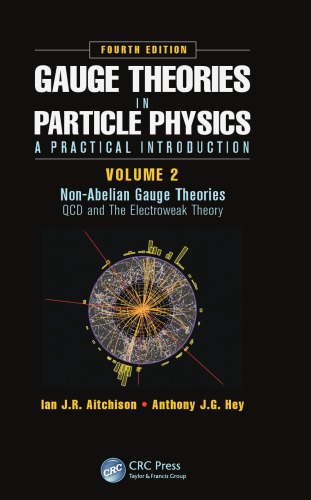
Gauge Theories in Particle Physics QCD and The Electroweak Theory Fourth Edition by Ian J R Aitchison, Anthony Hey ISBN 978-1466513075 1466513071

Original price was: $50.00.$35.00Current price is: $35.00.
Gauge Theories in Particle Physics QCD and The Electroweak Theory Fourth Edition by Ian J R Aitchison, Anthony J.G. Hey – Ebook PDF Instant Download/Delivery: 978-1466513075, 1466513071
Full download Gauge Theories in Particle Physics QCD and The Electroweak Theory Fourth Edition after payment
Product details:
ISBN 10: 1466513071c
ISBN 13: 978-1466513075
Author: Ian J R Aitchison, Anthony J.G. Hey
Volume 2 of this revised and updated edition provides an accessible and practical introduction to the two non-Abelian quantum gauge field theories of the Standard Model of particle physics: quantum chromodynamics (QCD) and the Glashow-Salam-Weinberg (GSW) electroweak theory.
This volume covers much of the experimental progress made in the last ten years. A new chapter on CP violation and oscillation phenomena describes CP violation in B-meson decays as well as the main experiments that have led to our current knowledge of mass-squared differences and mixing angles in neutrino physics. Exploring a new era in particle physics, this edition discusses one of the most recent and exciting breakthroughs―the discovery of a boson with properties consistent with those of the Standard Model Higgs boson. It also updates many other topics, including jet algorithms, lattice QCD, effective Lagrangians, and three-generation quark mixing and the CKM matrix.
New to the Fourth Edition
New chapter on CP violation and oscillations in mesonic and neutrino systems
New section on three-generation quark mixing and the CKM matrix
Improved discussion of two-jet cross section in electron-positron annihilation
New section on jet algorithms
Recent lattice QCD calculations with dynamical fermions
New section on effective Lagrangians for spontaneously broken chiral symmetry, including the three-flavor extension, meson mass relations, and chiral perturbation theory
Update of asymptotic freedom
Discussion of the historic discovery of a Higgs-like boson
The authors discuss the main conceptual points of the theories, detail many practical calculations of physical quantities from first principles, and compare these quantitative predictions with experimental results, helping readers improve both their calculation skills and physical insight.
Table of contents:
I Introductory Survey, Electromagnetism as a Gauge Theory, and Relativistic Quantum Mechanics
1 The Particles and Forces of the Standard Model
1.1 Introduction: the Standard Model
1.2 The fermions of the Standard Model
1.2.1 Leptons
1.2.2 Quarks
1.3 Particle interactions in the Standard Model
1.3.1 Classical and quantum fields
1.3.2 The Yukawa theory of force as virtual quantum ex-change
1.3.3 The one-quantum exchange amplitude
1.3.4 Electromagnetic interactions
1.3.5 Weak interactions
1.3.6 Strong interactions
1.3.7 The gauge bosons of the Standard Model
1.4 Renormalization and the Higgs sector of the Standard Model
1.4.1 Renormalization
1.4.2 The Higgs boson of the Standard Model
1.5 Summary
Problems
2 Electromagnetism as a Gauge Theory
2.1 Introduction
2.2 The Maxwell equations: current conservation
2.3 The Maxwell equations: Lorentz covariance and gauge invari-ance
2.4 Gauge invariance (and covariance) in quantum mechanics
2.5 The argument reversed: the gauge principle
2.6 Comments on the gauge principle in electromagnetism Problems
3 Relativistic Quantum Mechanics
3.1 The Klein-Gordon equation
3.1.1 Solutions in coordinate space
3.1.2 Probability current for the KG equation
3.2 The Dirac equation
3.2.1 Free-particle solutions
3.2.2 Probability current for the Dirac equation
3.3 Spin
3.4 The negative-energy solutions
3.4.1 Positive-energy spinors.
3.4.2 Negative-energy spinors
3.4.3 Dirac’s interpretation of the negative-energy solutions of the Dirac equation.
3.4.4 Feynman’s interpretation of the negative-energy solu-tions of the KG and Dirac equations
3.5 Inclusion of electromagnetic interactions via the gauge princi-ple: the Dirac prediction of g = 2 for the electron
Problems
4 Lorentz Transformations and Discrete Symmetries
4.1 Lorentz transformations
4.1.1 The KG equation.
4.1.2 The Dirac equation.
4.2 Discrete transformations: P, C and T
4.2.1 Parity
4.2.2 Charge conjugation.
4.2.3 CP
4.2.4 Time reversal
4.2.5 CPT
Problems
II Introduction to Quantum Field Theory
5 Quantum Field Theory I: The Free Scalar Field
5.1 The quantum field: (i) descriptive
5.2 The quantum field: (ii) Lagrange-Hamilton formulation
5.2.1 The action principle: Lagrangian particle mechanics
5.2.2 Quantum particle mechanics à la Heisenberg-Lagrange-Hamilton
5.2.3 Interlude: the quantum oscillator
5.2.4 Lagrange-Hamilton classical field mechanics.
5.2.5 Heisenberg-Lagrange-Hamilton quantum field mechan-ics
5.3 Generalizations: four dimensions, relativity and mass Problems
6 Quantum Field Theory II: Interacting Scalar Fields
6.1 Interactions in quantum field theory: qualitative introduction
6.2 Perturbation theory for interacting fields: the Dyson expansion of the S-matrix
6.2.1 The interaction picture
6.2.2 The S-matrix and the Dyson expansion
6.3 Applications to the ‘ABC’ theory
6.3.1 The decay CA+B.
6.3.2 A+BA+B scattering: the amplitudes
6.3.3 A+BA+B scattering: the Yukawa exchange mech-anism, s and u channel processes
6.3.4 A+BA+B scattering: the differential cross section
6.3.5 A+B A + B scattering: loose ends
Problems
7 Quantum Field Theory III: Complex Scalar Fields, Dirac and Maxwell Fields; Introduction of Electromagnetic Inter-actions
7.1 The complex scalar field: global U(1) phase invariance, parti-cles and antiparticles
7.2 The Dirac field and the spin-statistics connection
7.3 The Maxwell field A(x)
7.3.1 The classical field case
7.3.2 Quantizing A(x)..
7.4 Introduction of electromagnetic interactions
7.5 P, C and T in quantum field theory
7.5.1 Parity
7.5.2 Charge conjugation
7.5.3 Time reversal
Problems
III Tree-Level Applications in QED
8 Elementary Processes in Scalar and Spinor Electrodynamics
8.1 Coulomb scattering of charged spin-0 particles
8.1.1 Coulomb scattering of s+ (wavefunction approach)
8.1.2 Coulomb scattering of s+ (field-theoretic approach).
8.1.3 Coulomb scattering of s
8.2 Coulomb scattering of charged spin- particles
8.2.1 Coulomb scattering of e (wavefunction approach)
8.2.2 Coulomb scattering of e (field-theoretic approach)
8.2.3 Trace techniques for spin summations
8.2.4 Coulomb scattering of e+
8.3 is scattering
8.3.1 The amplitude for es+ → est
8.3.2 The cross section for es+es+
8.4 Scattering from a non-point-like object: the pion form factor in e+ → e+
8.4.1 e scattering from a charge distribution
8.4.2 Lorentz invariance
8.4.3 Current conservation
8.5 The form factor in the time-like region: ete → ㅠㅠ and
crossing symmetry
8.6 Electron Compton scattering
8.6.1 The lowest-order amplitudes
8.6.2 Gauge invariance
8.6.3 The Compton cross section
8.7 Electron muon elastic scattering
8.8 Electron-proton elastic scattering and nucleon form factors
8.8.1 Lorentz invariance
8.8.2 Current conservation
Problems
9 Deep Inelastic Electron-Nucleon Scattering and the Parton Model 2
9.1 Inelastic electron-proton scattering: kinematics and structure functions
9.2 Bjorken scaling and the parton model
9.3 Partons as quarks and gluons
9.4 The Drell-Yan process
9.5 ete annihilation into hadrons
Problems
IV Loops and Renormalization
10 Loops and Renormalization I: The ABC Theory
10.1 The propagator correction in ABC theory
[2] 10.1.1 The O(g²) self-energy II Π (92) C10.1.2 Mass shift
10.1.3 Field strength renormalization
10.2 The vertex correction
10.3 Dealing with the bad news: a simple example
10.3.1 Evaluating 12 (92)
10.3.2 Regularization and renormalization
10.4 Bare and renormalized perturbation theory
10.4.1 Reorganizing perturbation theory
10.4.2 The O(goh) renormalized self-energy revisited: how counter
terms are determined by renormalization conditions
10.5 Renormalizability
Problems
11 Loops and Renormalization II: QED
11.1 Counter terms
11.2 The O(e2) fermion self-energy
11.3 The O(e²) photon self-energy
11.4 The O(e²) renormalized photon self-energy
[2] 11.5 The physics of II (92)11.5.1 Modified Coulomb’s law
11.5.2 Radiatively induced charge form factor.
11.5.3 The running coupling constant
[2] 11.5.4 2 in the s-channel11.6 The O(e²) vertex correction, and Z₁ = Z2
11.7 The anomalous magnetic moment and tests of QED
11.8 Which theories are renormalizable Problems and does it matter?
A Non-relativistic Quantum Mechanics
B Natural Units
C Maxwell’s Equations: Choice of Units
D Special Relativity: Invariance and Covariance
E Dirac 8-Function
F Contour Integration
G Green Functions
H Elements of Non-relativistic Scattering Theory
H.1 Time-independent formulation and differential cross section
H.2 Expression for the scattering amplitude: Born approximation
H.3 Time-dependent approach
I The Schrödinger and Heisenberg Pictures
J Dirac Algebra and Trace Identities
J.1 Dirac algebra
J.1.1 y matrices
J.1.2 s identities.
J.1.3 Hermitian conjugate of spinor matrix elements
J.1.4 Spin sums and projection operators
J.2 Trace theorems
K Example of a Cross Section Calculation
K.1 The spin-averaged squared matrix element
K.2 Evaluation of two-body Lorentz-invariant phase space in ‘lab-oratory’ variables
L Feynman Rules for Tree Graphs in QED
L.1 External particles
L.2 Propagators
L.3 Vertices
References
Index
People also search for:
gauge theories in particle physics
gauge theories in particle physics 40th anniversary edition
gauge theory of elementary particle physics pdf
particles in particle physics
particle physics vs theoretical physics
Tags: Ian J R Aitchison, Anthony Hey, Gauge Theories, Particle Physics