
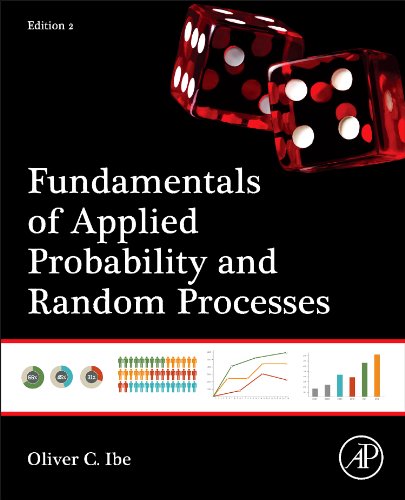
Fundamentals of Applied Probability and Random Processes Second Edition by Oliver Ibe ISBN 9780128010358 0128010358


Original price was: $50.00.$35.00Current price is: $35.00.
Fundamentals of Applied Probability and Random Processes Second Edition by Oliver Ibe – Ebook PDF Instant Download/Delivery: 9780128010358, 0128010358
Full download Fundamentals of Applied Probability and Random Processes Second Edition after payment
Product details:
ISBN 10: 0128010358
ISBN 13: 9780128010358
Author: Oliver Ibe
The long-awaited revision of Fundamentals of Applied Probability and Random Processes expands on the central components that made the first edition a classic. The title is based on the premise that engineers use probability as a modeling tool, and that probability can be applied to the solution of engineering problems. Engineers and students studying probability and random processes also need to analyze data, and thus need some knowledge of statistics. This book is designed to provide students with a thorough grounding in probability and stochastic processes, demonstrate their applicability to real-world problems, and introduce the basics of statistics. The book’s clear writing style and homework problems make it ideal for the classroom or for self-study.
Table of contents:
Chapter 1: Basic Probability Concepts
1.1 Introduction
1.2 Sample Space and Events
1.3 Definitions of Probability
1.4 Applications of Probability
1.5 Elementary Set Theory
1.6 Properties of Probability
1.7 Conditional Probability
1.8 Independent Events
1.9 Combined Experiments
1.10 Basic Combinatorial Analysis
1.11 Reliability Applications
1.12 Chapter Summary
1.13 Problems
Chapter 2: Random Variables
2.1 Introduction
2.2 Definition of a Random Variable
2.3 Events Defined by Random Variables
2.4 Distribution Functions
2.5 Discrete Random Variables
2.6 Continuous Random Variables
2.7 Chapter Summary
2.8 Problems
Chapter 3: Moments of Random Variables
3.1 Introduction
3.2 Expectation
3.3 Expectation of Nonnegative Random Variables
3.4 Moments of Random Variables and the Variance
3.5 Conditional Expectations
3.6 The Markov Inequality
3.7 The Chebyshev Inequality
3.8 Chapter Summary
3.9 Problems
Chapter 4: Special Probability Distributions
4.1 Introduction
4.2 The Bernoulli Trial and Bernoulli Distribution
4.3 Binomial Distribution
4.4 Geometric Distribution
4.5 Pascal Distribution
4.6 Hypergeometric Distribution
4.7 Poisson Distribution
4.8 Exponential Distribution
4.9 Erlang Distribution
4.10 Uniform Distribution
4.11 Normal Distribution
4.12 The Hazard Function
4.13 Truncated Probability Distributions
4.14 Chapter Summary
4.15 Problems
Chapter 5: Multiple Random Variables
5.1 Introduction
5.2 Joint CDFs of Bivariate Random Variables
5.3 Discrete Bivariate Random Variables
5.4 Continuous Bivariate Random Variables
5.5 Determining Probabilities from a Joint CDF
5.6 Conditional Distributions
5.7 Covariance and Correlation Coefficient
5.8 Multivariate Random Variables
5.9 Multinomial Distributions
5.10 Chapter Summary
5.11 Problems
Chapter 6: Functions of Random Variables
6.1 Introduction
6.2 Functions of One Random Variable
6.3 Expectation of a Function of One Random Variable
6.4 Sums of Independent Random Variables
6.5 Minimum of Two Independent Random Variables
6.6 Maximum of Two Independent Random Variables
6.7 Comparison of the Interconnection Models
6.8 Two Functions of Two Random Variables
6.9 Laws of Large Numbers
6.10 The Central Limit Theorem
6.11 Order Statistics
6.12 Chapter Summary
6.13 Problems
Chapter 7: Transform Methods
7.1 Introduction
7.2 The Characteristic Function
7.3 The S-Transform
7.4 The Z-Transform
7.5 Random Sum of Random Variables
7.6 Chapter Summary
7.7 Problems
Chapter 8: Introduction to Descriptive Statistics
8.1 Introduction
8.2 Descriptive Statistics
8.3 Measures of Central Tendency
8.4 Measures of Dispersion
8.5 Graphical and Tabular Displays
8.6 Shape of Frequency Distributions: Skewness
8.7 Shape of Frequency Distributions: Peakedness
8.8 Chapter Summary
8.9 Problems
Chapter 9: Introduction to Inferential Statistics
9.1 Introduction
9.2 Sampling Theory
9.3 Estimation Theory
9.4 Hypothesis Testing
9.5 Regression Analysis
9.6 Chapter Summary
9.7 Problems
Chapter 10: Introduction to Random Processes
10.1 Introduction
10.2 Classification of Random Processes
10.3 Characterizing a Random Process
10.4 Crosscorrelation and Crosscovariance Functions
10.5 Stationary Random Processes
10.6 Ergodic Random Processes
10.7 Power Spectral Density
10.8 Discrete-Time Random Processes
10.9 Chapter Summary
10.10 Problems
Chapter 11: Linear Systems with Random Inputs
11.1 Introduction
11.2 Overview of Linear Systems with Deterministic Inputs
11.3 Linear Systems with Continuous-time Random Inputs
11.4 Linear Systems with Discrete-time Random Inputs
11.5 Autoregressive Moving Average Process
11.6 Chapter Summary
11.7 Problems
Chapter 12: Special Random Processes
12.1 Introduction
12.2 The Bernoulli Process
12.3 Random Walk Process
12.4 The Gaussian Process
12.5 Poisson Process
12.6 Markov Processes
12.7 Discrete-Time Markov Chains
12.8 Continuous-Time Markov Chains
12.9 Gambler’s Ruin as a Markov Chain
12.10 Chapter Summary
12.11 Problems
People also search for:
fundamentals of applied electromagnetics 8th edition
microbial biotechnology fundamentals of applied microbiology
fundamentals of applied electromagnetics solutions
fundamentals of applied electromagnetics 8th edition solutions
fundamentals of applied electromagnetics solution manual
Tags: Oliver Ibe, Fundamentals of Applied, Random Processes