
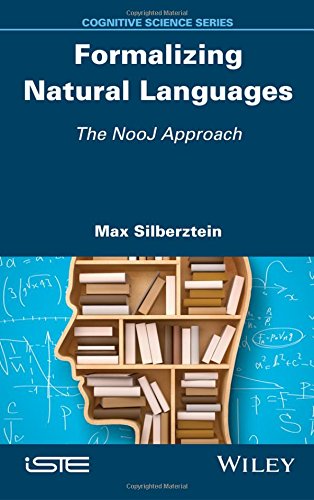
Formalizing Natural Languages The NooJ Approach 1st Edition by Max Silberztein ISBN 1848219024 9781848219021


Original price was: $50.00.$35.00Current price is: $35.00.
Formalizing Natural Languages The NooJ Approach 1st Edition by Max Silberztein – Ebook PDF Instant Download/Delivery: 1848219024, 9781848219021
Full download Formalizing Natural Languages The NooJ Approach 1st Edition after payment
Product details:
ISBN 10: 1848219024
ISBN 13: 9781848219021
Author: Max Silberztein
This book is at the very heart of linguistics. It provides the theoretical and methodological framework needed to create a successful linguistic project. Potential applications of descriptive linguistics include spell-checkers, intelligent search engines, information extractors and annotators, automatic summary producers, automatic translators, and more. These applications have considerable economic potential, and it is therefore important for linguists to make use of these technologies and to be able to contribute to them. The author provides linguists with tools to help them formalize natural languages and aid in the building of software able to automatically process texts written in natural language (Natural Language Processing, or NLP). Computers are a vital tool for this, as characterizing a phenomenon using mathematical rules leads to its formalization. NooJ – a linguistic development environment software developed by the author – is described and practically applied to examples of NLP.
Formalizing Natural Languages The NooJ Approach 1st Table of contents:
1 Introduction: the Project
1.1. Characterizing a set of infinite size
1.2. Computers and linguistics
1.3. Levels of formalization
1.4. Not applicable
1.5. NLP applications
1.6. Linguistic formalisms: NooJ
1.7. Conclusion and structure of this book
1.8. Exercises
1.9. Internet links
PART 1: Linguistic Units
2 Formalizing the Alphabet
2.1. Bits and bytes
2.2. Digitizing information
2.3. Representing natural numbers
2.4. Encoding characters
2.5. Alphabetical order
2.6. Classification of characters
2.7. Conclusion
2.8. Exercises
2.9. Internet links
3 Defining Vocabulary
3.1. Multiple vocabularies and the evolution of vocabulary
3.2. Derivation
3.3. Atomic linguistic units (ALUs)
3.4. Multiword units versus analyzable sequences of simple words
3.5. Conclusion
3.6. Exercises
3.7. Internet links
4 Electronic Dictionaries
4.1. Could editorial dictionaries be reused?
4.2. LADL electronic dictionaries
4.3. Dubois and Dubois-Charlier electronic dictionaries
4.4. Specifications for the construction of an electronic dictionary
4.5. Conclusion
4.6. Exercises
4.7. Internet links
PART 2: Languages, Grammars and Machines
5 Languages, Grammars, and Machines
5.1. Definitions
5.2. Generative grammars
5.3. Chomsky-Schützenberger hierarchy
5.4. The NooJ approach
5.5. Conclusion
5.6. Exercises
5.7. Internet links
6 Regular Grammars
6.1. Regular expressions
6.2. Finite-state graphs
6.3. Non-deterministic and deterministic graphs
6.4. Minimal deterministic graphs
6.5. Kleene’s theorem
6.6. Regular expressions with outputs and finite-state transducers
6.7. Extensions of regular grammars
6.8. Conclusion
6.9. Exercises
6.10. Internet links
7 Context-Free Grammars
7.1. Recursion
7.2. Parse trees
7.3. Conclusion
7.4. Exercises
7.5. Internet links
8 Context-Sensitive Grammars
8.1. The NooJ approach
8.2. NooJ contextual constraints
8.3. NooJ variables
8.4. Conclusion
8.5. Exercises
8.6. Internet links
9 Unrestricted Grammars
9.1. Linguistic adequacy
9.2. Conclusion
9.3. Exercise
9.4. Internet links
PART 3: Automatic Linguistic Parsing
10 Text Annotation Structure
10.1. Parsing a text
10.2. Annotations
10.3. Text annotation structure (TAS)
10.4. Exercise
10.5. Internet links
11 Lexical Analysis
11.1. Tokenization
11.2. Word forms
11.3. Morphological analyses
11.4. Multiword unit recognition
11.5. Recognizing expressions
11.6. Conclusion
11.7. Exercise
12 Syntactic Analysis
12.1. Local grammars
12.2. Structural grammars
12.3. Conclusion
12.4. Exercises
12.5. Internet links
13 Transformational Analysis
13.1. Implementing transformations
13.2. Theoretical problems
13.3. Transformational analysis with NooJ
13.4. Question answering
13.5. Semantic analysis
13.6. Machine translation
13.7. Conclusion
13.8. Exercises
13.9. Internet links
People also search for Formalizing Natural Languages The NooJ Approach 1st:
formalizing natural languages the nooj approach
formal language vs natural language
formal vs natural language
what is the difference between natural language and formal language
natural language and formal language
Tags: Max Silberztein, Formalizing, Languages