
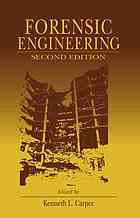
Forensic engineering 2nd Edition by Kenneth L Carper ISBN 978-0849374845 0849374847

Original price was: $50.00.$35.00Current price is: $35.00.
Forensic engineering 2nd Edition by Kenneth L Carper – Ebook PDF Instant Download/Delivery: 978-0849374845, 0849374847
Full download Forensic engineering 2nd Edition after payment
Product details:
ISBN 10: 0849374847
ISBN 13: 978-0849374845
Author: Kenneth L Carper
This edition of Forensic Engineering updates the original work with new case studies and investigative techniques. Contributors to the book are the foremost authorities in each area of specialization. These specialty areas include fire investigation, industrial accidents, product liability, traffic accidents, civil engineering and transportation disasters, and environmental systems failures. Each chapter includes discussions of guidelines, techniques, methods, and tools employed in accident investigation and analysis. In addition, the book contains vital information on forensic photogrammetry, the planning and writing of reports, and the presentation of evidence as an expert witness in traditional litigation. The book also analyzes the role of the forensic engineer in the evolving methods of alternate dispute resolution. Overall, Forensic Engineering is a tremendously valuable reference for forensic experts practicing in all engineering fields, as well as design and construction professionals, attorneys, product manufacturers, and insurance professionals. It is also as an excellent supplemental text for engineering and law students.
Table of contents:
1 What Is Forensic Engineering?
Kenneth L. Carper
Introduction 1.1
Definitions
1.1.2 Accident Reconstruction
1.1.3 Typical Clients and Projects
1.1.4 Influence on Improved Practices
1.2 Qualifications of the Forensic Engineer
1.2.1 Technical Competency
1.2.2 Knowledge of Legal Procedures
1.2.3 Detective Skills
1.2.4 Oral and Written Communication Skills
1.2.5 Other Skills
1.2.6 Personality Characteristics
1.3 Ethics and Professional Responsibilities
1.4 Resources and Professional Organizations
1.4.1 Professional Organizations
1.4.2 Journals and Regular Publications
1.5 Opportunities in Forensic Engineering Practice
References
2 Learning from Failures
Kenneth L. Carper
2.1 Introduction
2.2 Historical Context: Trial-and-Error Tradition
2.3 Definition of Failure
2.4 Causes of Failure
2.5 Data Collection and Information Dissemination
2.6 Failure Trends and Professional Response
2.6.1 Trends Leading to an Increase in the Frequency and Severity of Failures
©2001 CRC Press LLC
2.6.2 Failure-reduction Strategies
2.6.3 Summary
References
3 Fire Investigation
Paul E. Pritzker
3.1 Introduction
3.2 Background
3.3 Investigative Techniques, Procedures, and Tools
3.4 Training
3.5 The Engineering Team
3.6 Fire Investigative Results
3.7 Fire Investigations: Case Studies
3.7.1 High-rise Apartment Incinerator Door
3.7.2 Industrial Equipment Fire
3.7.3 Condominium Natural Gas Explosion
3.7.4 Cooking Fire: Improper Stove Part
3.7.5 Malfunctioning Television Set
3.7.6 Electrical Accident: Government Building
3.7.7 Vacation Home: Inadequate Egress
3.7.8 Boating Accident
3.7.9 Arson
3.7.10 Computer Equipment Facility Fire
3.7.11 Do-it-Yourself Wiring
3.8 NFPA Guide for Fire and Explosion Investigation (1998 Edition)
3.9 Fire Model Applications
3.10 Effects of Recent Legal Decisions on Expert Testimony in Fire Analysis Litigation: Daubert and Benfield
3.11 Spoliation of Evidence
3.12 Conclusion
3.13 Information Sources
4 Industrial Accidents
Ron Hendry
4.1 Introduction
4.2 Categories of Investigation
4.3 Diversity of Technical Qualifications for Industrial Accident Investigators
4.4 Involved Parties
4.5 Goals of the Investigation
4.6 Ethical Considerations
4.6.1 Before Taking the Assignment
4.6.2
Wearing More Than One Hat
4.6.3
The Investigator Must Have Sound Bases for an Opinion
Referring the Client to the Type of Expert Needed 4.6.4
4.7 Investigative Techniques
4.8 Investigative Tools
4.9 Investigative Activities
4.9.1
Failure Analysis
4.9.2 A Failure Analysis Example
4.9.3
Failure Analysis Using Photographs
4.9.4
Tests and Simulations
4.9.5 Layout and Analytical Analysis
4.9.6 Use of Multiple Investigators
4.10 Industrial Accidents Involving Knowledge, Accountability, and Job Description
4.10.1 User Knowledge and Accountability
4.10.2 Differences Between the Maintenance and Operator Functions
4.11 General Observations: Human Nature and Accidents
4.11.1 Safety First?
4.11.2 Procedural Errors
4.11.3 Miscalculations
4.11.4 Fewer Accidents Happen When All Runs Smoothly
4.11.5 Using The Machine Even Though it is Not Running Normally
4.11.6 Accident-prone Workers
4.12 Original Equipment Manufacturer (OEM)
Responsibilities and Problems
4.12.1 Designing for the Emergency
4.12.2 Poorly Evaluated Product Changes
4.12.3 Who Provides the Guarding?
4.12.4 The Open-and-Obvious-Hazard Argument
4.12.5 Changes in the Intended Mode of Operation
4.12.6 Mismatch between Provided Maintenance and Needs of the Machine
4.12.7
Feedback
4.12.8 Machines That “Don’t Wear Out”
4.12.9 Not All Accidents are Avoidable by the OEM’s Efforts
4.13 Other Investigations: Case Studies
4.13.1 How Much Visibility is Enough?
4.13.2 Gross Negligence Actions
4.13.3 The Painted Scaffold
4.13.4 Water, Water Everywhere
4.13.5 Ammonia-flavored Ice Cream
4.13.6 Anti-two Block
4.14 Impact of Forensic Activity on Improved Practices, Products, or Planning
4.15 Conclusion
4.16 Information Sources
5 Product Liability
Lindley Manning
5.1 Introduction
5.1.1 Definition of Product Liability
5.1.2 Legal Systems
5.2 Product Liability Law
5.2.1 English Common Law
5.2.2 United States Law
5.2.3 Strict Liability
5.2.4 Restatement of Torts
5.2.5 Modifications to Strict Liability
5.2.6 Failure to Warn
5.2.7 Subsequent Change
5.2.8 Defect without Liability
5.3 Product Liability Other Than Strict Liability
5.3.1 Negligence
5.3.2 Breach of Warranty
5.4 Other Legal Doctrines
5.4.1 Comparative Negligence
5.4.2 Deep Pockets
5.4.3 Workers’ Compensation
5.5 Court Systems
5.5.1 Federal Courts
5.5.2 State Courts
5.6 The Litigation Process
5.6.1 The Manufacturer
5.6.2 Plaintiffs
5.6.3 Experts
5.7 Tools of the Trade
5.8 Concluding Comments
5.8.1 Tort Reform
5.8.2 Daubert Case
5.8.3 The Kumho Case
5.8.4 Case Trends
5.8.5 Change – The Only Certainty
References
6 Traffic Accident Reconstruction
Joel T. Hicks
6.1 Introduction
6.1.1 Typical Clients
6.1.2 Typical Information Sought
6.1.3 Scope and Purpose of Investigation
6.1.4 Resources
6.2 Investigative Techniques, Procedures, and Tools
6.2.1 Background Information
6.2.2 Photographs
6.2.3 Inspecting the Scene and the Vehicles
6.2.3.1 Inspecting the Scene
6.2.3.2 Inspecting the Vehicles
6.3 Analytical Resources, Skills, and Methods
6.3.1 The Drawing
6.3.2 Distance, Speed, and Time
6.3.2.1 Momentum
6.3.2.2 Work and Energy
6.3.2.3 Force, Mass, and Acceleration
6.3.2.4 The Simple Case: Maximum Braking
6.3.2.5 The Not-so-Simple Case: Less Than Full Braking
6.3.2.6 Center of Mass
6.3.2.7 Coefficient of Friction
6.3.3 Collision Dynamics
6.3.3.1 Trajectory
6.3.3.2 Impact Analysis
6.3.4 Analysis of Variance
6.3.5 Sequence of Events
6.4 The Report
6.4.1 Formal Reports
6.4.2 Other Report Types
6.5 Beyond the Report: Examples of Increased Safety as a Result of Forensic Investigations
6.5.1 Tom Prewitt’s Work: Perception of Sirens
6.5.2 Front axle Brakes on “Bob” Tractors
6.5.3 Suspension Bolt Recall
6.6 Case Studies
6.6.1 Rear-end Case Study
6.6.2 Right-angle Case Study
References
7 Transportation Disaster Investigation
Rudolf Kapustin
7.1 Introduction
7.2 History
7.2.1 First Fatal Aircraft Accident
7.2.2 Need for an Aviation Accident Authority
7.2.3 The National Transportation Safety Board (NTSB)
Accident Investigation Methodology 7.3
7.3.1 U.S. Experience in Accident Investigation
7.3.2 The Investigation “Team” and “Party” Concept
7.3.2.1
The Concept – How it Works
7.3.2.2
Members of the Typical Investigation Team
7.3.3 Procedures for the Investigative Team
7.3.4 The Public Hearing: Applying the “Party”
7.4 Concept
7.3.4.1 Public Hearing: a Continuing Phase of the Investigation
7.3.4.2 Designation of Parties to the Hearing
7.3.4.3 Introduction of Evidence Into the Record: Witness Questioning Procedures
7.3.4.4 Compilation and Use of the Evidence
7.3.5 The Report A Case History: Air Florida Potomac River Accident
7.4.1 Description of the Accident
7.4.2 The Investigation
7.4.2.1 Operations Group Investigation
7.4.2.2 Witness Group Report
7.4.2.3 Weather Group Report
7.4.2.4 Air Traffic Control Group Report
7.4.2.5 Airport Group Report
7.4.2.6 Power Plant Group Report
7.4.2.7 Structures Group Report
7.4.2.8 Systems Group Report
7.4.2.9 Survival Factors Group Report
7.4.2.10 Cockpit Voice Recorder and Flight Data Recorder Group Report
7.4.2.11 Performance Group Report
7.4.2.12 Human Performance Report
7.4.2.13 Maintenance Records Group Report
Selected Findings and Conclusions 7.4.3
7.4.3.1 Findings
7.4.3.2 Probable Cause
Recommendations 7.4.3.3
Response from the FAA to NTSB 7.4.3.4 Recommendations
7.4.3.5 Further Recommendations
7.5 The Purpose of Investigation: Prevention of Accidents References
8 Civil Engineering Investigation
Glenn R. Bell
Introduction 8.1
8.2 Qualifications of the Investigator
8.3 Activities in the Investigative Process
8.4 The Investigative Team
8.5 Site Investigation and Sample Collection
8.5.1 General
8.5.2 Equipment
8.5.3 Written Record of Observations
8.5.4 Photography
8.5.5 Sample Removal
8.5.6 Eyewitness Accounts
8.5.7 Field Tests Structural Investigations
8.5.7.1 General
8.5.7.2 Load Tests
8.5.7.3 Instrumentation
8.5.7.4 Dimensional Measurements
8.5.7.5 Concrete and Masonry Materials
8.5.7.6 Metal Materials
8.5.7.7 Wood Materials
8.5.7.8 Weld Testing
8.5.7.9 Water and Air Penetration, Heat Loss
8.5.7.10 Subsurface Investigation
8.5.8
Field Tests – Geotechnical Investigations
8.5.8.1
8.5.8.2
General
Borings and Penetration Tests
8.5.8.3 Test Pits
8.5.8.4
In-place Strength Tests
8.5.8.5 Load Tests
8.5.8.6
Instrumentation
8.5.8.7
Dimensional Measurements
8.5.8.8 Seismic Tests
8.6 Document Collection and Review
General
8.6.1
8.6.2 Project-specific Documents
8.6.3
Research Documents
8.7 Theoretical Analyses
8.8 Laboratory Tests
8.8.1
General
8.8.2
Structural Laboratory Tests
8.8.2.1 Component or Mockup Load Tests
8.8.2.2 Concrete Materials
8.8.2.3 Resistance to Environmental Attack
8.8.2.4
Metal Materials
8.8.2.5 Masonry Materials
8.8.2.6 Wood Materials
8.8.2.7
Subsurface Tests and Nondestructive Weld Testing
8.8.2.8 Model Tests
8.8.2.9 Water and Air Penetration, Heat Loss
8.8.2.10 Scanning Electron Microscope
Examination
8.8.3 Geotechnical Laboratory Tests
8.8.3.1 Soil Classification
8.8.3.2 Strength Tests
8.8.3.3 Water-related Tests
8.8.3.4 Groundwater Tests
8.8.3.5 Others
8.9 Failure Hypotheses, Data Analyses, Formation of Conclusions
8.10 Determination of Procedural Responsibilities
8.11 Reports
References
9 Environmental Systems Failures
Fred H. Taylor
9.1 Introduction
9.2 Purpose and Scope of Investigations
9.2.1 Functions of the Environmental Systems Forensic Engineer (ESFE)
9.2.2 Client Relationships
9.2.3 Fields of Practice
9.2.4 Qualifications of the ESFE
9.3 Techniques
9.4 Tools
9.4.1 Tools in the Field
9.4.2 Tools in the Office
9.5 Associated Disciplines
9.6 Change in the Industry
9.7 Case Histories
9.7.1 44-Story Office Building, San Francisco, California
9.7.1.1 Complaint
9.7.1.2 System
9.7.1.3 Problem
9.7.1.4 Investigation
9.7.1.5 Conclusions
9.7.2 18-Story Office Building, San Jose, California
9.7.2.1 Complaint
9.7.2.2 System
9.7.2.3 Problem
9.7.2.4 Investigation
9.7.2.5 Conclusions
9.7.3 Three-Story County Administration Building, Central California
9.7.3.1 Complaint
9.7.3.2 System
9.7.3.3 Investigation
9.7.3.4 Conclusions
9.8 Conclusions
References
10 The Report
M.D. Morris
10.1 Basic Notions
10.2 Thinking and Planning
10.2.1 Reasons for Writing
10.2.2 The Audience
10.2.3 Substance
10.2.4 Investigation/Preparation
10.3 Conducting the Investigation
10.4 Data Distillation and Distribution
10.5 Outline Building
10.6 Writer’s Block
10.7 A Few Helpful Ground Rules
10.8 Delivery
10.9 Writing
11 Forensic Photogrammetry
William G. Hyzer
11.1 Introduction
11.2 Photographic Testimony
11.3 Photographic Techniques
11.3.1 Cameras
11.3.2 SLR Camera Lenses
11.3.3 Additional Accessory Items
11.4 Measurements From Photographs
11.4.1 Reference Scales
11.4.2 Macro Photogrammetric Scale
11.4.3 Perspective Grid Technique
11.5 Reconstruction Methods
11.5.1 Two-dimensional Reconstruction Methods
11.5.2 Two-dimensional Reconstruction without a Scale
11.5.3 Three-dimensional Reconstruction from a Single Image
11.5.4 Reverse Projection
11.5.5 Multiple-image Methods
11.6 Darkroom Procedures
11.7 Record Keeping
11.8 Role of the Imaging Expert
11.9 Guidelines for Effective Forensic Photography
References
12 The Engineer as an Expert Witness
Robert A. Rubin and Dana Wordes
12.1 Introduction
12.2 Ethical Considerations
12.3 Claim Analysis
12.4 Discovery
12.5 Interrogatories
12.6 Depositions
12.7 Preparation for Trial, Arbitration, or Mediation Proceedings
12.8 Rules of Evidence
12.8.1 Relevancy
12.8.2 Hearsay
12.8.3 Exceptions to Hearsay
12.8.4 Privileged Communications
12.9 The Trial
12.10 Preparing for a Court Appearance
12.11 Direct Examination
12.12 Cross-examination
12.13 Re-direct and Re-Cross-examination
12.14 Summary
12.15 Alternative Dispute Resolution
12.15.1 Mediation
12.15.2 Minitrial
12.15.3 Disputes Review Board
12.15.4 Arbitration
Acknowledgments
References
13 Conclusion
Kenneth L. Carper
People also search for:
30 forensic engineering
delta v forensic engineering
element forensic engineering
lgi forensic engineering
fischer forensic engineering