
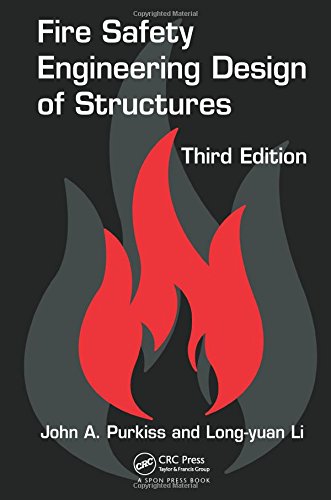
Fire Safety Engineering Design of Structures Third Edition by John Purkiss, Long Yuan Li ISBN 978-1466585478 1466585471
Original price was: $50.00.$35.00Current price is: $35.00.
Fire Safety Engineering Design of Structures Third Edition by John A. Purkiss, Long-Yuan Li – Ebook PDF Instant Download/Delivery: 978-1466585478, 1466585471
Full download Fire Safety Engineering Design of Structures Third Edition after payment
Product details:
ISBN 10: 1466585471
ISBN 13: 978-1466585478
Author: John A. Purkiss, Long-Yuan Li
FIRE SAFETY ENGINEERING DESIGN OF STRUCTURES 3ED (HB 2014)
Table of contents:
-
Fire Safety Engineering
-
Design Concerns
-
Control of Ignition
-
Control of Flammability
-
Control of Growth of Fire
-
Fire Safety Management
-
Means of Escape
-
Detection and Control of the Fire
-
Fire Detection
-
Smoke Control
-
Fire Fighting Systems
-
Compartmentation
-
Fire Spread between Structures
-
Structure Collapse
-
Regulatory Control
-
Fire Precautions during Construction and Maintenance
-
Summary
-
Active Measures
-
Passive Measures
-
Design Philosophies
-
Ambient Limit State Design
-
Fire Limit States
-
Load-Bearing Capacity Criterion
-
Insulation Criterion
-
Determination of Partial Safety Factors
-
Assessment Models
-
Assessment Method – Level 1
-
Assessment Method – Level 2
-
Assessment Method – Level 3
-
Practical Considerations
-
Applicability of Assessment Levels
-
Interaction Between Active and Passive Measures
-
Prescriptive Approach
-
Standard Fire Test
-
Drawbacks to the Fire Test
-
Expense
-
Specimen Limitations
-
Effect of Restraint or Continuity
-
Confidentiality of Results
-
Loading
-
Failure Modes
-
Reproducibility
-
Prescriptive Determination of Fire Resistance
-
Concrete
-
Structural Steelwork
-
Masonry
-
Timber
-
Behaviour of Natural Fires
-
Development of Compartment Fires
-
Pre-flashover Period
-
Post-flashover Period
-
Decay Phase
-
Factors Affecting the Growth Phase
-
Calculation of Compartment Temperature-Time Responses
-
Estimation of Fire Characteristics
-
Fire Severity and Time Equivalence
-
Localized Fires
-
Zone Modelling and Computational Fluid Dynamics (CFD)
-
Properties of Materials at Elevated Temperatures
-
Thermal Data
-
Materials Data
-
Constitutive Stress-Strain Laws
-
Calculation Approach
-
Thermal Analysis
-
Calculation of Temperature in Timber Element
-
Structural Analysis
-
Coupled Heat and Mass Transfer in Concrete
-
Volumetric Fractions of Solid, Liquid and Gaseous Phases
-
Mass Transfer of Free Water and Gaseous Mixture
-
Heat Transfer in a Multiphase Medium
-
Numerical Results
-
Design of Concrete Elements
-
Calculation of Temperatures
-
Graphical Data
-
The ISE and Concrete Society Design Guide (1978)
-
FIP/CEB Report (1978)
-
EN 1992-1-2
-
Empirical Methods
-
Wickström’s Method
-
Hertz’s Method
-
Values of Thermal Diffusivity
-
Position of the 500°C Isotherm
-
Simple Calculation Methods
-
Calculation of Load Effects
-
Direct Calculation
-
Indirect Calculation
-
Materials Partial Safety Factors
-
Methods of Determining Section Capacity
-
Reduced Section Method (500°C Isotherm)
-
Method of Slices (Zone Method)
-
Calibration of the 500°C Isotherm Method and the Zone Method
-
Columns
-
Comparisons Between the Methods of Calculation
-
Design and Detailing Considerations
-
Shear
-
Bond
-
Spalling
-
Moisture Content
-
Concrete Porosity and Permeability
-
Stress Conditions
-
Aggregate Type
-
Section Profile and Cover
-
Heating Rate
-
Concrete Strength
-
High Strength Concrete and Self-Compacting Concrete
-
Detailing
-
Design of Steel Elements
-
Calculation of Temperatures
-
Basic Principles
-
Heat Flow in Uninsulated Steelwork
-
Heat Flow in Insulated Steelwork
-
ECCS Method of Calculation
-
EN 1993-1-2 Approach
-
Effect of Moisture
-
Effective Density of Insulation
-
Delay Time
-
Empirical Approach for the Calculation of Temperatures
-
Bare Steelwork
-
Protected Steelwork
-
Calculation of Am/V
-
Thermal Properties of Insulation Materials
-
Design of Non-composite Steelwork
-
Determination of Structural Load in the Fire Limit State
-
EN 1993-1-2 Approach for the Determination of Structural Fire Capacity
-
Background to the Eurocode Method
-
Eurocode Methods
-
Other Steelwork Constructions
-
External Steelwork
-
Shelf Angle Floors
-
Stainless Steel
-
Cold-Formed Steel Sections
-
Methods of Protection
-
Types of Protection
-
Board Systems
-
Spray Protection
-
Intumescent Paints
-
Brickwork/Blockwork
-
Concrete Encasement
-
Manufacturer’s Data
-
Connections
-
Aging and Partial Loss of Protection
-
Aging Effects
-
Partial Loss of Protection
-
Composite Construction
-
Composite Slabs
-
Insulation Requirement
-
Calculation Approach
-
Effective Thickness
-
Load-bearing Capacity
-
Calculation of Moment Capacity
-
Composite Beams
-
Critical Temperature Approach
-
Full Moment Calculation
-
Concrete-filled Steel I- and H-Section Columns
-
Concrete-Filled Steel Tube Columns
-
Design of Timber Elements
-
Design to EN 1995-1-2
-
Empirical Approaches
-
Masonry, Aluminium, Plastics and Glass
-
Masonry
-
Aluminium
-
Plastics and Plastic-Based Composites
-
Glass
-
Frames
-
Tests on Isolated Frames
-
Tests on the Large Frame Structures at Cardington
-
Fire Behaviour of Connections
-
Pitched Roof Portals
-
Assessment and Repair of Fire Damaged Structures
-
Visual Inspection
-
Damage Assessment
-
Strength Assessment of the Structure
-
Methods of Repair
-
Demolition of Fire Damaged Structures
-
References
-
Author Index
-
Subject Index
People also search for:
fire safety engineering design
is fire protection engineering a good career
is fire protection engineering hard
what did fire protection engineers invent
how to be a fire engineer
Tags: John Purkiss, Long Yuan Li, Fire Safety, Design of Structures