
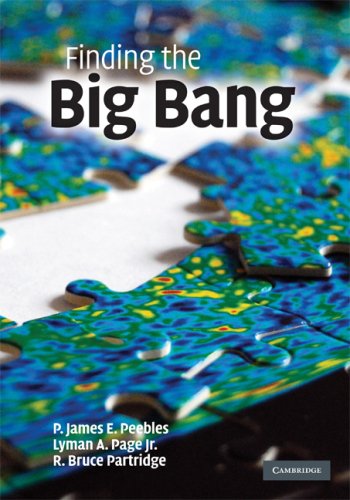
Finding the big bang 1st Edition by James Peebles, Lyman Page, Bruce Partridge ISBN 978-0521519823 0521519829
Original price was: $50.00.$35.00Current price is: $35.00.
Finding the big bang 1st Edition by P. James E. Peebles, Lyman A. Page Jr., R. Bruce Partridge – Ebook PDF Instant Download/Delivery: 978-0521519823, 0521519829
Full download Finding the big bang 1st Edition after payment
Product details:
ISBN 10: 0521519829
ISBN 13: 978-0521519823
Author: P. James E. Peebles, Lyman A. Page Jr., R. Bruce Partridge
Cosmology, the study of the universe as a whole, has become a precise physical science, the foundation of which is our understanding of the cosmic microwave background radiation (CMBR) left from the big bang. The story of the discovery and exploration of the CMBR in the 1960s is recalled for the first time in this collection of 44 essays by eminent scientists who pioneered the work. Two introductory chapters put the essays in context, explaining the general ideas behind the expanding universe and fossil remnants from the early stages of the expanding universe. The last chapter describes how the confusion of ideas and measurements in the 1960s grew into the present tight network of tests that demonstrate the accuracy of the big bang theory. This book is valuable to anyone interested in how science is done, and what it has taught us about the large-scale nature of the physical universe.
Table of contents:
1 Introduction
2 A guide to modern cosmology
2.1 The expanding universe
2.2 The thermal cosmic microwave background radiation
2.3 What is the universe made of?
3 Origins of the cosmology of the 1960s
3.1 Nucleosynthesis in a hot big bang
3.2 Nucleosynthesis in alternative cosmologies
3.3 Thermal radiation from a bouncing universe
3.4 Interstellar molecules and the sea of microwave radiation
3.5 Direct detection of the microwave radiation
3.6 Cosmology in the early 1960s
3.6.1 The steady state cosmology and the cosmological tests
3.6.2 Light elements from the big bang
3.6.3 Radiation from the big bang
3.6.4 Galaxy formation
3.6.5 The situation in the early 1960s
4 Recollections of the 1960s
4.1 Precursor evidence from communications experiments
4.1.1 David C. Hogg: Early low-noise and related studies at Bell Laboratories, Holmdel, NJ
4.2 Precursor evidence from interstellar molecules
4.2.1 Neville J. Woolf: Conversations with Dicke
4.2.2 George B. Field: Cyanogen and the CMBR
4.2.3 Patrick Thaddeus: Measuring the cosmic microwave background with interstellar molecules
4.3 Precursor evidence from element abundances
4.3.1 Donald E. Osterbrock: The helium content of the universe
4.4 The path to the hot big bang in the Soviet Union
4.4.1 Yuri Nikolaevich Smirnov. Unforgettable Yakov Zel’dovich
4.4.2 Igor Dmitriyevich Novikov. Cosmology in the Soviet Union in the 1960s
4.4.3 Andrei Georgievich Doroshkevich: Cosmology in the 1960s
4.4.4 Rashid Sunyaev. When we were young
4.4.5 Malcolm S. Longair: Moscow 1968-1969
4.5 Detection at Bell Laboratories
4.5.1 Arno Penzias: Encountering cosmology
4.5.2 Robert W. Wilson: Two astronomical discoveries
4.6 The Bell Laboratories-Princeton connection
4.6.1 Bernard F. Burke: Radio astronomy from first contacts to the CMBR
4.6.2 Kenneth C. Turner: Spreading the word – or how the news went from Princeton to Holmdel
4.7 Developments at Princeton
4.7.1 P. James E. Peebles: How I learned physical cosmology
4.7.2 David T. Wilkinson: Measuring the cosmic microwave background radiation
4.7.3 Peter G. Roll: Recollections of the second measurement of the CMBR at Princeton University in 1965
4.7.4 R. Bruce Partridge. Early days of the primeval fireball
4.8 Developments at Cambridge
4.8.1 Malcolm S. Longair: Cambridge cosmology in the 1960s
4.8.2 John Faulkner. The day Fred Hoyle thought he had disproved the big bang theory
4.8.3 Robert V. Wagoner: An initial impact of the CMBR on nucleosynthesis in big and little bangs
4.8.4 Martin Rees: Cosmology and relativistic astrophysics in Cambridge
4.9 Critical reactions to the hot big bang interpretation
4.9.1 Geoffrey R. Burbidge and Jayant V. Narlikar. Some comments on the early history of the CMBR
4.9.2 David Layzer: My reaction to the discovery of the CMBR
4.9.3 Michele Kaufman: Not the correct explanation for the CMBR
4.10 Measuring the CMBR energy spectrum
4.10.1 Jasper V. Wall: The CMB how to observe and not see
4.10.2 John R. Shakeshaft: Early CMBR observations at the Mullard Radio Astronomy Observatory
4.10.3 William “Jack” Welch: Experiments with the CMBR
4.10.4 Kazimir S. Stankevich: Investigation of the background radiation in the early years of its discovery
4.10.5 Paul Boynton: Testing the fireball hypothesis
4.10.6 Robert A. Stokes: Early spectral measurements of the cosmic microwave background radiation
4.10.7 Martin Harwit: An attempt at detecting the cosmic background radiation in the early 1960s
4.10.8 Judith L. Pipher. Being a young graduate student in interesting times – Ignoring the forest for the trees
4.10.9 Kandiah Shivanandan: The big bang, brighter than a thousand suns
4.10.10 Rainer Weiss: CMBR research at MIT shortly after the discovery is there a blackbody peak?
4.11 Structure in the distributions of matter and radiation
4.11.1 Yu Jer-tsang: Clusters and superclusters of galaxies
4.11.2 Rainer K. Sachs: The synergy of mathematics and physics
4.11.3 Arthur M. Wolfe. CMBR reminiscences
4.11.4 Joe Silk: A journey through time
4.11.5 George F. R. Ellis: The cosmic background radiation and the initial singularity
4.12 Measuring the CMBR anisotropy
4.12.1 Ronald N. Bracewell and Edward K. Conklin: Early cosmic background studies at Stanford Radio Astronomy Institute
4.12.2 Stephen Boughn: The early days of the CMBR – An undergraduate’s perspective
4.12.3 Karl C. Davis: Going the “easy” direction -and finding a lot of the wrong thing
4.12.4 Paul S. Henry: Driven to drink pursuit of the cosmic microwave background radiation
5 Cosmology and the CMBR since the 1960s
5.1 The CMBR energy spectrum
5.2 The aether drift
5.3 The CMBR intrinsic anisotropy spectrum
5.3.1 Theoretical concepts
5.3.2 Advances in the anisotropy measurements and analysis
5.4 The cosmological tests
5.5 Lessons
People also search for:
where can you find the big bang theory
what are the 3 evidence of the big bang theory
how is the big bang described
evidences for big bang
finding big
Tags: James Peebles, Lyman Page, Bruce Partridge, big bang