
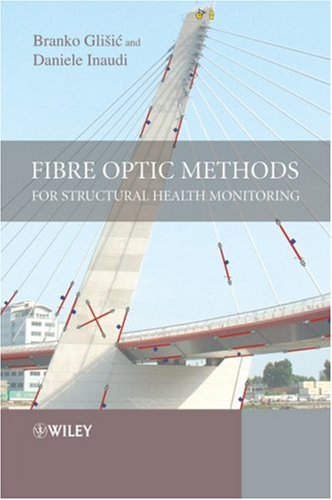
Fibre Optic Methods for Structural Health Monitoring 1st Edition by Branko Glisic, Daniele Inaudi ISBN 0470061421 978-0470061428


Original price was: $50.00.$35.00Current price is: $35.00.
Fibre Optic Methods for Structural Health Monitoring 1st Edition by Branko Glisic, Daniele Inaudi – Ebook PDF Instant Download/Delivery: 0470061421, 978-0470061428
Full download Fibre Optic Methods for Structural Health Monitoring 1st Edition after payment
Product details:
ISBN 10: 0470061421
ISBN 13: 978-0470061428
Author: Branko Glisic, Daniele Inaudi
The use of fibre optic sensors in structural health monitoring has rapidly accelerated in recent years. By embedding fibre optic sensors in structures (e.g. buildings, bridges and pipelines) it is possible to obtain real time data on structural changes such as stress or strain. Engineers use monitoring data to detect deviations from a structure’s original design performance in order to optimise the operation, repair and maintenance of a structure over time.
Fibre Optic Methods for Structural Health Monitoring is organised as a step-by-step guide to implementing a monitoring system and includes examples of common structures and their most-frequently monitored parameters. This book:
presents a universal method for static structural health monitoring, using a technique with proven effectiveness in hundreds of applications worldwide;
discusses a variety of different structures including buildings, bridges, dams, tunnels and pipelines;
features case studies which describe common problems and offer solutions to those problems;
provides advice on establishing mechanical parameters to monitor (including deformations, rotations and displacements) and on placing sensors to achieve monitoring objectives;
identifies methods for interpreting data according to construction material and shows how to apply numerical concepts and formulae to data in order to inform decision making.
Fibre Optic Methods for Structural Health Monitoring is an invaluable reference for practising engineers in the fields of civil, structural and geotechnical engineering. It will also be of interest to academics and undergraduate/graduate students studying civil and structural engineering.
Table of contents:
1. Introduction to Structural Health Monitoring
1.1 Basic Notions, Needs and Benefits
1.1.1 Introduction
1.1.2 Basic Notions
1.1.3 Monitoring Needs and Benefits
1.1.4 Whole Lifespan Monitoring
1.2 The Structural Health Monitoring Process
1.2.1 Core Activities
1.2.2 Actors
1.3 On-Site Example of Structural Health Monitoring Project
2. Fibre-Optic Sensors
2.1 Introduction to Fibre-Optic Technology
2.2 Fibre-Optic Sensing Technologies
2.2.1 SOFO Interferometric Sensors
2.2.2 Fabry–Perot Interferometric Sensors
2.2.3 Fibre Bragg-Grating Sensors
2.2.4 Distributed Brillouin- and Raman-Scattering Sensors
2.3 Sensor Packaging
2.4 Distributed Sensing Cables
2.4.1 Introduction
2.4.2 Temperature-Sensing Cable
2.4.3 Strain-Sensing Tape: SMARTape
2.4.4 Combined Strain- and Temperature-Sensing: SMARTprofile
2.5 Software and System Integration
2.6 Conclusions and Summary
3 Fibre-Optic Deformation Sensors: Applicability and Interpretation of Measurements
3.1 Strain Components and Strain Time Evolution
3.1.1 Basic Notions
3.1.2 Elastic and Plastic Structural Strain
3.1.3 Thermal Strain
3.1.4 Creep
3.1.5 Shrinkage
3.1.6 Reference Time and Reference Measurement
3.2 Sensor Gauge Length and Measurement
3.2.1 Introduction
3.2.2 Deformation Sensor Measurements
3.2.3 Global Structural Monitoring: Basic Notions
3.2.4 Sensor Measurement Dependence on Strain Distribution: Maximal Gauge Length
3.2.5 Sensor Measurement in Inhomogeneous Materials: Minimal-Gauge Length
3.2.6 General Principle in the Determination of Sensor Gauge Length
3.2.7 Distributed Strain Sensor Measurement
3.3 Interpretation of Strain Measurement
3.3.1 Introduction
3.3.2 Sources of Errors and Detection of Anomalous Structural Condition
3.3.3 Determination of Strain Components and Stress from Total-Strain Measurement
3.3.4 Example of Strain Measurement Interpretation
4 Sensor Topologies: Monitoring Global Parameters
4.1 Finite Element Structural Health Monitoring Concept: Introduction
4.2 Simple Topology and Applications
4.2.1 Basic Notions on Simple Topology
4.2.2 Enchained Simple Topology
4.2.3 Example of an Enchained Simple Topology Application
4.2.4 Scattered Simple Topology
4.2.5 Example of a Scattered Simple Topology Application
4.3 Parallel Topology
4.3.1 Basic Notions on Parallel Topology: Uniaxial Bending
4.3.2 Basic Notions on Parallel Topology: Biaxial Bending
4.3.3 Deformed Shape and Displacement Diagram
4.3.4 Examples of Parallel Topology Application
4.4 Crossed Topology
4.4.1 Basic Notions on Crossed Topology: Planar Case
4.4.2 Basic Notions on Crossed Topology: Spatial Case
4.4.3 Example of a Crossed Topology Application
4.5 Triangular Topology
4.5.1 Basic Notions on Triangular Topology
4.5.2 Scattered and Spread Triangular Topologies
4.5.3 Monitoring of Planar Relative Movements Between Two Blocks
4.5.4 Example of a Triangular Topology Application
People also search for:
structural fiber
structural health monitoring of composite structures using fiber optic methods
structure optical fibre
fibre optic structure
fiber optic structure
Tags:
Branko Glisic,Daniele Inaudi,Fibre Optic,Structural Health Monitoring