
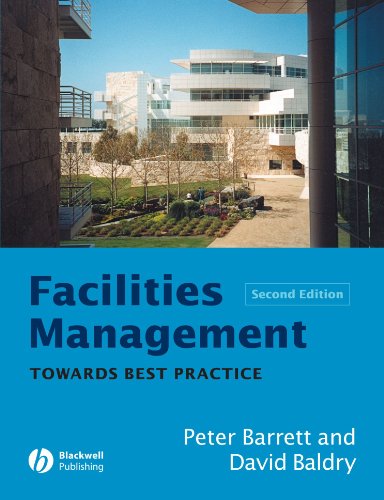
Facilities Management Towards Best Practise 2nd Edition by Peter Barret, David Baldry ISBN 0632064455 978-0632064458

Original price was: $50.00.$35.00Current price is: $35.00.
Facilities Management Towards Best Practise 2nd Edition by Peter Barret, David Baldry – Ebook PDF Instant Download/Delivery: 0632064455, 978-0632064458
Full download Facilities Management Towards Best Practise 2nd Edition after payment
Product details:
ISBN 10: 0632064455
ISBN 13: 978-0632064458
Author: Peter Barret, David Baldry
Facilities management has been one of the fastest growing professional disciplines for some years, both in terms of volume and diversity of commercial activity. However, a widely accepted and implemented body of knowledge is still lacking.
This book contributes to that knowledge building by taking models and ideas from a wide range of sources and linking them to extensive case study material drawn from practising facilities managers.
The text is divided into three parts:
· Current practice is illustrated, with a second chapter looking at enhancing services
· Key facilities management issues are considered:user needs evaluation, outsourcing and computer–based information systems
· Extensive advice is provided on managing people through change and on decision making
The Second Edition features new material on user needs, briefing and procurement strategy, together with new public sector case studies.
This high quality book provides a comprehensive approach to the range of issues [and] the combination of case studies with theoretical perspectives and research has a strong practical emphasis Chartered Surveyor Monthly
′A thorough and very well researched book…as a student text it is first class′ Construction Manager
Table of contents:
Part 1: Facilities Management Practice
1 Current Good Practice in Facilities Management
1.1 Introduction
1.1.1 Scope of the chapter
1.1.2 Summary of the different sections
1.1.3 How to use this chapter
1.2 Facilities Management Models
1.2.1 Context
1.2.2 Office manager model
1.2.3 Single site model
1.2.4 Localised sites model
1.2.5 Multiple sites model
1.2.6 International model
1.2.7 Public sector model
1.3 Case Studies
1.3.1 Overview
1.3.2 Office manager example
1.3.3 Single site example 1
1.3.4 Single site example 2
1.3.5 Localised sites example
1.3.6 Multiple sites example 1
1.3.7 Multiple sites example 2
1.3.8 Public sector example 1
1.3.9 Public sector example 2
1.4 Facilities Management Systems
1.4.1 Overview
1.4.2 Case study findings
1.4.3 Facilities management structure
1.4.4 Management of facilities management services
1.4.5 Meeting current core business needs
1.4.6 Facilities management and external influences
1.5 Generic Model
1.6 References
2 Improving Facilities Management Performance
2.1 Introduction
2.1.1 Context
2.1.2 Overview
2.1.3 Summary of the different sections
2.2 Client Perception of Facilities Management Services
2.2.1 Context
2.2.2 The nature of professional service quality
2.3 Stimulating and Sustaining Improvements
2.3.1 General approach
2.3.2 Supple systems
2.4 Strategic Facilities Management
2.4.1 Possible relationships between facilities management and strategic planning
2.4.2 Factors preventing inclusion of facilities management in strategic planning
2.4.3 Facilities strategy
2.5 Learning Organisations
2.5.1 Context
2.5.2 Individual learning
2.5.3 Team learning
2.6 Summary and Interactions
2.7 References
Appendix: Current Models of Learning Organisations
Part 2: Key Facilities Management Issues
3 User Needs Evaluation
3.1 Introduction
3.1.1 Aims
3.1.2 Context
3.1.3 Summary of the different sections
3.2 The Relationship Between the Facilities Management
Function and User Needs Evaluation
3.2.1 Aims
3.2.2 The importance of the design of buildings
3.2.3 Value of user knowledge/involvement
3.24 The importance of building appraisals for organisations
3.2.5 Facilities management and building appraisals
3.2.6 Uses and benefits of building appraisals
3.3 Briefing
3.3.1 Aims
3.3.2 The importance of briefing
3.3.3 Empowering clients and appropriate user involvement
3.3.4 Managing the project dynamics and appropriate team building
3.3.5 Using appropriate visualisation techniques
3.3.6 Management of the briefing process
3.3.7 Information required during the briefing process
3.4 Post-Occupancy Evaluation (POE)
3.4.1 Aims
3.4.2 Building evaluation systems
3.4.3 POE methods
3.5 Data Collection: Methods, Analysis and Presentation
3.5.1 Aims
3.5.2 Context
3.5.3 Data collection methods
3.5.4 Data analysis
3.5.5 Presentation techniques
3.6 References
Appendix: Post-Occupancy Evaluation Data Sheets
4 Procurement
4.1 Introduction
4.1.1 Aims
4.1.2 Context
4.1.3 Procurement of supplier organisations
4.2 Understanding Outsourcing in a Facilities Management Context
4.2.1 Aims
4.2.2 Concept
4.2.3 The scope and scale of outsourcing
4.2.4 Grouping of facilities management contracts
4.2.5 User’s outsourcing potential
4.3 Beyond Core Business
4.3.1 Aims
4.3.2 Core business
4.4 Facilities Management Resource Decision Making
4.4.1 Aims
4.4.2 The shortcomings of the intuitive approach
4.4.3 Primary advantages and disadvantages of outsourcing
4.4.4 Secondary driving and constraining forces
4.4.5 Determining the user’s ‘environment’ towards facilities management resourcing
4.5 Summary
4.6 References
Appendix: Description of Case Study Organisations
Case Study 1
Case Study 2
5 Computer-based Information Systems
5.1 Introduction
5.1.1 Scope of the chapter
5.1.2 Summary of the different sections
5.2 Information, Information Technology and Information Systems in Facilities Management
5.2.1 Computer-based information systems: What are they and why are they important?
5.2.2 Information technology: What is its relationship to information systems?
5.2.3 Information technology: How has it been applied to the facilities management function?
5.2.4 The organisational context of information: What type of information is required by the facilities manager?
5.2.5 Computer-based information systems: How can they be developed?
5.3 The Development of Computer-based Information Systems
5.3.1 Introduction
5.3.2 The project team
5.3.3 Stage 1: System definition and outline
5.3.4 Stage 2: System development
5.3.5 Stage 3: System implementation
5.3.6 Stage 4: System maintenance and learning
Part 3: Enabling Capabilities
6 Managing People Through Change
6.1 Introduction
6.1.1 The changing face of the work environment
6.1.2 Putting the human element into change
6.1.3 Managing people through change objectives
6.1.4 Organisation development approach to managing people through change
6.1.5 The role of the facilities manager within the change process
6.1.6 Chapter aim and structure
6.2 Stage 1: How to Get the Change Process Started
6.2.1 Stage objectives
6.2.2 Stage rationale and context
6.2.3 Tasks
6.2.4 Tools
6.2.5 Input
6.2.6 Output
6.3 Stage 2: How to Collect Information for the Change Project
6.3.1 Stage objective
6.3.2 Stage rationale and context
6.3.3 Task
6.3.4 Tools
6.3.5 Input
6.3.6 Output
6.4 Stage 3: How to Develop an Action Plan
6.4.1 Stage objectives
6.4.2 Stage rationale and context
6.4.3 Tasks
6.4.4 Tools
6.4.5 Input
6.4.6 Output
6.5 Stage 4: How to Implement and Evaluate the Change Project
6.5.1 Stage objectives
6.5.2 Stage rationale and context
6.5.3 Tasks
6.5.4 Tools
6.5.5 Input
6.5.6 Output
6.6 Concluding Remarks
6.7 Reference
7 Decision Making
7.1 Introduction
7.1.1 The importance of decision making
7.1.2 The myth and reality of decision making
7.1.3 The need to rationalise the decision-making process
7.1.4 The decision-making process
7.1.5 Chapter structure
7.2 Stage 1: Exploration of the Nature of the Problem
7.2.1 Introduction
7.2.2 Step 1: Sense problem
7.2.3 Step 2: Set initial objectives
7.2.4 Step 3: Identify problem characteristics
7.2.5 Step 4: Establish decision-making group
7.2.6 Step 5: Establish decision-making process plan
7.3 Stage 2: Generation of Possible Solutions
7.3.1 Introduction
7.3.2 Step 1: Collection and analysis of information
7.3.3 Step 2: Apply creative solution-generation techniques
7.4 Stage 3: Choosing Among Possible Solutions
7.4.1 Introduction
7.4.2 Step 1: Identify evaluation criteria
7.4.3 Step 1A: Apply decision rule
7.4.4 Step 2: Test feasibility
7.4.5 Step 3: Test acceptability
7.4.6 Step 4: Test vulnerability
7.4.7 Step 5: Choose solution
7.4.8 How to implement, follow up and control a decision
7.5 Conclusion
7.6 References
People also search for:
facilities management best practice model
facilities management good practice guide
facilities management guidelines
great facilities
health facilities management
Tags: Peter Barret, David Baldry, Facilities Management, Best Practise