
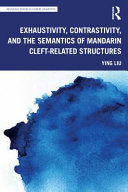
Exhaustivity Contrastivity and the Semantics of Mandarin Cleft Related Structures 1st Edition by Ying Liu ISBN 978-0367631451 0367631458
Original price was: $50.00.$35.00Current price is: $35.00.
Exhaustivity Contrastivity and the Semantics of Mandarin Cleft Related Structures 1st Edition by Ying Liu – Ebook PDF Instant Download/Delivery: 978-036763145, 0367631458
Full download Exhaustivity Contrastivity and the Semantics of Mandarin Cleft Related Structures 1st Edition after payment
Product details:
ISBN 10: 0367631458
ISBN 13: 978-0367631451
Author: Ying Liu
Exhaustivity, Contrastivity, and the Semantics of Mandarin Cleft-related Structures investigates the semantics of the cleft and cleft-related structures in Mandarin, which, over several decades, have presented analytical challenges for semantic theory.
The goal of this book, in broad terms, is three-fold: (i) to figure out what clefting adds to the semantics of a sentence; (ii) to set apart the meaning and the discourse function of each type of cleft-related structure; and (iii) to provide a uniform analysis of Mandarin clefts and their related structures. More specifically, it addresses the following questions: (i) what is the semantics of Mandarin clefts? (ii) what do exhaustivity and contrastivity contribute to the meaning of clefts? (iii) what are the semantic (or pragmatic) factors that determine the variation of clefts, related structures, and canonical sentences? and (iv) cross-linguistically speaking, how do Mandarin shi…de cleft and its related structures differ from similar constructions such as English it-cleft, French c’est cleft, and German es-cleft?
This book will be informative for linguists who are working on cleft constructions and focus on sensitive structures cross-linguistically, and those interested in experimental semantics and pragmatics.
Table of contents:
1. Introduction
1.1 The data – The empirical linguistic data under investigation.
1.2 The problem – The central linguistic issue: likely interpretation or structure of clefts.
1.3 Aim and methods – Research objectives and methodology.
Empirical (e.g., corpus, experimental)
Typological comparisons (cross-linguistic insights)
1.4 Major findings – Summarizes key outcomes of the research.
1.5 Organization – Preview of chapters to come.
2. Theoretical background
2.1–2.2 Focus and Information Structure – Reviews central theoretical constructs: focus, its marking, and functions.
2.3 Multi-dimensional meanings – Explores semantic layers: presupposition, implicature, entailment.
2.4 Question Under Discussion (QUD) – Focus-related discourse theory underpinning cleft interpretation.
3. Clefts and related structures
Introduces what clefts are and contrasts:
Prototypical vs non-prototypical clefts
Pseudo-clefts, specificational sentences
Focus on Mandarin:
shi…de, bare shi, bare de, and how these map onto focus and meaning.
Ends with verum focus (emphasis on truth) and sentence-initial shi.
4. The interpretation of clefts
Main theme: Exhaustivity (Is a cleft exclusive in reference?)
Various accounts: assertion, presupposition, implicature.
Focus on:
Contrastivity: How clefts convey contrast.
Mandarin clefts: Experimental results show patterns in usage and interpretation.
5. A unified analysis of shi-clefts
Theoretical proposal:
Based on unique identification.
Derives meaning of shi and applies it to a broader range of structures.
Offers empirical and theoretical justification for this unified analysis.
6. The semantics of de
Revisits previous theories about de.
Rejects some views (e.g., aspectual-only interpretation).
Proposes:
Two types of de: one with verum focus/emphasis, one with perfectivity.
Explores interplay with aspect markers (le, guo).
7. Conclusion
Likely summarizes theoretical contributions, experimental findings, and implications for broader linguistic theory.
People also search for:
exhaustivity definition
what are the examples of contrastive analysis
exhaustivity linguistics
exhaustivity and specificity
exhaustivity semantics
Tags: Ying Liu, Exhaustivity Contrastivity, the Semantics, Related Structures