
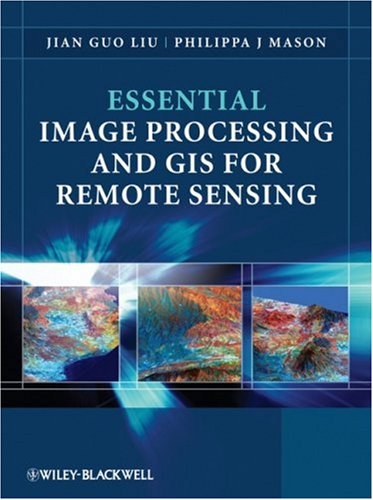
(Ebook PDF) Essential Image Processing and GIS for Remote Sensing 1st Edition by Jian Guo Liu, Philippa Mason 0470510315 9780470510315 Full chapter

Original price was: $50.00.$35.00Current price is: $35.00.
Essential Image Processing and GIS for Remote Sensing 1st Edition by Jian Guo Liu, Philippa J. Mason – Ebook PDF Instant Download/Delivery: 0470510315, 978-0470510315
Full dowload Essential Image Processing and GIS for Remote Sensing 1st Edition after payment
Product details:
ISBN 10: 0470510315
ISBN 13: 978-0470510315
Author: Jian Guo Liu, Philippa J. Mason
Essential Image Processing and GIS for Remote Sensing is an accessible overview of the subject and successfully draws together these three key areas in a balanced and comprehensive manner. The book provides an overview of essential techniques and a selection of key case studies in a variety of application areas.
Key concepts and ideas are introduced in a clear and logical manner and described through the provision of numerous relevant conceptual illustrations. Mathematical detail is kept to a minimum and only referred to where necessary for ease of understanding. Such concepts are explained through common sense terms rather than in rigorous mathematical detail when explaining image processing and GIS techniques, to enable students to grasp the essentials of a notoriously challenging subject area.
The book is clearly divided into three parts, with the first part introducing essential image processing techniques for remote sensing. The second part looks at GIS and begins with an overview of the concepts, structures and mechanisms by which GIS operates. Finally the third part introduces Remote Sensing Applications. Throughout the book the relationships between GIS, Image Processing and Remote Sensing are clearly identified to ensure that students are able to apply the various techniques that have been covered appropriately. The latter chapters use numerous relevant case studies to illustrate various remote sensing, image processing and GIS applications in practice.
Essential Image Processing and GIS for Remote Sensing 1st Table of contents:
-
Chapter 1: Fundamentals of Remote Sensing
- Principles of remote sensing: electromagnetic spectrum, sensors, and platforms
- Types of remote sensing data: multispectral, hyperspectral, radar, and LiDAR
- Overview of remote sensing applications in environmental monitoring, urban planning, and agriculture
-
Chapter 2: Image Processing Techniques
- Basic image processing concepts: image enhancement, filtering, and restoration
- Geometric correction and image rectification
- Radiometric correction and normalization
- Techniques for feature extraction and classification of remote sensing data
-
Chapter 3: GIS and Its Role in Remote Sensing
- Introduction to GIS: basic concepts, data models, and spatial analysis
- GIS software and tools commonly used in remote sensing applications
- The integration of GIS with remote sensing data for spatial analysis
- Case studies illustrating GIS applications in various fields (e.g., environmental management, disaster response)
-
Chapter 4: Image Classification and Interpretation
- Supervised vs. unsupervised classification techniques
- Classification algorithms (e.g., Maximum Likelihood, Decision Trees, Neural Networks)
- Accuracy assessment of classification results
- Remote sensing image interpretation for land cover mapping and change detection
-
Chapter 5: Multispectral and Hyperspectral Remote Sensing
- Basics of multispectral and hyperspectral remote sensing
- Data preprocessing techniques for multispectral and hyperspectral imagery
- Applications in environmental monitoring, agriculture, and vegetation analysis
-
Chapter 6: Time-Series Analysis and Change Detection
- Time-series analysis in remote sensing for monitoring dynamic environments
- Techniques for detecting and analyzing land-use/land-cover changes over time
- Case studies on monitoring deforestation, urban growth, and agricultural expansion
-
Chapter 7: Remote Sensing for Environmental Monitoring
- Remote sensing applications in climate change, pollution monitoring, and resource management
- Vegetation indices (e.g., NDVI) and their use in environmental monitoring
- Monitoring water bodies, wetlands, and coastal zones with remote sensing data
-
Chapter 8: Advanced Image Processing Techniques
- Image segmentation, object-based image analysis, and texture analysis
- Machine learning and deep learning techniques for remote sensing data analysis
- Advanced topics in change detection and multi-temporal analysis
-
Chapter 9: GIS-Based Spatial Analysis and Modeling
- Spatial analysis techniques in GIS (buffering, overlay, spatial interpolation)
- Modeling and simulation in GIS for decision support systems
- Geospatial modeling for land-use planning and environmental management
-
Chapter 10: Integrating Remote Sensing, GIS, and Field Data
- Data fusion techniques: combining remote sensing, GIS, and field data for comprehensive analysis
- Sensor fusion: combining multiple sensor data for more accurate interpretations
- Ground truthing and validation of remote sensing and GIS data
-
Chapter 11: Applications of Remote Sensing and GIS in Real-World Scenarios
- Case studies in disaster management (e.g., flood monitoring, wildfire detection)
- Agricultural applications (e.g., crop health monitoring, precision farming)
- Urban studies and land-use planning with remote sensing and GIS
-
Conclusion: Future Trends in Remote Sensing, Image Processing, and GIS
- Emerging technologies and methodologies in remote sensing and GIS
- The future of satellite and UAV-based remote sensing
- Trends in artificial intelligence and machine learning for remote sensing applications
People also search for Essential Image Processing and GIS for Remote Sensing 1st:
the essential guide to image processing pdf
essential imaging the woodlands
basic image import processing and export
what are the essential art supplies
essentials of digital imaging module 2
Tags:
Jian Guo Liu,Philippa Mason,Essential,Image,Processing,GIS,Remote Sensing 1st