
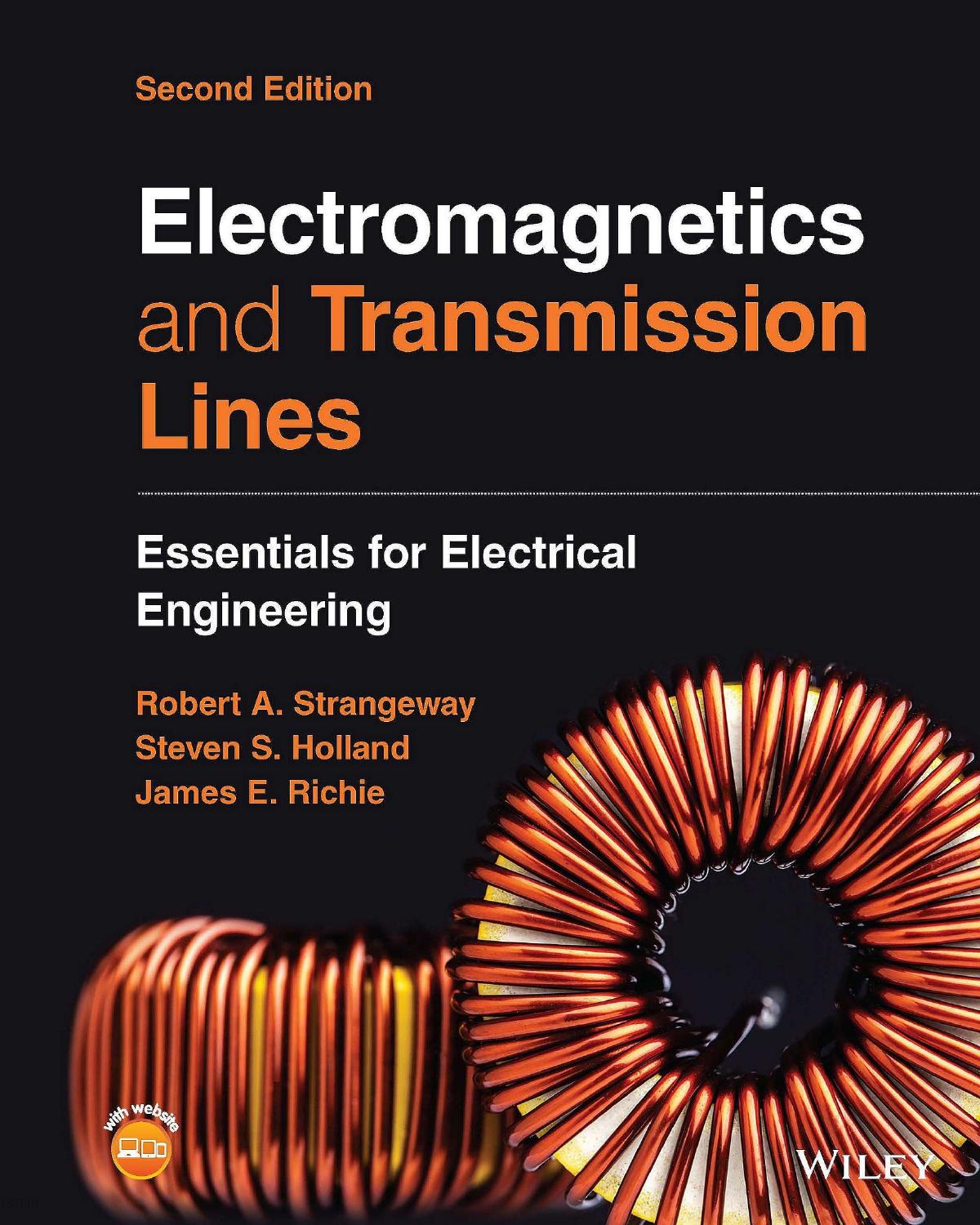
Electromagnetics and Transmission Lines Essentials for Electrical Engineering 2nd Edition by Robert Strangeway, James Elwood Richie, Steven Sean Holland ISBN 978-1119881902 1119881900
Original price was: $50.00.$35.00Current price is: $35.00.
Electromagnetics and Transmission Lines Essentials for Electrical Engineering 2nd Edition by Robert A. Strangeway, James Elwood Richie, Steven Sean Holland- Ebook PDF Instant Download/Delivery: 978-1119881902, 1119881900
Full download Electromagnetics and Transmission Lines Essentials for Electrical Engineering 2nd Edition after payment
Product details:
ISBN 10: 1119881900
ISBN 13: 978-1119881902
Author: Robert A. Strangeway, James Elwood Richie, Steven Sean Holland
Electromagnetics and Transmission Lines
Textbook resource covering static electric and magnetic fields, dynamic electromagnetic fields, transmission lines, antennas, and signal integrity within a single course
Electromagnetics and Transmission Lines provides coverage of what every electrical engineer (not just the electromagnetic specialist) should know about electromagnetic fields and transmission lines. This work examines several fundamental electrical engineering concepts and components from an electromagnetic fields viewpoint, such as electric circuit laws, resistance, capacitance, and self and mutual inductances. The approach to transmission lines (T-lines), Smith charts, and scattering parameters establishes the underlying concepts of vector network analyzer (VNA) measurements. System-level antenna parameters, basic wireless links, and signal integrity are examined in the final chapters.
As an efficient learning resource, electromagnetics and transmission lines content is strategically modulated in breadth and depth towards a single semester objective. Extraneous, distracting topics are excluded. The wording style is somewhat more conversational than most electromagnetics textbooks in order to enhance student engagement and inclusivity while conveying the rigor that is essential for engineering student development. To aid in information retention, the authors also provide supplementary material, including a homework solutions manual, lecture notes, and VNA experiments.
Sample topics covered in Electromagnetics and Transmission Lines include:
- Vector algebra and coordinate systems, Coulomb’s law, Biot-Savart law, Gauss’s law, and solenoidal magnetic flux
- Electric potential, Ampere’s circuital law, Faraday’s law, displacement current, and the electromagnetic principles underlying resistance, capacitance, and self and mutual inductances
- The integral form of Maxwell’s equations from a conceptual viewpoint that relates the equations to physical understanding (the differential forms are also included in an appendix)
- DC transients and AC steady-state waves, reflections, and standing waves on T-lines
- Interrelationships of AC steady-state T-line theory, the Smith chart, and scattering parameters
- Antenna basics and line-of-sight link analysis using the Friis equation
- An introduction to signal integrity
Electromagnetics and Transmission Lines is an authoritative textbook learning resource, suited perfectly for engineering programs at colleges and universities with a single required electromagnetic fields course. Student background assumptions are multivariable calculus, DC and AC electric circuits, physics of electromagnetics, and elementary differential equations.
Table of contents:
1 Vectors, Vector Algebra, and Coordinate Systems
1.1 Vectors
1.2 Vector Algebra
1.2.1 Dot Product
1.2.2 Cross Product
1.3 Field Vectors
1.4 Cylindrical Coordinate System, Vectors, and Conversions
1.4.1 Cartesian (Rectangular) Coordinate System: Review
1.4.2 Cylindrical Coordinate System
1.5 Spherical Coordinate System, Vectors, and Conversions
1.6 Summary of Coordinate Systems and Vectors
1.7 Homework
Part 1 Static Electric and Magnetic Fields
2 The Superposition Laws of Electric and Magnetic Fields
2.1 Point Electric Charges, Coulomb’s Law, and Electric Fields
2.2 Electric Charge Distributions and Charge Density
2.3 Coulomb’s Law in Integral Form and Examples
2.4 Introduction to Magnetostatics and Current Density
2.5 Biot–Savart Law and Examples for Line Currents
2.6 Summary of Important Equations
2.7 Homework
3 The Flux Laws of Electric and Magnetic Fields
3.1 An Intuitive Development of Electric Flux and Gauss’s Law
3.1.1 A First Look at Electric Flux Density
3.1.2 Electric Flux and Gauss’s Law
3.2 Practical Determination of Electric Fields Using Gauss’s Law
3.3 Determination of Charge from Electric Fields
3.4 Magnetic Flux
3.5 Summary of Important Equations
3.6 Homework
4 The Path Laws and Circuit Principles
4.1 Electric Potential (Voltage) and Kirchhoff’s Voltage Law
4.1.1 Potential–Electric Field Relationship
4.1.2 Kirchhoff’s Voltage Law (KVL)
4.1.3 Dielectric–Conductor Electric Field Boundary Conditions
4.2 Capacitance
4.2.1 Determination of Capacitance
4.2.2 Dielectrics and Permittivity
4.2.3 Energy Storage in Electric Fields
4.3 Resistance
4.4 Ampere’s Circuital Law (ACL)
4.4.1 An Intuitive Development of ACL
4.4.2 Using ACL to Determine H
4.5 Inductance
4.5.1 Determination of Inductance
4.5.2 Magnetic Materials and Permeability
4.5.3 Magnetic Field Boundary Conditions
4.5.4 Energy Storage in a Magnetic Field
4.6 Summary of Important Equations
4.7 Appendices
Appendix 4.A Dielectric–Dielectric Electric Field Boundary Conditions
Appendix 4.B Development of Relative Permittivity
Appendix 4.C Development of Resistance
Appendix 4.D Introduction to Magnetic Circuits
4.8 Homework
Problems for Appendix 4.D
Part 2 Time-Changing Electric and Magnetic Fields
5 Maxwell’s Equations
5.1 Introduction to Time-Changing Electromagnetic Fields
5.2 Faraday’s Law
5.2.1 Lorentz Force Law and Induced Voltage
5.2.2 Time-Changing Magnetic Fields
5.2.3 Another Look at Kirchhoff’s Voltage Law
5.2.4 Another Look at the Inductor
5.2.5 The Ideal Transformer
5.2.6 Mutual Inductors
5.3 Displacement Current
5.3.1 Time-Changing Electric Fields
5.3.2 Another Look at the Capacitor
5.3.3 Mutual Capacitance
5.4 Chapter Summary: Maxwell’s Equations in Integral Form
5.5 Appendices
Appendix 5.A A Faraday’s Law Thought Experiment
Appendix 5.B Maxwell’s Equations in Differential Form
Appendix 5.C Continuity Equation and KCL
5.6 Homework
6 Transmission Lines: Waves and Reflections
6.1 Transient Waves in DC Circuits
6.1.1 Propagation of Waves in DC Circuits
6.1.2 Reflection of Waves in DC Circuits
6.2 Introduction to AC Wave Phenomena
6.2.1 Traveling Waves
6.2.2 Wavelength and Distance Considerations
6.2.3 Electromagnetic (EM) Fields on a Transmission Line
6.3 Reflections in AC Transmission Line Circuits
6.3.1 Reflected Waves and Measures of Reflection
6.3.2 Smith Chart: Impedance and Measures of Reflection
6.4 Scattering Parameters (S-parameters)
6.4.1 Power, Gain, and Loss
6.4.2 S-parameter Definitions
6.4.3 S-Parameter Examples
6.4.4 Vector Network Analyzer
6.5 Summary of Important Equations
6.6 Appendix: dBm “Dos” and dBm “Don’ts”
6.7 Homework
7 Transmission Lines: Theory and Applications
7.1 A Circuit Model for AC Transmission Lines
7.2 Voltage and Current Solutions for a Lossless Transmission Line
7.3 Interpreting the Voltage and Current Solutions
7.4 Lossy Transmission Line Solutions
7.5 Practical Transmission Line Calculations and Insights
7.5.1 Transmission Line Impedance Expression
7.5.2 Special Case of Lossless Transmission Lines
7.5.3 Standing Wave Patterns
7.5.4 Reflection Coefficient vs. Position
7.6 Smith Chart Revisited: Electrical Distance
7.6.1 Rotation on the Smith Chart – an Electrical Distance Perspective
7.6.2 Lossy Transmission Line Traces on a Smith Chart
7.7 Determining Load Impedance from Input Impedance
7.8 Summary of Important Equations
7.9 Appendices
Appendix 7.A Conversion of Maxwell’s Equations into the Telegrapher’s Equations
Appendix 7.B Development of the Particular Solutions for T-line Waves
Appendix 7.C Alternate Development of Reflection Coefficient vs. Position
7.10 Homework
8 Antennas and Links
8.1 Introduction to Antennas
8.1.1 An Intuitive Transition from a Transmission Line to an Antenna
8.1.2 Antenna Concepts
8.2 Uniform Plane Waves
8.2.1 Comparison of Uniform Plane Wave and Transmission Line Solutions
8.2.2 The Poynting Vector and Electromagnetic Wave Power
8.2.3 Polarization
8.3 Antenna Parameters
8.3.1 Antenna Gain
8.3.2 Radiation Patterns
8.3.3 Radiation Resistance and VSWR
8.4 Links
8.4.1 Free-Space Loss
8.4.2 Friis Transmission Equation for Link Loss
8.5 Summary of Important Equations
8.6 Homework
9 Signal Integrity
9.1 Introduction to Signal Integrity
9.2 Transmission Line Effects
9.3 Crosstalk
9.3.1 Electric and Magnetic Field Coupling
9.3.2 Shielding
9.4 Electromagnetic Interference
9.4.1 Overview
9.4.2 EMI Measurements
9.5 Power/Ground Switching Noise
9.6 Summary of Important Equations
9.7 Homework
People also search for:
electromagnetics and transmission
basics of electromagnetics and transmission lines
electromagnetics and transmission lines
electromagnetics and transmission lines pdf
electromagnetics and transmission lines essentials for electrical engineering
Tags: Robert Strangeway, James Elwood Richie, Steven Sean Holland, Electromagnetics and Transmission, Electrical Engineering