
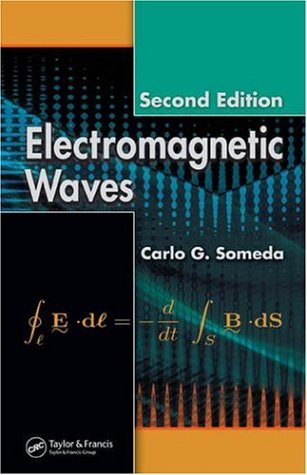
Electromagnetic Waves Second Edition by Carlo Someda ISBN 978-0849395895 0849395895


Original price was: $50.00.$35.00Current price is: $35.00.
Electromagnetic Waves Second Edition by Carlo G. Someda- Ebook PDF Instant Download/Delivery: 978-0849395895, 0849395895
Full download Electromagnetic Waves Second Edition after payment
Product details:
ISBN 10: 0849395895
ISBN 13: 978-0849395895
Author: Carlo G. Someda
Adapted from a successful and thoroughly field-tested Italian text, the first edition of Electromagnetic Waves was very well received. Its broad, integrated coverage of electromagnetic waves and their applications forms the cornerstone on which the author based this second edition. Working from Maxwell’s equations to applications in optical communications and photonics, Electromagnetic Waves, Second Edition forges a link between basic physics and real-life problems in wave propagation and radiation. Accomplished researcher and educator Carlo G. Someda uses a modern approach to the subject. Unlike other books in the field, it surveys all major areas of electromagnetic waves in a single treatment. The book begins with a detailed treatment of the mathematics of Maxwell’s equations. It follows with a discussion of polarization, delves into propagation in various media, devotes four chapters to guided propagation, links the concepts to practical applications, and concludes with radiation, diffraction, coherence, and radiation statistics. This edition features many new and reworked problems, updated references and suggestions for further reading, a completely revised appendix on Bessel functions, and new definitions such as antenna effective height. Illustrating the concepts with examples in every chapter, Electromagnetic Waves, Second Edition is an ideal introduction for those new to the field as well as a convenient reference for seasoned professionals.
Table of contents:
BASIC EQUATIONS FOR ELECTROMAGNETIC FIELDS
-
Introduction: Experimental Laws
-
Maxwell’s Equations and the Charge Continuity Equation
-
Constitutive Relations
-
Imposed Currents
-
Divergence Equations
-
Continuity Conditions
-
The Wave Equation. The Helmholtz Equation
-
Magnetic Vector Potential
-
Fitzgerald Electric Vector Potential
-
Hertz Vector Potential
-
Further Applications and Suggested Reading
-
References
POLARIZATION
-
Introduction
-
Steinmetz Representation of Time-Harmonic Vectors
-
Parallel and Orthogonal Complex Vectors
-
Properties of Time-Harmonic Vectors
-
Properties of the Complex Vectors
-
Linear Polarization Ratio
-
Circular Polarization Ratio
-
Stokes Parameters
-
The Poincaré Sphere
-
Evolution of Polarization in a Linear Medium: Jones Matrix
-
Further Applications and Suggested Reading
-
References
GENERAL THEOREMS
-
Introduction
-
Poynting’s Theorem. Wave Impedance
-
Uniqueness Theorem
-
Reciprocity Theorem
-
Equivalence Theorem
-
Induction Theorem
-
Duality Theorem
-
TE-TM Field Decomposition Theorem
-
Spatial Symmetries. Reflection Operators
-
Further Applications and Suggested Reading
-
References
PLANE WAVES IN ISOTROPIC MEDIA
-
Separability of Variables in the Homogeneous Helmholtz Equation
-
Solution of the Homogeneous Helmholtz Equation in Cartesian Coordinates
-
Plane Waves: Terminology and Classification
-
Traveling Waves. Phase Velocity
-
Standing Waves
-
Poynting Vector and Wave Impedance
-
Completeness of Plane Waves
-
Reflection and Refraction of Plane Waves
-
Fresnel Formulas
-
Reflection in Multilayer Structures
-
Total Reflection
-
Reflection on the Surface of a Good Conductor
-
Further Applications and Suggested Reading
-
References
PLANE WAVE PACKETS AND BEAMS
-
Modulated Waves. Group Velocity
-
Dispersion
-
The Scalar Approximation
-
The Equations of Geometrical Optics
-
Geometrical Optics: Electromagnetic Implications
-
Examples of Ray Tracing in Radio Propagation and in Optics
-
The WKBJ Method
-
Further Comments on the WKBJ Method
-
Gaussian Beams
-
Hermite-Gauss and Laguerre-Gauss Modes
-
Reflection and Refraction of Gaussian Beams
-
On the Completeness of a Series
-
Further Comments on Rays and Beams
-
Further Applications and Suggested Reading
-
References
PLANE WAVES IN ANISOTROPIC MEDIA
-
General Properties of Anisotropic Media
-
Wave Equations and Potentials in Anisotropic Media
-
Birefringent Media
-
Fresnel’s Equation of Wave Normals
-
An Application: Phase Matching of Two Waves
-
Gyrotropic Media
-
The Appleton-Hartree Formula
-
An Example of Permittivity Dyadic
-
Second Example of Permeability Dyadic
-
Faraday Rotation
-
Further Applications and Suggested Reading
-
References
WAVEGUIDES WITH CONDUCTING WALLS
-
Introduction
-
Homogeneously Filled Cylindrical Structures: Simplified Proof of the TE-TM Decomposition Theorem
-
Waveguides with Ideal Conducting Walls
-
Transmission Modes of Lossless Cylindrical Structures
-
Mode Orthogonality
-
Some Remarks on Completeness
-
Rectangular Waveguides
-
Circular Waveguides and Coaxial Cables
-
Waveguides with Nonideal Walls
-
On Wall Impedances
-
Hybrid Modes
-
Further Applications and Suggested Reading
-
References
WAVES ON TRANSMISSION LINES
-
Introduction
-
Uniform Transmission Lines
-
Impedance Transformation Along a Transmission Line
-
Lossless Transmission Lines
-
Low-Loss Transmission Lines
-
Partially Standing Waves
-
The Smith Chart
-
Remote Measurement of the Load Impedance
-
Impedance Matching
-
Transmission-Line Equations: An Alternative Derivation
-
TEM and Quasi-TEM Propagation in Planar Lines
-
The Coupled-Mode Equations
-
Further Applications and Suggested Reading
-
References
RESONANT CAVITIES
-
Introduction
-
Separable Coordinate Systems in Three Dimensions
-
Completeness of Resonator Modes
-
Mode Orthogonality in a Perfect Resonator
-
Lossless Cylindrical Cavities
-
Simple Examples
-
Lossy Resonators: Perturbation Analysis. Intrinsic Q-Factor
-
Resonators Coupled to External Loads. Loaded Q-Factor
-
Open Resonators
-
Stability of Open Resonators
-
Q-Factor of an Open Resonator
-
Further Applications and Suggested Reading
-
References
DIELECTRIC WAVEGUIDES
-
Introduction
-
Waves Guided by a Surface of Discontinuity: The Characteristic Equation
-
Guided Modes of a Slab Waveguide
-
Radiation Modes of a Slab Waveguide
-
The Cylindrical Rod: Exact Modes
-
Modal Cut-Off in the Cylindrical Rod
-
Weakly Guiding Rods: The LP Modes
-
Dispersion in Dielectric Waveguides
-
Graded-Index Waveguides
-
The Alpha Profiles: An Important Class of Multimode Graded-Index Fibers
-
Attenuation in Optical Fibers
-
Further Applications and Suggested Reading
-
References
RETARDED POTENTIALS
-
Introduction
-
Green’s Functions for the Scalar Helmholtz Equation
-
Lorentz-Gauge Vector Potentials in a Homogeneous Medium
-
Field Vectors in Terms of Dyadic Green’s Functions
-
Inhomogeneous Media: Polarization Currents
-
Time-Domain Interpretation of Green’s Functions
-
Green’s Function Expansion Into Orthogonal Eigenfunctions
-
An Example: Field in a Rectangular Box
-
Spherical Harmonics
-
Multipole Expansion
-
An Introduction to Cylindrical Harmonics
-
Further Applications and Suggested Reading
-
References
FUNDAMENTALS OF ANTENNA THEORY
-
Introduction
-
Equivalent Dipole Moment of an Extended Source
-
Far-Field Approximations
-
First Example: Short Electric-Current Element
-
Characterization of Antennas
-
Behavior of Receiving Antennas. Reciprocity
-
Examples
-
Antenna Arrays
-
Broad-Side and End-Fire Arrays
-
Further Applications and Suggested Reading
-
References
DIFFRACTION
-
Introduction
-
The Diffraction Integral: The Vector Formulation
-
Illumination Conditions. Babinet’s Principle
-
The Scalar Theory of Diffraction
-
Diffraction Formulas and Rayleigh-Sommerfeld
-
The Fresnel Diffraction Region
-
The Fraunhofer Diffraction Region
-
Examples
-
The Field Near a Focus: First Example of Fresnel Diffraction
-
Diffraction from a Straight Edge: Second Example of Fresnel Diffraction
-
A Short Note on the Geometrical Theory of Diffraction
-
Further Applications and Suggested Reading
-
References
AN INTRODUCTION TO THE THEORY OF COHERENCE
-
Background and Purpose of the Chapter
-
The Analytical Signal
-
Complex Degree of Coherence
-
Temporal Coherence of a Source
-
Spatial Coherence of a Source
-
Higher-Order Coherence: An Introduction
-
An Introduction to Photocount Distributions
-
Modal Noise in Optical-Fiber Transmission Systems: A Short Outline
-
Further Applications and Suggested Reading
-
References
APPENDIX A: VECTOR CALCULUS: DEFINITIONS AND FUNDAMENTAL THEOREMS
APPENDIX B: VECTOR DIFFERENTIAL OPERATORS IN FREQUENTLY USED REFERENCE SYSTEMS
APPENDIX C: VECTOR IDENTITIES
APPENDIX D: FUNDAMENTALS ON BESSEL FUNCTIONS
-
Bessel, Neumann and Hankel Functions
-
Modified Bessel Functions
-
Bessel Function Formulas
REFERENCES
FURTHER SUGGESTED READING
INDEX
People also search for:
electromagnetic waves with wavelength 10 nm are called
what are electromagnetic waves
what type of electromagnetic waves is used in radar
what do all electromagnetic waves have in common
wavelength of electromagnetic waves
Tags: Carlo Someda, Electromagnetic Waves