
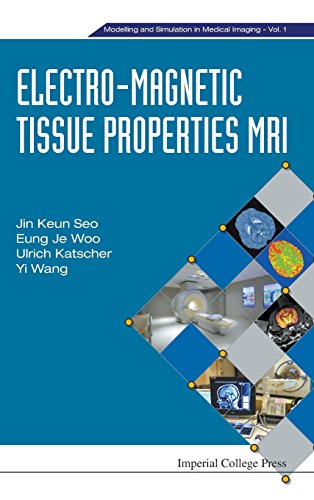
Electro Magnetic Tissue Properties MRI 1st Edition by Jin Keun Seo, Eung Je Woo, Ulrich Katscher, Yi Wang ISBN 978-1783263394 1783263393


Original price was: $50.00.$35.00Current price is: $35.00.
Electro Magnetic Tissue Properties MRI 1st Edition by Jin Keun Seo, Eung Je Woo, Ulrich Katscher, Yi Wang – Ebook PDF Instant Download/Delivery: 978-1783263394, 1783263393
Full download Electro Magnetic Tissue Properties MRI 1st Edition after payment
Product details:
ISBN 10: 1783263393
ISBN 13: 978-1783263394
Author: Jin Keun Seo, Eung Je Woo, Ulrich Katscher, Yi Wang
This is the first book that presents a comprehensive introduction to and overview of electro-magnetic tissue property imaging techniques using MRI, focusing on Magnetic Resonance Electrical Impedance Tomography (MREIT), Electrical Properties Tomography (EPT) and Quantitative Susceptibility Mapping (QSM). The contrast information from these novel imaging modalities is unique since there is currently no other method to reconstruct high-resolution images of the electro-magnetic tissue properties including electrical conductivity, permittivity, and magnetic susceptibility. These three imaging modalities are based on Maxwell’s equations and MRI data acquisition techniques. They are expanding MRI’s ability to provide new contrast information on tissue structures and functions.To facilitate further technical progress, the book provides in-depth descriptions of the most updated research outcomes, including underlying physics, mathematical theories and models, measurement techniques, computation issues, and other challenging problems.
Table of contents:
1. Introduction
1.1 Electro-magnetic Tissue Properties of Biological
Tissues
1.2 Three Electro-magnetic Tissue Property Imaging
Modalities.
1.3 Mathematical Frameworks
1.4 General Notations
2. Electro-magnetism and MRI
2.1 Basics of Electro-magnetism
2.1.1 Maxwell’s equations
2.1.2 Electric field due to point charges in free space
2.1.3 Molecular polarization
2.1.4 Electrical bioimpedance for cylindrical subjects
2.1.4.1 Conductivity and resistance
at direct current
2.1.4.2 Permittivity and capacitance
2.1.4.3 Admittivity of a material including both mobile and immobile charges
2.1.5 Boundary value problems in electrostatics
2.1.6 Time-harmonic Maxwell’s equations and eddy
current model.
2.1.7 Magnetic field created by magnetic
moment
2.2 Magnetic Resonance Imaging
2.2.1 MR signal and Larmor precession of spins ignoring relaxation effects
2.2.1.1 Larmor precession of M in an external field B
2.2.1.2 MR signal ignoring relaxation
effects
2.2.1.3 MR signal with gradient field
2.2.1.4 One-dimensional imaging with frequency encoding
2.2.1.5 Two-dimensional imaging with phase and frequency encoding
2.2.2 On-resonance RF excitation to flip M toward the zy-plane
2.2.2.1 Time-harmonic RF field B₁.
2.2.2.2 Time-harmonic RF excitation and flip angle.
2.2.3 Signal detection and RF reciprocity principle.
2.2.3.1
RF reciprocity principle
2.2.4 Relaxation effects
2.3 Fourier Transform
2.4 Image Processing
2.4.1 Diffusion techniques for denoising:
L¹ vs. L2 minimization
2.4.2 Segmentation
2.4.3 Sparse sensing
References
3. Magnetic Resonance Electrical Impedance Tomography
3.1 Overview and History of MREIT
3.2 Overall Structure of MREIT
3.3 Measurement of Internal Data B.
3.3.1 Noise analysis
3.3.2 Pulse sequence
3.4 Forward Model
3.4.1 Boundary value problem in MREIT
3.4.2 Computation of B…
3.5 Uniform Current Density Electrodes
3.5.1 Mathematical model for uniform current electrode in half space
3.5.2 Optimal geometry of non-uniform recessed electrodes
3.6 Mathematical Model of MREIT for Stable Reconstruction
3.6.1 Map from oto B. data
3.6.2 Toward uniqueness of an MREIT problem
3.6.2.1 Scaling uncertainty of o σ
3.6.2.2 Two linearly independent currents for uniqueness
3.7 MREIT with Object Rotations
3.7.1 Current density imaging
3.7.1.1 Recovering a transversal current density J having J0 using B
3.7.2 Early MREIT algorithms
3.7.3 J-substitution algorithm.
3.7.3.1 J-substitution: Uniqueness
3.7.3.2 J-substitution algorithm: Iterative scheme
3.8 MREIT Without Subject Rotation
3.8.1 Harmonic B. algorithm
3.8.1.1 Mathematical model and corresponding inverse problem
3.8.1.2 Two-dimensional MREIT model
3.8.1.3 Representation formula
3.8.1.4 Local reconstruction using harmonic B. algorithm
3.8.1.5 Conductivity reconstructor using harmonic B. algorithm
3.8.1.6 Non-iterative harmonic B algorithm with transversally dominant current density
3.8.1.7 A posteriori error estimate: two-dimensional MREIT model
3.8.2 Variational B. and gradient B decomposition algorithm
3.8.2.1 Variational B. algorithm
3.8.2.2 Gradient B. decomposition
algorithm
3.9 Anisotropic Conductivity Reconstruction
Problem
3.9.1 Definition of effective conductivity for a cubic sample
3.9.2 Anisotropic conductivity reconstruction in MREIT
3.10 Imaging Experiments
3.10.1 Phantom experiment
3.10.1.1 Non-biological phantom imaging
3.10.1.2 Biological phantom imaging
3.10.1.3 Contrast mechanism of apparent conductivity
3.10.2 Animal experiment.
3.10.2.1 Postmortem animal imaging
3.10.2.2 In vivo animal imaging
3.10.3 In vivo human imaging
3.10.4 Challenging problems and future
directions
Acknowledgments.
References
4. MR-EPT
4.1 Mathematical Model
4.1.1 Central EPT equation
4.1.2 Approximate EPT equation
4.1.3 Boundary effects
4.1.4 Anisotropy
4.1.5 Local SAR
4.2 Data Collection Method
4.2.1 Amplitude
4.2.2 Phase
4.3 Image Reconstruction
4.3.1 SNR and calculus operation kernel
4.3.2 Main field strength and SNR
4.4 Numerical Simulations
4.4.1 Head model
4.5 Experiments
4.5.1 Phantom experiments
4.5.2 Volunteer experiments
4.6 Medical Applications
4.7 Challenging Problems and Future Directions
Acknowledgments
References
5. Quantitative Susceptibility Mapping
5.1 Introduction
5.2 Mathematical Model for Relating MRI Signal to Tissue Susceptibility
5.2.1 The forward problem description
5.2.1.1 Formulation of the forward problem from tissue magnetization to MRI measured field
5.2.1.2 Inverse problem and mathematical
analysis
5.2.1.3 Ill-poised issue of the inverse problem from measured field to magnetization source
5.2.2 Solutions to the inverse problem
5.2.2.1 Morphology enabled dipole inversion (MEDI)
5.2.2.2 Other forms of prior information for dipole inversion
5.2.2.3 Condition the inverse problem well for precise solution Calculation of Susceptibility using Multiple
Orientation Sampling
(COSMOS)
5.3 Data Acquisition Method
5.4 Image Reconstruction Method
5.4.1 The MEDI reconstruction algorithm
5.4.2 Background field removal without affecting local fields
5.5 Numerical Simulation
5.6 Experimental Validation
5.6.1 Validation of the reference standard COSMOS method
5.6.2 Validation of the MEDI method
5.6.3 Clinical applications
5.6.3.1 Cerebral microhemorrhage
5.6.3.2 Hemorrhage
5.6.3.3 Deep brain stimulation
5.6.3.4 Parkinson’s disease
5.6.3.5 Multiple sclerosis
5.7 Challenging Problems and Future Directions
Acknowledgments.
References.
Index
People also search for:
electromagnetic properties of blood
electromagnetic properties of human tissue
electromagnetic properties examples
electromagnetic properties
tissue properties
Tags: Jin Keun Seo, Eung Je Woo, Ulrich Katscher, Yi Wang, Electro Magnetic, Tissue Properties