
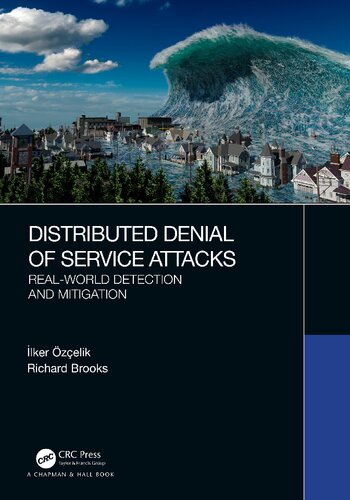
Distributed Denial of Service Attacks 1st Edition by Ilker Özçelik, Richard Brooks ISBN 978-1138626812 1138626813


Original price was: $50.00.$35.00Current price is: $35.00.
Distributed Denial of Service Attacks 1st Edition by Ilker Özçelik, Richard Brooks – Ebook PDF Instant Download/Delivery: 978-1138626812, 1138626813
Full download Distributed Denial of Service Attacks 1st Edition after payment
Product details:
ISBN 10: 1138626813
ISBN 13: 978-1138626812
Author: Ilker Özçelik, Richard Brooks
Distributed Denial of Service (DDoS) attacks have become more destructive, wide-spread and harder to control over time. This book allows students to understand how these attacks are constructed, the security flaws they leverage, why they are effective, how they can be detected, and how they can be mitigated. Students use software defined networking (SDN) technology to created and execute controlled DDoS experiments. They learn how to deploy networks, analyze network performance, and create resilient systems.
This book is used for graduate level computer engineering instruction at Clemson University. It augments the traditional graduate computing curricula by integrating: Internet deployment, network security, ethics, contemporary social issues, and engineering principles into a laboratory based course of instruction. Unique features of this book include:
A history of DDoS attacks that includes attacker motivations
Discussion of cyber-war, censorship, and Internet black-outs
SDN based DDoS laboratory assignments
Up-to-date review of current DDoS attack techniques and tools
Review of the current laws that globally relate to DDoS
Abuse of DNS, NTP, BGP and other parts of the global Internet infrastructure to attack networks
Mathematics of Internet traffic measurement
Game theory for DDoS resilience
Construction of content distribution systems that absorb DDoS attacks
This book assumes familiarity with computing, Internet design, appropriate background in mathematics, and some programming skills. It provides analysis and reference material for networking engineers and researchers. By increasing student knowledge in security, and networking; it adds breadth and depth to advanced computing curricula.
Table of contents:
Chapter 1: Introduction
1.1 Performance Testing and Analysis of DDoS Detection Approaches
1.2 Deceiving DDoS Detection
1.3 DDoS Mitigation
1.4 Organization
Chapter 2: What is DDoS?
2.1 Definition
2.2 Classification
2.2.1 Resource Saturation
2.2.1.1 System/Device Resources
2.2.1.2 Network Bandwidth
2.2.2 Exploiting Vulnerability
2.2.3 Tampering
2.2.4 Purpose
2.2.4.1 Fragmentation and Reassembly
2.2.4.2 TCP-based
2.2.4.3 Low and Slow Attacks
2.2.4.4 Filtering
2.2.4.5 Others
2.2.5 Physical Destruction
2.3 Botnet
2.3.1 Botnet Architectures
2.3.2 Botnet Topologies
2.3.2.1 Star
2.3.2.2 Multi-server
2.3.2.3 Hierarchical
2.3.2.4 Random
2.3.3 Botnet Resilience and CnC Resolution
2.3.3.1 IP Flux
2.3.3.2 Domain Flux
2.3.3.3 Blind Proxy Redirection
2.4 Attack Tools
2.4.1 Classification of Attack Tools
2.4.2 Popular Attack Tools
2.5 Problems
2.6 Glossary
Chapter 3: History and Motivation
3.1 A Brief History of Computers and Computer Crime
3.2 DDoS Tools and Technologies
3.2.1 DDoS Bots and Stressers
3.2.2 Botnets
3.2.3 Worms
3.2.4 DNS DDoS
3.2.5 BGP Exploits
3.3 DDoS History
3.3.1 Early DoS
3.3.2 Hackers
3.3.2.1 L0pht
3.3.2.2 Mafiaboy
3.3.3 Commercial Exploitation
3.3.3.1 DDoS for Hire
3.3.3.2 Ransomware
3.3.4 Censorship
3.3.4.1 Myanmar
3.3.4.2 Kyrgyzstan
3.3.4.3 Kazakh
3.3.4.4 Iran
3.3.4.5 Vietnam
3.3.4.6 Radio Free Europe/Radio Liberty
3.3.4.7 Krebs on Security
3.3.5 Cyberwar
3.3.5.1 Hainan
3.3.5.2 Estonia
3.3.5.3 Georgia
3.3.5.4 Ukraine
3.3.5.5 Israel
3.3.5.6 US and Korea
3.3.6 Hacktivism and/or Terrorism
3.3.6.1 Electronic Disturbance Theater
3.3.6.2 Electrohippies
3.3.6.3 Lufthansa
3.3.6.4 Russian Election
3.3.6.5 Chanology
3.3.6.6 CNN
3.3.6.7 Operations Titstorm and Payback
3.3.6.8 Lizard Squad
3.3.6.9 Black Lives Matter
3.3.6.10 Syrian Electronic Army
3.3.6.11 Daesh
3.3.7 Internet Blackouts
3.4 Conclusions
3.5 Problems
3.6 Glossary
Chapter 4: Legal Considerations
4.1 Introduction
4.2 Laws against DDoS
4.3 Jurisdiction
4.4 DDoS Liability
4.5 Protest
4.6 Cyberwar
4.7 Conclusion
4.8 Problems
4.9 Glossary
Chapter 5: DDoS Research – Traffic
5.1 Dataset
5.1.1 Classification
5.1.2 Features
5.2 Traffic Generation
5.2.1 Approaches
5.2.2 Tools
5.2.2.1 Stress Testing / Attack Traffic Generation Tools
5.2.2.2 Background Traffic Generation Tools
5.2.2.3 Replay Tools
5.3 (D)DoS Benchmark Datasets
5.4 Discussion
5.5 Problems
5.6 Glossary
Chapter 6: DDoS Research – Testing
6.1 Network Simulators / Emulators
6.1.1 Popular Network Simulators / Emulators
6.1.1.1 NS2
6.1.1.2 NS3
6.1.1.3 OMNET++
6.1.1.4 Shadow
6.1.1.5 GNS3
6.1.1.6 IMMUNES
6.1.1.7 CORE
6.1.1.8 Mininet
6.1.1.9 VNX
6.1.1.10 Wistar
6.2 Network Testbeds
6.2.1 Technologies and Concepts
6.2.2 Popular Network Testbeds
6.2.2.1 Emulab
6.2.2.2 PlanetLab
6.2.2.3 GENES
6.2.2.4 CREONET
6.2.2.5 FIRE
6.2.2.6 SAVI
6.2.2.7 JGN
6.3 Case Study Network Mirroring
6.3.1 Experiment Setup
6.3.2 Advantages of Experiment Setup
6.4 Problems
6.5 Glossary
Chapter 7: DDoS Research – Evaluation
7.1 Performance Evaluation Metrics
7.1.1 Detection Performance
7.1.2 Mitigation Performance
7.1.3 System Cost
7.1.4 Qualitative Evaluation
7.2 Discussion
7.3 Problems
7.4 Glossary
Chapter 8: Attack Detection
8.1 Classification of DDoS Detection Algorithms
8.2 An Empirical Study: DDoS Detection Using Operational Network Data
8.2.1 Literature
8.2.2 Background
8.2.2.1 Cumulative Sum (CUSUM)
8.2.2.2 Wavelet
8.2.2.3 Entropy
8.2.3 Performance Testing Using Operational Network Data
8.2.3.1 Traffic Volume-based Detection
8.2.3.2 Entropy-based Detection
8.2.3.3 Comparison and Discussion
8.2.4 Cusum-Entropy
8.2.4.1 Cusum Entropy Algorithm
8.3 Problems
8.4 Glossary
Chapter 9: Deceiving DDoS Detection
9.1 A Case Study: Deceiving Entropy-based DDoS Detection Systems
9.1.1 Entropy Spoofing
9.1.1.1 Controlling Entropy Value
9.1.2 Experimental Results
9.1.3 Discussion
9.2 Problems
9.3 Glossary
Chapter 10: Attack Mitigation
10.1 Classification
10.1.1 Classification based on Mitigation Time
10.1.1.1 Before An Attack (Prevention)
10.1.1.2 During An Attack (Detection)
10.1.1.3 After An Attack (Reaction / Source Identification)
10.1.2 Classification based on Deployment Type
10.1.2.1 Centralized
10.1.2.2 Distributed
10.1.3 Classification based on Deployment Location
10.1.3.1 Source-based
10.1.3.2 Destination-based
10.1.3.3 Network-based
10.1.3.4 Hybrid
10.1.4 Classification based on Reaction Place
10.1.4.1 On The Premises
10.1.4.2 In The Cloud
10.1.5 Classification based on Reaction Type
10.1.5.1 Filtering-based
10.1.5.2 Increasing Attack Surface
10.1.5.3 Moving Target
10.2 Content Delivery Networks
10.3 Deflect
10.4 DDM: Dynamic DDoS Mitigation System
10.4.1 DDM Building Blocks
10.4.1.1 Resource Manager
10.4.1.2 DNS Module
10.4.1.3 Deflect Module
10.4.1.4 Data Collection Module
10.4.1.5 Decision Module
10.4.1.6 DDM Controller
10.4.2 DDM Testing
10.4.2.1 Attack Scenarios
10.4.2.2 Test Results
10.4.3 Discussion
10.5 DDoS Mitigation Using Game Theory
10.5.1 Distributed Denial of Service Mitigation Approach Traffic Flow
10.5.1.1 Player 1 – Blue
10.5.1.2 Player 2 – Red
10.5.2 Distributed Denial of Service Mitigation Approach Reconfiguration Strategies
10.5.2.1 Game
10.5.2.2 Sum of Games and Thermographs
10.6 Economic Denial of Sustainability
10.7 Discussion and Comparison
10.8 Problems
10.9 Glossary
People also search for:
distributed denial of service attack
a distributed denial of service attack aims to
what are types of distributed denial of service ddos attacks
distributed denial of service (ddos)
distributed denial of service attack definition
Tags: Ilker Özçelik, Richard Brooks, Distributed Denial, Service Attacks