
Decision by Objectives 1st Edition by Ernest Forman, Mary Ann Selly ISBN 9810241429 978-9810241421


Original price was: $50.00.$35.00Current price is: $35.00.
Decision by Objectives 1st Edition by Ernest H. Forman, Mary Ann Selly – Ebook PDF Instant Download/Delivery: 9810241429, 978-9810241421
Full download Decision by Objectives 1st Edition after payment
Product details:
ISBN 10: 9810241429
ISBN 13: 978-9810241421
Author: Ernest H. Forman, Mary Ann Selly
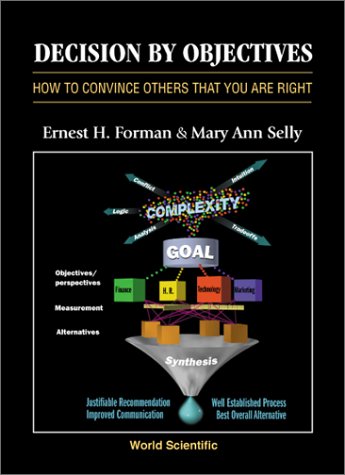
Decision-making is a process of choosing from possible courses of action in order to attain goals and objectives. Nobel laureate Herbert Simon wrote that the whole process of managerial decision-making is synonymous with the practice of management. Decision-making is at the core of all managerial functions. Planning, for example, involves the following decisions: What should be done? When? How? Where? By whom? Other managerial functions, such as organizing, implementing, and controlling, rely heavily on decision-making.Decision by Objectives is an invaluable book about the art and science of decision-making. It presents a very practical approach to decision-making that has a sound theoretical foundation, known as the analytic hierarchy process. Intended for both the student and the professional, the book includes approaches to prioritizing, evaluating alternative courses of action, forecasting, and allocating resources. By focusing on objectives rather than alternatives alone, it shows the reader how to synthesize information from multiple sources, analyses, and perspectives. The methods presented have been gaining popularity throughout the world.
Table of contents:
Chapter 1
Introduction: Management Decision-Making Today..
The Need for Better Decision-making.
Tradeoffs.
BOGSAT
Cognitive limitations..
Satisficing..
Common Simplistic Strategies.
Cognitive Decision Rules.
Unimportant vs. Crucial Decisions..
Resistance to Change.
Requisites for Change..
The Analytic Hierarchy Process..
Chapter 2
Problem Solving and Decision-Making.
Problem Solving.
Decision Making.
Intelligence, Design, Choice……
Decision-making is a Process..
Analysis vs. Synthesis..
Quantitative vs. Qualitative..
Objectivity vs. Subjectivity.
Linear versus Non-Linear..
Chapter 3
Decision-making Concepts & Methodologies..
Alternatives – Pros and Cons..
Misuse of Numbers.
Levels of Measurement
Nominal
Ordinal..
Interval..
Ratio
Weights and Scores
Channel capacity and short term memory…
Need for Hierarchical Structure..
Orders of magnitude.
Arbitrary assignment.
Absolute versus relative
Words instead of numbers.
Chapter 4
The Analytic Hierarchy Process and Expert Choice..
The Analytic Hierarchy Process..
Beyond Weights and Scores..
Inconsistency.
Causes of Inconsistency.
Clerical Error.
Lack of Information..
Lack of Concentration.
Real World Is Not Always Consistent..
Inadequate Model Structure
Compensatory and Non-Compensatory Decision-making..
Principles and Axioms of the Analytic Hierarchy Process.
Expert Choice..
Developing a Decision Hierarchy.
Goal
Objectives..
Altematives.
More Complex Hierarchies.
Establishing Priorities..
Pairwise Comparisons
Eigenvalues and Eigenvectors..
Numerical judgments..
Graphical judgments..
Verbal judgments..
Synthesis..
Sensitivity.
A Typical Application of AHP/EXPERT CHOICE.
Seven Step Process for Choice…
Other decision-making ‘recipes’
Musts and Wants.
Summary of the benefits of AHP.
Incremental Improvement.
Chapter 5
From Brainstorming to Structuring to Evaluation and Choice..
Brainstorming…
Creativity.
Narrowing Down..
Categorizing and Combining..
Voting….
Multiple Choice.
Rating
Considering Multiple Objectives.
Structuring.
Top Down Structuring..
Bottom Up Structuring.
From Pros/Cons to Objectives..
Evaluationand Choice..
Chapter 6
Other Topics/Refinements..
Missing Judgments..
Using Hard Data..
Converting to Pairwise.
Transformation of data..
Artificial Clustering of Elements – Linking Clusters..
Ratings Approach…
Absolute vs. Relative Measurement.
An Overview of a Ratings Model.
Creating the Ratings Model from Evaluation and Choice..
Using Ranges for Intensities..
Using the Same Intensities for all Objectives..
From absolute to relative measurement..
Ideal and Distributive Synthesis Modes (Preventing or allowing rank reversals)
The Cause of Rank Adjustment..
Closed and Open Systems – Scarcity and Abundance…
Closed and Open Synthesis Modes with AHP.
Illustrative Example..
When is scarcity germane?..
Summary…..
Structural adjustment/Product adjustment..
Structural adjustment..
Product Adjustment..
Complete Hierarchy.
Benefit/Cost..
Benefit/Cost/Risk
Pairwise Comparisons versus MAUT Swing Weights..
Integrating with Quantitative Methodologies..
Linear Programming..
Queueing Models..
Critical Path Method..
Forecasting.
Integer Programming.
Chapter 7
Forecasting – The Forward Process..
Illustration 1 – Synthesizing Forecasting Methods for a Compos
forecast
Illustration 2 – Selecting a Forecasting Method..
Illustration 3 – Deriving Probability Distributions..
Illustration 4 – Forecasting Alternative Outcomes..
Illustration 5 – Forecasting models interacting with choice
model(s).
Illustration 6 — Deriving Scenario Likelihoods….
Illustration 7 – Analytical Planning (The Forward/Backward Process).
Chapter 8
Resource Allocation..
Methodology Overview…
Identify/design alternatives.
Identify and structure the organization’s goals and objectives
Prioritize the objectives and sub-objectives.
Measure Alternatives’ Contributions
Find the Best Combination of Alternatives..
Discrete Alternative Resource Allocation..
Benefit/Cost Ratios-Sort and Allocate.
Maximizing Benefits– Optimization
Flexibility of Benefits Optimization Approach:.
Constraints for dependencies..
Constraints representing Synergy.
Orders of Magnitude Considerations….
Summary of B/C Ratios vs. Optimization of Benefits:
Activity Level Resource Allocation.
Benefit/Cost Ratios..
Maximizing Benefits– Optimization
Resource Allocation Summary..
Chapter 9
Meetings, Meeting Facilitation and Group Support Systems (GSS)
Groups and meetings.
Dissatisfaction with outcomes of meetings.
What is a meeting?
Meeting Model
Meeting Outcomes: Relational as well as Task…
A Meeting Facilitation Framework….
Facilitation activities by meeting stage.
Pre-meeting activities..
During Meeting activities..
Chapter 10.
Feedback.
Intuitive and Formal Feedback.
Top Down Evaluation of Bridge Selection AHP Model.
Top Down and Bottom Up
AHP with Feedback -A more formal mechanism…
Iterating for feedback.
Supermatrix for feedback.
Intuitive versus formal feedback.
The Analytic Network Process..
A Car buying example with Feedback.
Links in a Feedback Network Model
Summary of Steps in Building a Feedback Network.
Chapter 11
Empowered for the Future..
Everything That Counts..
Beyond Buzzwords.
Empowered..
People also search for:
decision making objectives examples
what is the objective of the product decision
decision-making goals and objectives examples
objectives based decision
a decision with more than one objective