
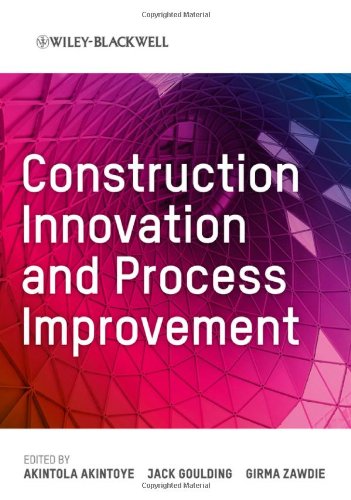
Construction Innovation and Process Improvement 1st Edition by Akintola Akintoye, Jack Goulding, Girma Zawdie ISBN 1405156481 978-1405156486


Original price was: $50.00.$35.00Current price is: $35.00.
Construction Innovation and Process Improvement 1st Edition by Akintola Akintoye, Jack Goulding, Girma Zawdie – Ebook PDF Instant Download/Delivery: 1405156481, 978-1405156486
Full download Construction Innovation and Process Improvement 1st Edition after payment
Product details:
ISBN 10: 1405156481
ISBN 13: 978-1405156486
Author: Akintola Akintoye, Jack Goulding, Girma Zawdie
Innovation in construction is essential for growth. The industry strives to remain competitive using a variety of approaches and needs to engage structured initiatives linked to proven innovation concepts, techniques and applications. Even in mature markets like the Architecture, Engineering and Construction (AEC) sector, where business behaviour is generally considered as being risk averse, it is increasingly important to embed innovation into mainstream business practices.
In Construction Innovation and Process Improvement a number of wide ranging issues from construction practice in different countries with different contexts are presented to provide a rich collection of literature embracing theory and practice.
Chapters are divided into three broad themes of construction innovation relating to: Theory and Practice; Process Drivers; and Future Technologies. Several questions are posed, including for example: What is particularly unique about construction innovation in theory and practice? What are the major drivers of construction innovation? What factors are needed to support and deliver future construction technologies?
In attempting to respond to such questions, the book sheds new light on these challenges, and provides readers with a number of ways forward, especially cognisant of the increased role of globalisation, the enhanced impact of knowledge, and importance of innovation. All these can have a significant impact on strategic decision-making, competitive advantage, and sustainable policies and practices.
Part One deals with change management, technology, sustainable construction, and supply chain management; Part Two addresses innovation and process improvement drivers, including strategic management, concurrent engineering, risk management, innovative procurement, knowledge management; Part Three explores future technologies in construction – and particularly, how these can be harnessed and leveraged to help procure innovation and process improvement.
Table of contents:
Part I Theory and Practice
Chapter 1. Construction Innovation and Process Improvement
Akintola Akintoye, Jack S. Goulding, and Girma Zawdie
1.1 Introduction
1.2 Innovation in Construction
1.3 Construction Innovation: Theory and Practice
1.4 Construction Innovation: Process Drivers
1.5 Construction Innovation: Future Technologies
1.6 Conclusion
Chapter 2. Construction Innovation through Change Management
Girma Zawdie
2.1 Introduction
2.2 The Innovation Process: Evolution as a Systemic Phenomenon
2.3 Role of Culture as Challenge for Change Management and Innovation
2.4 General Framework for Change Management
2.5 Innovation in Construction
2.6 Conclusion
Chapter 3. Construction Innovation: Theory and Practice
Martin G. Sexton and Shu-Ling Lu
3.1 Introduction
3.2 Definitional Debate on Innovation
3.3 Market-based, Resource-based and Balanced Perspectives on Innovation
3.4 Case Study of Innovation in a Small Construction Professional Service Firm
3.5 Conclusion
Chapter 4. Culture and Innovation
Anita Liu and Richard Fellows
4.1 Introduction
4.2 Culture and Construction
4.3 Culture and Innovation
4.4 Factors Affecting Innovation
4.5 Conclusion
4.6 Acknowledgements
Chapter 5. Innovation, Technology, and Knowledge Transfer for Sustainable Construction
Emilia van Egmond
5.1 Introduction
5.2 Innovation, Technology, and Knowledge Transfer Practices
5.3 Innovation, Technology, and Knowledge Transfer in Construction
5.4 The Construction Innovation System
5.5 Technological Regime in Construction
5.6 Opportunities, Appropriation, and Cumulative Effect of Innovation
5.7 Managing Innovation for Sustainable Construction: The Dutch Case
5.8 Conclusion
Chapter 6. Innovation and Value Delivery through Supply Chain Management
Derek H.T. Walker
6.1 Introduction
6.2 Organisational Value
6.3 Value Generation and SCM
6.4 Emerging Supply Chain Management Issues
6.5 Case Study of Supply Chain Management Triggering Total Business Transformation
6.6 Conclusion
6.7 Acknowledgements
Part II Process Drivers
Chapter 7. Strategic Management in Construction
Jack S. Goulding
7.1 Introduction
7.2 Construction Sector Dynamism and Drivers
7.3 Business Processes Redesign
7.4 Business Strategy
7.5 Business Performance Assessment
7.6 Strategy Development within Construction
7.7 Conclusion
Chapter 8. Risk Management in Planning for Process Improvement
Oluwaseyi Awodele, Stephen Ogunlana, and Graeme Bowles
8.1 Introduction
8.2 Process Improvement
8.3 Planning for Process Improvement
8.4 Risk and its Management
8.5 Integrating Risk Management into Planning for Process Improvement
8.6 Conclusion
Chapter 9. Modern Methods of Construction
Wafaa Nadim
9.1 Introduction
9.2 The Need for Change
9.3 Modern Methods of Construction
9.4 Open Building Manufacturing – ManuBuild Project
9.5 Offsite Production in the UK Construction Industry
9.6 Conclusion
Chapter 10. Construction Innovation through Knowledge Management
Charles Egbu
10.1 Introduction
10.2 Knowledge and Knowledge Management – Context and Definition
10.3 Knowledge Management and Innovations in Project-Based Environments
10.4 Managing Knowledge in Construction: Challenges Facing Project-Based Organisations
10.5 Knowledge Management Strategy – Issues and Contexts
10.6 Knowledge Management Techniques and Technologies
10.7 Effective Knowledge Management Practices in Turbulent Economic and Market Conditions
10.8 Conclusion
Chapter 11. Innovation through Collaborative Procurement Strategy and Practices
Akintola Akintoye and Jamie Main
11.1 Introduction
11.2 Construction Procurement and the Procurement Cycle
11.3 Procurement Strategies
11.4 Conventional Procurement Methods
11.5 Collaborative Procurement or Innovation Procurement Methods
11.6 Conclusion
Chapter 12. Concurrent Engineering in Construction
Chimay J. Anumba and John M. Kamara
12.1 Introduction
12.2 The Concept of Concurrent Engineering
12.3 Implementation of CE
12.4 Benefits of Concurrent Engineering
12.5 CE in Construction
12.6 Critical Enablers of CE Adoption in the Construction Industry
12.7 Overcoming Barriers to CE Adoption
12.8 Benefits of CE to the Construction Industry
12.9 Conclusion
12.10 Acknowledgement
Chapter 13. Complexity Theory: Implications for the Built Environment
Mark D. Sharp
13.1 Introduction
13.2 Complexity Overview
13.3 Complexity in the Built Environment
13.4 Complexity in Organisations
13.5 Toolkits
13.6 Complex Innovation in Organisations
13.7 Conclusion
Part III Future Technologies
Chapter 14. Design Innovation: Advanced Visualisation Futures
Farzad Pour Rahimian
14.1 Introduction
14.2 Design Innovation and Existing Visualisation Tools
14.3 Cognitive Approach to Design
14.4 Virtual Reality Interfaces within Conceptual Architectural Design
14.5 Technical Implications for Developing Tangible Virtual Reality Design Interfaces
14.6 Conclusion
Chapter 15. Virtual Planning and Knowledge-Based Decision Support
Joseph H.M. Tah
15.1 Introduction
15.2 The Complex Nature of Construction Projects
15.3 Construction Planning and Virtual Prototyping
15.4 Building Information Modelling
15.5 Interoperability and Industry Foundation Classes
15.6 Knowledge-Based Decision Support for Virtual Prototyping
15.7 The Promotion of Innovation through Virtual Planning in Practice
15.8 Conclusion
Chapter 16. E-Readiness in Construction
Eric Lou, Mustafa Alshawi, and Jack S. Goulding
16.1 Challenges Facing the Construction Industry
16.2 Business Dynamics and Technology
16.3 Building ICT Capability
16.4 Business Process and ICT
16.5 People and ICT
16.6 Business Process and Implementation
16.7 E-Readiness
16.8 Organisational E-Readiness in Construction
16.9 Conclusion
Chapter 17. Building Information Modelling
Umit Isikdag, Jason Underwood, and Murat Kuruoglu
17.1 Introduction
17.2 Background
17.3 A Case Study on the Implementation of BIM
17.4 Building Information Modelling in the UK
17.5 Innovation through BIM
17.6 Conclusion
Chapter 18. Industry Preparedness: Advanced Learning Paradigms for Exploitation
Jack S. Goulding and Farzad Pour Rahimian
18.1 Introduction
18.2 Learning and Training Developments and Opportunities
18.3 Virtual Reality Systems
18.4 Case Study
18.5 Conclusion
18.6 Acknowledgements
People also search for:
construction innovation examples
construction innovation ideas
innovation and continuous improvement examples
construction innovation
construction management innovation
Tags:
Akintola Akintoye,Jack Goulding,Girma Zawdie,Construction Innovation,Process Improvement