
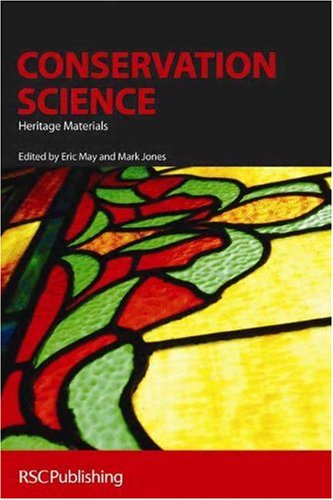
Conservation Science Heritage Materials 1st Edition by Eric May, Mark Jones ISBN 0854046593 978-0854046591

Original price was: $50.00.$35.00Current price is: $35.00.
Conservation Science Heritage Materials 1st Edition by Eric May, Mark Jones – Ebook PDF Instant Download/Delivery: 0854046593, 978-0854046591
Full download Conservation Science Heritage Materials 1st Edition after payment
Product details:
ISBN 10: 0854046593
ISBN 13: 978-0854046591
Author: Eric May, Mark Jones
Conservation of artefacts and heritage materials is an increasingly popular and fascinating area, spanning both historical and scientific disciplines. Materials come in many forms ranging from sunken ships to tapestries, from buildings to books. With this wide range of matrices and materials to analyse and preserve, an interdisciplinary approach is needed drawing upon skills from many areas of knowledge. Conservation Science: Heritage Materials links these fields of research together forming a comprehensive text book that discusses analytical aspects, wall paintings, organic and inorganic materials. It provides up to date information on subjects including research on decay and degradation and an understanding of the deterioration mechanisms of historic and artistic works. Also included are a number of case studies of particularly important finds including the upkeep of the Mary Rose and the preservation of the sail on Nelsons ship HMS Victory. This book provides an essential guide and reference source for those working in all areas of heritage conservation.
Table of contents:
Chapter 1 Introduction
Margaret Rule
Cultural Heritage: The Archaeologist, the Conservator and the Public – An Essential Coalition
1.1 The Archaeologist
1.2 The Conservator
From Discovery to Display
2.1 Special Problems of Underwater Recovery
2.2 The Raising of the Mary Rose: A Case Study
2.3 Preservation of the Evidence:
A Multi-discipline Task
Conservation with a Purpose
Museums: The Past into the Future
References and Further Reading
Chapter 2 Methods in Conservation
A. Elena Charola and Robert J. Koestler
Introduction
Preliminary Examination
Analytical Methods
3.1 Interaction of Radiation with Matter
3.2 Interaction of Elemental Particles with Matter
3.3 Dating Methods
Diagnosis of Deterioration Processes
Conservation Treatments
5.1 Cleaning
5.2 Desalination
5.3 Consolidation
5.4 Disinfestation
Preventive Conservation
Chapter 3 Paper
Vincent Daniels
The Constituents of Paper
1.1 Fibres
1.2 Paper Size
The Directional Properties of Paper
How Paper Interacts with Water
Deterioration of Paper
4.1 Acid-Catalysed Hydrolysis of Cellulose
4.2 Oxidation of Cellulose
Deacidification
Bleaching and Washing of Paper to Remove Discolouration
Foxing
Accelerated Ageing Tests
Safe Environments for Paper
Methods for Monitoring the Deterioration of Paper
10.1 Physical Measurements
10.2 Chemical Methods
Characterisation of Paper
Conclusions
References and Further Reading
Chapter 4 Textiles
Paul Garside and Paul Wyeth
The Variety of Textiles
Textile Materials
Case Study 1: Linen Fibres and the Victory Sail
3.1 The Chemical Composition and Microstructure of Linen
3.2 The Mechanical Performance of the Victory Sail
3.3 Degradation of Cellulosic Fibres
3.4 Acidity Measurements on the Victory Sail
3.5 Conservation and Display of the Victory Fore Topsail
Case Study 2: Silk Fibres and the Shackleton Ensign
4.1 The Chemical Composition and Microstructure of Silk
4.2 Silk Processing for Use as a Textile Fibre
4.3 The Condition of the Shackleton Ensign
4.4 Assessing the Condition of Silk by Microanalytical Techniques
4.5 Degradation of Silk Fibres
4.6 Conservation Treatment of the Shackleton Ensign
Case Study 3: Wool Fibres and the Tree of Jesse Tapestry
5.1 The Chemical Composition and Microstructure of Wool
5.2 Wool as a Textile Fibre
5.3 Degradation of Wool
5.4 Assessing the Condition of Wool by Microanalytical Techniques
5.5 Conservation and Treatment of the Tree of Jesse Tapestry
Conclusions
Acknowledgements
References and Further Reading
Chapter 5 Leather
Roy Thomson
Introduction
The Nature and Properties of Leather
2.1 Criteria which Define Tannage
2.2 Collagen
2.3 Tanning Materials
The Manufacture of Leather
3.1 Vegetable Tanning Processes
3.2 Alum Tawing
3.3 Oil Tannage
3.4 Fur Dressing
The Deterioration of Leather
4.1 Physical Deterioration
4.2 Biological Deterioration
4.3 Chemical Deterioration
Conservation Techniques
5.1 Biological Deterioration
5.2 Chemical Deterioration
Conclusions
Chapter 6 Metals
Desmond Barker
Introduction
1.1 Extraction
1.2 Metallurgy
Corrosion
Field Treatment and Transportation
Conservation
4.1 Acid Pickling
4.2 Aqueous Washing
4.3 Electrolytic Conservation
4.4 Hydrogen Reduction
Stabilisation and Consolidation
Conclusions
References and Further Reading
Chapter 7 Glass and Ceramics
Hannelore Römich
Introduction
Deterioration and Conservation of Glass
2.1 History of Glassmaking
2.2 Chemical Composition, Structure, and Physical Properties
2.3 Degradation Mechanisms: Basic Reactions in Water
2.4 Degradation of Objects Indoors
2.5 Weathering of Stained Glass Windows
2.6 Degradation of Archaeological Glasses
2.7 Conservation Materials: Coatings, Consolidants, Adhesives
2.8 Restoration and Cleaning
2.9 Conditions for Storage and Display
Deterioration and Conservation of Ceramics
3.1 History and Technology
3.2 Raw Materials
3.3 Firing Process
3.4 Colouration and Glazes
3.5 Dating and Provenance
3.6 Deterioration
3.7 Restoration and Conservation
Conclusions
Chapter 8 Plastics
Yvonne Shashoua
Plastics in Heritage Collections
The Chemistry and Physics of Plastics
2.1 Preparation of Polymers
2.2 Additives
2.3 Shaping Plastics
Identification of Plastics
3.1 Simple Tests
3.2 Analytical Techniques
Degradation of Plastics
4.1 Degradation of Cellulose Nitrate
4.2 Degradation of Cellulose Acetate
4.3 Degradation of Plasticised PVC
4.4 Degradation of Polyurethane Foam
Conservation of Plastics
5.1 Conservation of Cellulose Nitrate
5.2 Conservation of Cellulose Acetate
5.3 Conservation of Plasticised PVC
5.4 Conservation of Polyurethane Foam
Conclusions
References and Further Reading
Chapter 9 Stone
Robert Inkpen and Eric May
Introduction
The Degradation ‘Equation’
2.1 Material
2.2 Process
2.3 Environment
2.4 Limestone Weathering in an Urban Environment: Illustration of the Interaction of the Three Factors
Microorganisms and Stone Decay
3.1 Light-dependent Microbial Growths
3.2 Organics-dependent Microbial Growths
3.3 Inorganics-dependent Microbial Growths
3.4 Stone Colonisation and Biofilms
3.5 Interactions of Microbes with Stone Salts
Conservation Practices
4.1 Identification
4.2 Prevention
Chapter 10 Wall Paintings: Aspects of Deterioration and Restoration
Karin Petersen
Introduction
Wall Paintings as an Integral Part of Buildings
Damaging Processes
3.1 Deterioration by Soluble Salts
3.2 Deterioration by Microorganisms
Cleaning and Consolidation
4.1 Consolidation
4.2 Cleaning Methodologies
Conclusions
References and Further Reading
Chapter 11 Conservation of Ancient Timbers from the Sea
Mark Jones and Rod Eaton
Introduction
The Biodeteriogens
2.1 Marine Wood-Boring Animals
2.2 Lignolytic Marine Microorganisms
2.3 Erosion Bacteria
2.4 Tunnelling Bacteria
2.5 Cavitation Bacteria
2.6 Bacterial Symbionts of Shipworm
2.7 Soft Rot Fungi
2.8 Basidiomycete Fungi
2.9 Insect Borers
Wood Structure
3.1 Archaeological Wood Recovered from the Marine Environment
3.2 Properties and Condition of Waterlogged Archaeological Wood
3.3 Storage of Waterlogged Archaeological Wood
Chapter 12 In-situ Preservation of Waterlogged Archaeological Sites
David Gregory and Henning Matthiesen
Introduction
Environmental Monitoring
2.1 Water Level
2.2 Pore Water Composition
2.3 Redox Potential (Eh)
2.4 pH
Deterioration of Modern Materials Analogous to Artefacts
What does Environmental Monitoring Alone Tell us?
4.1 Case Study: In-situ Preservation of the Site of Nydam
4.2 Deterioration and Protection of Wooden Artefacts
4.3 Deterioration of Iron Artefacts
Conclusions
References and Further Reading
People also search for:
motivating people to be physically active 2nd edition
motivating people to be physically active pdf
what are people’s motivations
what can motivate a person
motivating person
Tags:
Eric May,Mark Jones,Conservation Science,Heritage Materials