
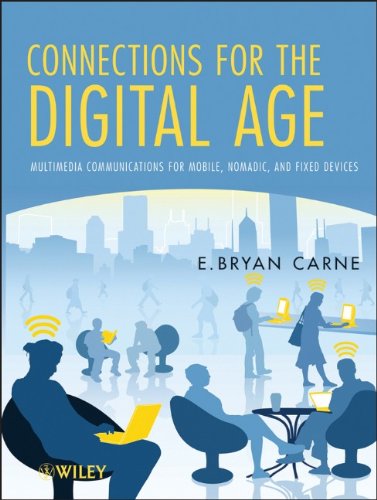
Connections for the Digital Age Multimedia Communications for Mobile Nomadic and Fixed Devices 1st Edition by Bryan Carne ISBN 978-1118104545 1118104545
Original price was: $50.00.$35.00Current price is: $35.00.
Connections for the Digital Age Multimedia Communications for Mobile Nomadic and Fixed Devices 1st Edition by E. Bryan Carne – Ebook PDF Instant Download/Delivery: 978-1118104545, 1118104545
Full download Connections for the Digital Age Multimedia Communications for Mobile Nomadic and Fixed Devices 1st Edition after payment
Product details:
ISBN 10: 1118104545
ISBN 13: 978-1118104545
Author: E. Bryan Carne
Explores and analyzes past and current technologies and trends in multimedia communication
Digital natives—those persons born in the digital age—have an ever-widening range of wireless-enabled devices at their disposal. They are the drivers of multimedia communications, continually seeking out the technologies and distribution channels that best match their needs. This book outlines the changes in telecommunications that are occurring to meet these needs. It addresses the continually increasing requirement to provide connections that make the electronic encounter as natural and convenient as possible, exploring the vast assortment of devices that exist as part of everyday living for digital natives.
Featuring precise diagrams and tables to illustrate the evolving environment, the book begins by describing the competitive interactions of telephone, cable TV, and cellular mobile companies in providing services and content. It outlines the creation of digital multimedia streams and how they are transported, explains what multimedia connections are available, and summarizes the activities of competitors while providing an overview of their markets and customer statistics.
This book uniquely covers wireline, optical fiber, cable, and wireless access methods, explaining the coding required to create digital streams. It combines ethernet with provider bridging and multi-protocol label switching and highlights the necessity to serve legacy streams. In addition, the book addresses controversial issue: will incumbent communications providers ever overtake Internet as the chief source of digital feeds and popular contents?
Featuring extensive references and a glossary of multimedia terms, Connections for the Digital Age is written for digital natives and other persons with an interest in multimedia communications; industrial, commercial, and financial managers; engineers; software professionals and Internet specialists; and students at technical schools and universities.
Table of contents:
1 A Digital World
-
Digital Natives and Immigrants
-
Contemporary Communications
-
Public Switched Telephone Network
-
The Internet
-
Enterprise Networks
-
Off-Air and Cable Television
-
Radio Broadcasting
-
-
Triple-Play Services
-
Contemporary Facilities
-
Competition
-
Legacy Telcos
-
Legacy Cellcos
-
Legacy Cablecos
-
The Dominance of the Internet
-
-
The Business of Multimedia Services
-
Residential Market Development
-
Evolving Networks
-
New Business Models
-
-
Next Generation Networks
-
Current Activities
-
EUIST Wireless World Initiative
-
2 Signal Formats
-
Digital Voice
-
Waveform Sampling
-
Plesiochronous and Synchronous Hierarchies
-
Processing to Achieve Lower Bit Rate Coding
-
Aural Modeling
-
Vocal Tract Modeling
-
-
Digital Audio
-
Digital Pictures
-
Computer Graphics
-
Still Scenes
-
-
Digital Video
-
MPEG 2
-
MPEG 4
-
MPEG 7
-
Digital TV Systems
-
-
Text
-
A Common Signal Format
-
Modulated Signals
-
Single-Carrier Modulation
-
Spread Spectrum Techniques
-
Multicarrier Modulation
-
-
Optical Fiber Transmission
-
Single Mode Fiber
-
Step Index and Graded Index Fibers
-
Optical Amplifiers
-
Optical Modulation
-
RF over Glass
-
-
Legacy Signal Formats
-
Packet Relay
-
Frame Relay
-
Cell Relay – Asynchronous Transfer Mode
-
3 Frames, TCP/IP, and VoIP
-
OSI Client-Server Model
-
Internet Model
-
Transport Layer
-
Internet Layer
-
Private Addresses
-
Link Layer
-
-
VoIP
-
Generating VoIP Packets
-
VoIP Performance
-
Real-Time Transport Protocol
-
H.323 Session Control Protocol
-
SIP Session Initiation Protocol
-
H.323 versus SIP
-
4 Carrier Ethernet
-
Ethernet Operation
-
Bridging Ethernets
-
Redundant Coding
-
Frame Extensions
-
-
Quality of Service
-
Integrated Services Framework
-
Differentiated Services Framework
-
Fairness
-
-
Carrier-Grade Ethernet
-
Bridges
-
-
Multiprotocol Label Switching
-
MPLS – Traffic Engineering
-
Generalized MPLS
-
PBB-TE and MPLS-TE
-
Protection, Restoration, Resilience, and OA&M
-
-
Pseudowires
-
PWE3 Encapsulation
-
Provisioning Pseudowires
-
5 Wire, Fiber, Cable, and Wireless Access
-
Digital Subscriber Lines
-
Representative DSL Systems
-
Digital Subscriber Line Access Multiplexer
-
Ethernet in the Access Network
-
-
Optical Fiber
-
Optical Fiber Access Links
-
Passive Optical Fiber Access Network
-
EPON and GPON
-
-
Cable Access
-
Cable Industry Statistics
-
Cable Network Architecture
-
Cable Connections
-
Data Over Cable
-
Video Headend
-
PacketCable
-
-
Wireless Access
-
IEEE 802.11 Wireless LAN
-
Wireless LAN
-
WiFi
-
Bluetooth
-
IEEE 802.16
-
WiMAX
-
6 Mobile Phones
-
First Generation Cellular Systems
-
The Air Interface
-
Roaming and Handover
-
Second Generation
-
Global System for Mobile Telecommunication
-
IS-136
-
IS-95 (cdmaOne)
-
-
Third Generation
-
Third Generation Partnership Project
-
Third Generation Partnership Project 2
-
-
Fourth Generation
-
Long-Term Evolution
-
IMT–Advanced
-
Seamless Mobility
-
Multiple Antennas
-
-
Backhaul
-
Satellite Mobile Phones
-
Skype
7 Future Networks and Services
-
IPTV
-
IPTV Network
-
IPTV Architectural Requirements
-
IPTV Middleware
-
-
Networked Home
-
G.hn
-
HomeGrid Forum
-
Multimedia Over Coax Alliance
-
Home Plug Powerline Alliance
-
Wi-Fi and Femtocells
-
-
Next Generation Networks
-
TISPAN NGN
-
Next Generation Cable Architecture
-
-
Omnibus Broadband Initiative
-
The Digital Future
-
Digital Natives and Immigrants
-
Advanced Terminals
-
Future Requirements
-
Provider Perspective
-
Implications for Digital Natives
-
People also search for:
connecting with digital audiences
digital connections common sense media
personal connections in the digital age
digital connections video series
connecting the digital dots literacy of the 21st century
Tags: Bryan Carne, the Digital Age Multimedia, Mobile Nomadic, Fixed Devices