
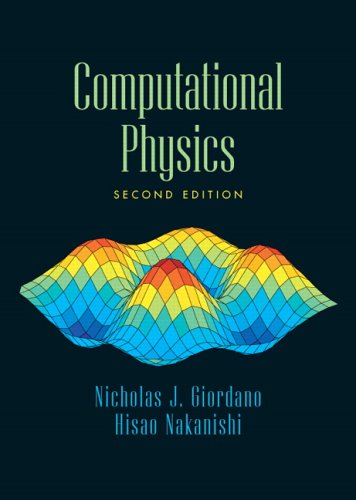
Computational Physics 2nd Edition by Nicholas Giordano, Hisao Nakanishi ISBN 978-0131469907 0131469908


Original price was: $50.00.$35.00Current price is: $35.00.
Computational Physics 2nd Edition by Nicholas J. Giordano, Hisao Nakanishi – Ebook PDF Instant Download/Delivery: 978-0131469907, 0131469908
Full download Computational Physics 2nd Edition after payment
Product details:
ISBN 10: 0131469908
ISBN 13: 978-0131469907
Author: Nicholas J. Giordano, Hisao Nakanishi
Contains a wealth of topics to allow instructors flexibility in the choice of topics and depth of coverage: Examines
projective motion with and without realistic air resistance. Discusses planetary motion and the three-body problem. Explores
chaotic motion of the pendulum and waves on a string. Includes topics relating to fractal growth and stochastic systems.
Offers examples on statistical physics and quantum mechanics. Contains ample explanations of the necessary algorithms
students need to help them write original programs, and provides many example programs and calculations for reference.
Table of contents:
1 A First Numerical Problem
1.1 Radioactive Decay
1.2 A Numerical Approach
.1.3 Design and Construction of a Working Program: Codes and Pseu-
docodes
1.4 Testing Your Program
1.5 Numerical Considerations
1.6 Programming Guidelines and Philosophy
2 Realistic Projectile Motion
2.1 Bicycle Racing: The Effect of Air Resistance
2.2 Projectile Motion. The Trajectory of a Cannon Shell
2.3 Baseball: Motion of a Batted Ball
2.4 Throwing a Baseball: The Effects of Spin
2.5 Golf
3 Oscillatory Motion and Chaos
3.1 Simple Harmonic Motion
3.2 Making the Pendulum More Interesting: Adding Dissipation, Non-linearity, and a Driving Force
3.3 Chaos in the Driven Nonlinear Pendulum
3.4 Routes to Chaos: Period Doubling
3.5 The Logistic Map: Why the Period Doubles.
3.6 The Lorenz Model
3.7 The Billiard Problem.
3.8 Behavior in the Frequency Domain: Chaos and Noise.
4 The Solar System
4.1 Kepler’s Laws
4.2 The Inverse-Square Law and the Stability of Planetary Orbits
4.3 Precession of the Perihelion of Mercury
4.4 The Three-Body Problem and the Effect of Jupiter on Earth
4.5 Resonances in the Solar System: Kirkwood Gaps and Planetary Rings
4.6 Chaotic Tumbling of Hyperion
5 Potentials and Fields
5.1 Electric Potentials and Fields: Laplace’s Equation
5.2 Potentials and Fields Near Electric Charges
5.3 Magnetic Field Produced by a Current.
5.4 Magnetic Field of a Solenoid: Inside and Out
6 Waves
6.1 Waves: The Ideal Case
6.2 Frequency Spectrum of Waves on a
String.
6.3 Motion of a (Somewhat) Realistic String
6.4 Waves on a String (Again): Spectral Methods
7 Random Systems
7.1 Why Perform Simulations of Random Processes?
7.2 Random Walks
7.3 Self-Avoiding Walks
7.4 Random Walks and Diffusion
7.5 Diffusion, Entropy, and the Arrow of
Time.
7.6 Cluster Growth Models
7.7 Fractal Dimensionalities of Curves
7.8 Percolation
7.9 Diffusion on Fractals
8 Statistical Mechanics, Phase Transitions, and the Ising Model
8.1 The Ising Model and Statistical Mechanics.
8.2 Mean Field Theory
8.3 The Monte Carlo Method
8.4 The Ising Model and Second-Order Phase Transitions
8.5 First-Order Phase Transitions
8.6 Scaling.
9 Molecular Dynamics
9.1 Introduction to the Method: Properties of a Dilute Gas
9.2 The Melting Transition
9.3 Equipartion and the Fermi-Pasta-Ulam Problem
10 Quantum Mechanics
10.1 Time-Independent Schrödinger Equation: Some Preliminaries
10.2 One Dimension: Shooting and Matching Methods
10.3 A Matrix Approach
10.4 A Variational Approach
10.5 Time-Dependent Schrödinger Equation: Direct Solutions.
10.6 Time-Dependent Schrödinger Equation in Two Dimensions
10.7 Spectral Methods
11 Vibrations, Waves, and the Physics of Musical Instruments
11.1 Plucking a String: Simulating a Guitar.
11.2 Striking a String: Pianos and Hammers
11.3 Exciting a Vibrating System with Friction: Violins and Bows
11.4 Vibrations of a Membrane: Normal Modes and Eigenvalue Problems
11.5 Generation of Sound
12 Interdisciplinary Topics
12.1 Protein Folding.
12.2 Earthquakes and Self-Organized Criticality
12.3 Neural Networks and the Brain
12.4 Real Neurons and Action Potentials
12.5 Cellular Automata
APPENDICES
A Ordinary Differential Equations with Initial Values
A.1 First-Order, Ordinary Differential Equations
A.2 Second-Order, Ordinary Differential Equations
A.3 Centered Difference Methods
A.4 Summary
B Root Finding and Optimization
B.1 Root Finding
B.2 Direct Optimization
B.3 Stochastic Optimization
C The Fourier Transform
C.1 Theoretical Background
C.2 Discrete Fourier Transform
C.3 Fast Fourier Transform (FFT)
C.4 Examples: Sampling Interval and Number of Data Points
C.5 Examples: Aliasing
C.6 Power Spectrum
D Fitting Data to a Function
D.1 Introduction.
D.2 Method of Least Squares: Linear Regression for Two Variables
D.3 Method of Least Squares: More General Cases
E Numerical Integration
E.1 Motivation
E.2 Newton-Cotes Methods: Using Discrete Panels to Approximate an
Integral
E.3 Gaussian Quadrature: Beyond Classic Methods of Numerical Inte-gration
People also search for:
a computational introduction to quantum physics pdf
reddit computational physics
computational physics rutgers
computational physics roadmap
computational physics research papers
Tags: Nicholas Giordano, Hisao Nakanishi, Computational Physics