
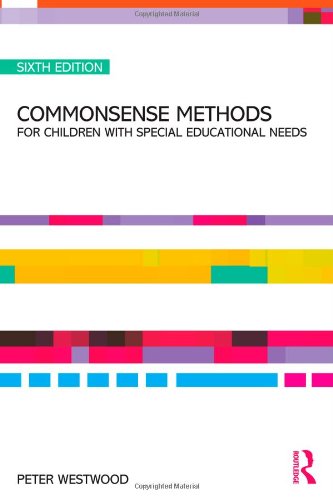
Commonsense Methods for Children with Special Educational Needs 6th Edition by Peter Westwood ISBN 978-0415583756 0415583756

Original price was: $50.00.$35.00Current price is: $35.00.
Commonsense Methods for Children with Special Educational Needs 6th Edition by Peter Westwood- Ebook PDF Instant Download/Delivery: 978-0415583756, 0415583756
Full download Commonsense Methods for Children with Special Educational Needs 6th Edition after payment
Product details:
ISBN 10: 0415583756
ISBN 13: 978-0415583756
Author: Peter Westwood
In this era of inclusive education it is essential that all teachers have a sound understanding of the nature of students’ special educational needs and how these needs may best be met in the classroom. Not only must teachers understand and accept students with disabilities and learning problems, but they must also possess a wide range of teaching and management strategies. Similar knowledge and skills are also required by classroom assistants and other personnel working in a support role in schools. This book offers sound practical advice on assessment and intervention based on the latest research evidence from the field.
This fully revised and updated sixth edition includes chapters on:
- general and specific learning difficulties
- students with autism
- intellectual, physical or sensory impairments
- self-regulation
- social skills
- behaviour management
- literacy and numeracy
- curriculum adaptation
- teaching methods.
In addition, the book presents a new chapter on the special needs of gifted and talented students.
The practical advice the author gives throughout the book is embedded within a clear theoretical context supported by current research and classroom practice.
Table of contents:
Chapter 1: Special Educational Needs and Learning Difficulties
-
Delineating Special Educational Needs
-
How Many Students Have Special Educational Needs?
-
Children with Learning Difficulties
-
Identification of Specific Learning Disability
-
Teaching Children with General and Specific Learning Difficulties
-
Online Resources
-
Further Reading
Chapter 2: Students with Intellectual Disability and Autism
8. Intellectual Disability
9. Identification of Intellectual Disability
10. Learning Characteristics of Students with Intellectual Disability
11. Specific Areas of Difficulty
12. Teaching Approaches for Students with Intellectual Disability
13. Preparation for Work
14. Approaches for Individuals with Severe and Complex Disabilities
15. Students with Autism Spectrum Disorders
16. Characteristics of Students with Autism
17. Diagnosis of Autism
18. Interventions for Autism
19. Teaching and Training Approaches: General Principles
20. Specific Programmes and Methods
21. Asperger Syndrome
22. Teaching Children with Asperger Syndrome
23. Online Resources
24. Further Reading
Chapter 3: Students with Physical Disabilities
25. The Impact of Physical Disability on Learning and Development
26. Cerebral Palsy
27. Instructional Needs of Students with Cerebral Palsy
28. Spina Bifida
29. Traumatic Brain Injury
30. Augmentative and Alternative Communication
31. General Points for Mainstream Teachers
32. Online Resources
33. Further Reading
Chapter 4: Students with Sensory Impairments
34. Vision Impairment
35. Special Educational Needs of Children with Impaired Vision
36. Accessing the Curriculum and the Environment
37. Teaching Students with Impaired Vision
38. Hearing Impairment
39. Types and Degrees of Hearing Loss
40. Impact of Deafness on Learning and Development
41. Basic Academic Skills
42. Modes of Communication
43. Assistive Technology
44. Teaching Students with Impaired Hearing
45. Online Resources
46. Further Reading
Chapter 5: Gifted and Talented Students
47. Defining Giftedness and Talent
48. Creativity
49. Identifying Gifted, Talented and Creative Students
50. Underachievement
51. Meeting the Needs of Gifted and Talented Students
52. Specific Programmes and Models
53. Online Resources
54. Further Reading
Chapter 6: Self-Management and Self-Regulation
55. Definition of Terms
56. Self-Management in Children
57. Teaching Self-Management
58. Locus of Control
59. Attribution Retraining
60. Teaching Cognitive Strategies
61. Maintenance and Generalization
62. Metacognition
63. Cognitive Behaviour Modification
64. Online Resources
65. Further Reading
Chapter 7: Managing Classroom Behaviour
66. Preventing Behaviour Problems
67. Positive Behaviour Support
68. Classroom Behaviour
69. Identifying the Problem
70. Behaviour Modification
71. Strategies for Reducing Disruptive Behaviour
72. Aggressive Behaviour
73. Bullying
74. Cognitive Approaches for Self-Control
75. Social Stories
76. Attention-Deficit Hyperactivity Disorder
77. Online Resources
78. Further Reading
Chapter 8: Social Skills and Peer Group Acceptance
79. Opportunities for Social Interaction
80. Creating a Supportive Environment
81. Facilitating Social Interaction
82. Importance of Group Work
83. Social Skills Training
84. Is Social Skills Training Effective?
85. Online Resources
86. Further Reading
Chapter 9: Reading and Reading Difficulties
87. A Sound Start
88. The Simple View of Reading
89. The Role of Phonemic Awareness
90. Teaching Letter-to-Sound Correspondences
91. Simple Word-Building Experiences
92. Selecting Early Text Materials
93. Moving Beyond Simple Phonics
94. Building Sight Vocabulary
95. Comprehension
96. Teaching Approaches
97. Online Resources
98. Further Reading
Chapter 10: Intervention for Reading Difficulties
99. General Principles for Reading Intervention
100. Using Tutors
101. Specific Programmes for Intervention
102. Other Intervention and Support Initiatives
103. Supplementary Tutoring Strategies and Activities
104. ICT and Reading
105. Online Resources
106. Further Reading
Chapter 11: Difficulties with Writing
107. Areas of Difficulty
108. Losing Confidence and Motivation
109. Teaching Approaches
110. Intervention for Individuals and Groups
111. Paving the Way to Success
112. Paired Writing
113. Suggestions for Reluctant Writers
114. Word Processors
115. Online Resources
116. Further Reading
Chapter 12: Difficulties with Spelling
117. Process Approach to Spelling
118. Skills-Based Approach to Spelling
119. Developmental Stages in Spelling Acquisition
120. Spelling by Eye, Ear, Hand and Brain
121. Teaching Spelling
122. Spelling Rules
123. Dictation
124. Spelling Lists
125. Developing Strategic Spellers
126. Remedial Strategies
127. Programming for Individual Students
128. Online Resources
129. Further Reading
Chapter 13: Difficulties with Basic Mathematics
130. Contemporary Perspectives on Mathematics Teaching
131. Whole-Class Teaching and Group Work
132. Learning Difficulties in Mathematics
133. Assisting Students Who Struggle in Mathematics
134. What Should Be Taught?
135. A Diagnostic Approach
136. Teaching and Learning at the Concrete and Semi-Concrete Levels
137. Teaching Computational Skills
138. Calculators
139. Developing Problem-Solving Skills and Strategies
140. Students with Specific Talents in Mathematics
141. Online Resources
142. Further Reading
Chapter 14: Differentiating Curriculum and Instruction
143. Keep It Simple
144. Basic Principles for Differentiation
145. Examples of Differentiation
146. Starting Points
147. Accommodations for Students with Disabilities
148. Universal Design for Learning
149. Online Resources
150. Further Reading
Chapter 15: Teaching Methods for General and Specific Purposes
151. Teacher-Directed Approaches
152. Student-Centred Approaches
153. Situated Learning
154. E-Learning
155. Online Resources
156. Further Reading
People also search for:
commonsense methods for children with special educational needs pdf
what to do when your child has no common sense
commonsense or common sense
common sense child definition
how do you teach common sense to a child
Tags: Peter Westwood, Commonsense Methods, Children with Special