
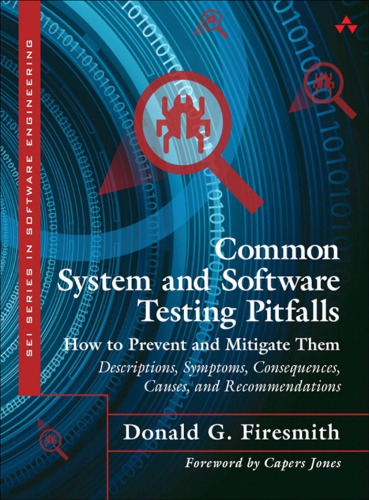
Common system and software testing pitfalls how to prevent and mitigate them descriptions symptoms consequences causes and recommendations 1st Edition by Donald Firesmith ISBN 0133748553 978-0133748550


Original price was: $50.00.$35.00Current price is: $35.00.
Common system and software testing pitfalls how to prevent and mitigate them descriptions symptoms consequences causes and recommendations 1st Edition by Donald Firesmith – Ebook PDF Instant Download/Delivery:
Full download Common system and software testing pitfalls how to prevent and mitigate them descriptions symptoms consequences causes and recommendations 1st Edition after payment
Product details:
ISBN 10: 0133748553
ISBN 13: 978-0133748550
Author: Donald G. Firesmith
“Don’s book is a very good addition both to the testing literature and to the literature on quality assurance and software engineering… . [It] is likely to become a standard for test training as well as a good reference for professional testers and developers. I would also recommend this book as background material for negotiating outsourced software contracts. I often work as an expert witness in litigation for software with very poor quality, and this book might well reduce or eliminate these lawsuits….”
–Capers Jones, VP and CTO, Namcook Analytics LLC
Software and system testers repeatedly fall victim to the same pitfalls. Think of them as “anti-patterns”: mistakes that make testing far less effective and efficient than it ought to be. In Common System and Software Testing Pitfalls, Donald G. Firesmith catalogs 92 of these pitfalls. Drawing on his 35 years of software and system engineering experience, Firesmith shows testers and technical managers and other stakeholders how to avoid falling into these pitfalls, recognize when they have already fallen in, and escape while minimizing their negative consequences.
Firesmith writes for testing professionals and other stakeholders involved in large or medium-sized projects. His anti-patterns and solutions address both “pure software” applications and “software-reliant systems,” encompassing heterogeneous subsystems, hardware, software, data, facilities, material, and personnel. For each pitfall, he identifies its applicability, characteristic symptoms, potential negative consequences and causes, and offers specific actionable recommendations for avoiding it or limiting its consequences.
This guide will help you
Pinpoint testing processes that need improvement–before, during, and after the project
Improve shared understanding and collaboration among all project participants
Develop, review, and optimize future project testing programs
Make your test documentation far more useful
Identify testing risks and appropriate risk-mitigation strategies
Categorize testing problems for metrics collection, analysis, and reporting
Train new testers, QA specialists, and other project stakeholders
With 92 common testing pitfalls organized into 14 categories, this taxonomy of testing pitfalls should be relatively complete. However, in spite of its comprehensiveness, it is also quite likely that additional pitfalls and even missing categories of pitfalls will be identified over time as testers read this book and compare it to their personal experiences. As an enhancement to the print edition, the author has provided the following location on the web where readers can find major additions and modifications to this taxonomy of pitfalls: http://donald.firesmith.net/home/common-testing-pitfalls
Please send any recommended changes and additions to dgf (at) sei (dot) cmu (dot) edu, and the author will consider them for publication both on the website and in future editions of this book.
Table of contents:
1 OVERVIEW
1.1 What Is Testing?
1.2 Testing and the V Models
1.3 What Is a Defect?
1.4 Why Is Testing Critical?
1.5 The Limitations of Testing
1.6 What Is a Testing Pitfall?
1.7 Categorizing Pitfalls
1.8 Pitfall Specifications
BRIEF OVERVIEWS OF THE TESTING PITFALLS
2.1 General Testing Pitfalls
2.1.1 Test Planning and Scheduling Pitfalls
2.1.2 Stakeholder Involvement and Commitment Pitfalls
2.1.3 Management-Related Testing Pitfalls
2.1.4 Staffing Pitfalls
2.1.5 Test-Process Pitfalls
2.1.6 Test Tools and Environments Pitfalls
2.1.7 Test Communication Pitfalls
2.1.8 Requirements-Related Testing Pitfalls
2.2 Test-Type-Specific Pitfalls
2.2.1 Unit Testing Pitfalls
2.2.2 Integration Testing Pitfalls
2.2.3 Specialty Engineering Testing Pitfalls
2.2.4 System Testing Pitfalls
2.2.5 System of Systems (SoS) Testing Pitfalls
2.2.6 Regression Testing Pitfalls
DETAILED DESCRIPTIONS OF THE TESTING PITFALLS
3.1 Common Negative Consequences
3.2 General Recommendations
3.3 General Testing Pitfalls
3.3.1 Test Planning and Scheduling Pitfalls
No Separate Test Planning Documentation (GEN-TPS-1)
Incomplete Test Planning (GEN-TPS-2)
Test Plans Ignored (GEN-TPS-3)
Test-Case Documents as Test Plans (GEN-TPS-4)
Inadequate Test Schedule (GEN-TPS-5)
Testing at the End (GEN-TPS-6)
3.3.2 Stakeholder Involvement and Commitment Pitfalls
Wrong Testing Mindset (GEN-SIC-1)
Unrealistic Testing Expectations (GEN-SIC-2)
Lack of Stakeholder Commitment to Testing (GEN-SIC-3)
3.3.3 Management-Related Testing Pitfalls
Inadequate Test Resources (GEN-MGMT-1)
Inappropriate External Pressures (GEN-MGMT-2)
Inadequate Test-Related Risk Management (GEN-MGMT-3)
Inadequate Test Metrics (GEN-MGMT-4)
Inconvenient Test Results Ignored (GEN-MGMT-5)
Test Lessons Learned Ignored (GEN-MGMT-6)
3.3.4 Staffing Pitfalls
Lack of Independence (GEN-STF-1)
Unclear Testing Responsibilities (GEN-STF-2)
Inadequate Testing Expertise (GEN-STF-3)
Developers Responsible for All Testing (GEN-STF-4)
Testers Responsible for All Testing (GEN-STF-5)
3.3.5 Test Process Pitfalls
Testing and Engineering Processes Not Integrated (GEN-PRO-1)
One-Size-Fits-All Testing (GEN-PRO-2)
Inadequate Test Prioritization (GEN-PRO-3)
Functionality Testing Overemphasized (GEN-PRO-4)
Black-Box System Testing Overemphasized (GEN-PRO-5)
Black-Box System Testing Underemphasized (GEN-PRO-6)
Too Immature for Testing (GEN-PRO-7)
Inadequate Evaluations of Test Assets (GEN-PRO-8)
Inadequate Maintenance of Test Assets (GEN-PRO-9)
Testing as a Phase (GEN-PRO-10)
Testers Not Involved Early (GEN-PRO-11)
Incomplete Testing (GEN-PRO-12)
No Operational Testing (GEN-PRO-13)
Inadequate Test Data (GEN-PRO-14)
Test-Type Confusion (GEN-PRO-15)
3.3.6 Test Tools and Environments Pitfalls
Over-Reliance on Manual Testing (GEN-TTE-1)
Over-Reliance on Testing Tools (GEN-TTE-2)
Too Many Target Platforms (GEN-TTE-3)
Target Platform Difficult to Access (GEN-TTE-4)
Inadequate Test Environments (GEN-TTE-5)
Poor Fidelity of Test Environments (GEN-TTE-6)
Inadequate Test Environment Quality (GEN-TTE-7)
Test Assets Not Delivered (GEN-TTE-8)
Inadequate Test Configuration Management (GEN-TTE-9)
Developers Ignore Testability (GEN-TTE-10)
3.3.7 Test Communication Pitfalls
Inadequate Architecture or Design Documentation (GEN-COM-1)
Inadequate Defect Reports (GEN-COM-2)
Inadequate Test Documentation (GEN-COM-3)
Source Documents Not Maintained (GEN-COM-4)
Inadequate Communication Concerning Testing (GEN-COM-5)
3.3.8 Requirements-Related Testing Pitfalls
Ambiguous Requirements (GEN-REQ-1)
Obsolete Requirements (GEN-REQ-2)
Missing Requirements (GEN-REQ-3)
Incomplete Requirements (GEN-REQ-4)
Incorrect Requirements (GEN-REQ-5)
Requirements Churn (GEN-REQ-6)
Improperly Derived Requirements (GEN-REQ-7)
Verification Methods Not Properly Specified (GEN-REQ-8)
Lack of Requirements Trace (GEN-REQ-9)
3.4 Test-Type-Specific Pitfalls
3.4.1 Unit Testing Pitfalls
Testing Does Not Drive Design and Implementation (TTS-UNT-1)
Conflict of Interest (TTS-UNT-2)
3.4.2 Integration Testing Pitfalls
Integration Decreases Testability Ignored (TTS-INT-1)
Inadequate Self-Monitoring (TTS-INT-2)
Unavailable Components (TTS-INT-3)
System Testing as Integration Testing (TTS-INT-4)
3.4.3 Specialty Engineering Testing Pitfalls
Inadequate Capacity Testing (TTS-SPC-1)
Inadequate Concurrency Testing (TTS-SPC-2)
Inadequate Internationalization Testing (TTS-SPC-3)
Inadequate Interoperability Testing (TTS-SPC-4)
Inadequate Performance Testing (TTS-SPC-5)
Inadequate Reliability Testing (TTS-SPC-6)
Inadequate Robustness Testing (TTS-SPC-7)
Inadequate Safety Testing (TTS-SPC-8)
Inadequate Security Testing (TTS-SPC-9)
Inadequate Usability Testing (TTS-SPC-10)
3.4.4 System Testing Pitfalls
Test Hooks Remain (TTS-SYS-1)
Lack of Test Hooks (TTS-SYS-2)
Inadequate End-To-End Testing (TTS-SYS-3)
3.4.5 System of Systems (SoS) Testing Pitfalls
Inadequate SoS Test Planning (TTS-SoS-1)
Unclear SoS Testing Responsibilities (TTS-SoS-2)
Inadequate Resources for SoS Testing (TTS-SoS-3)
SoS Testing Not Properly Scheduled (TTS-SoS-4)
Inadequate SoS Requirements (TTS-SoS-5)
Inadequate Support from Individual System Projects (TTS-SoS-6)
Inadequate Defect Tracking Across Projects (TTS-SoS-7)
Finger-Pointing (TTS-SoS-8)
3.4.6 Regression Testing Pitfalls
Inadequate Regression Test Automation (TTS-REG-1)
Regression Testing Not Performed (TTS-REG-2)
Inadequate Scope of Regression Testing (TTS-REG-3)
Only Low-Level Regression Tests (TTS-REG-4)
Test Resources Not Delivered for Maintenance (TTS-REG-5)
Only Functional Regression Testing (TTS-REG-6)
People also search for:
difference between wing chun and kung fu
is wing chun better than kung fu
difference between shaolin and wing chun
wing chun wooden man
wing chun wooden dummies
Tags:
Donald Firesmith,Common system,software testing,how to prevent