
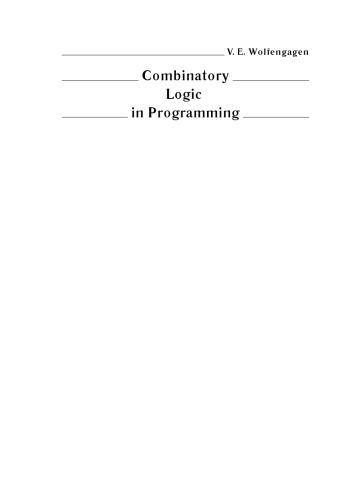
Combinatory logic in programming Computations with objects through examples and exercises 2nd Edition by Wolfengagen ISBN 5891581019 918-5891581019
Original price was: $50.00.$35.00Current price is: $35.00.
Combinatory logic in programming Computations with ob jects through examples and exercises 2nd Edition by Wolfengagen V.E. – Ebook PDF Instant Download/Delivery: 5891581019, 918-5891581019
Full download Combinatory logic in programming Computations with ob jects through examples and exercises 2nd Edition after payment
Product details:
ISBN 10: 5891581019
ISBN 13: 918-5891581019
Author: Wolfengagen V.E.
Wolfengagen’s 2nd edition is a comprehensive, structured resource for understanding computation via combinators and object-based computation. Its unique blend of theory, exercises, and advanced modeling is ideal for graduate students or professionals seeking a deep dive into applicative computational systems and their categorical foundations.
Table of contents:
1. Preliminaries
1.1 The spectrum of ideas
1.2 Layout of a chapter
1.3 State-of-the-art in an area
1.4 Typical task
1.5 Variants of task
1.6 A recommended order of solving the tasks
2. Derivation of Object
2.1 Principle of combinatory completeness
2.1.1 Combinatory characteristic
2.1.2 Systems of concepts
2.1.3 Combinatory completeness
2.1.4 Elementary combinatory logic
2.2 Deriving main combinators; tasks
2.3 Historical remark
3. Fixed Point
3.1 Theoretical background
3.1.1 Abstraction
3.1.2 Multiabstraction
3.1.3 Local recursion
3.2 Main tasks
Exercises
4. Extensionality
4.1 Theoretical background
4.2 Tasks
Exercises
5. Numerals
5.1 Numbers and numerals
5.2 Combinatory arithmetic
5.3 Tasks
Exercises
6. Typed Combinators
6.1 Notion of a type
6.1.1 Combinatory terms
6.1.2 A-terms
6.2 Tasks
7. Basis I, K, S
7.1 Theoretical background
7.2 Tasks
Exercises
8. Basis I, B, C, S
8.1 Theoretical background
8.2 A property of being basic
8.3 Elementary examples
Exercises
9. Applications of Fixed Point Combinator Y
9.1 Fixed point theorem
9.2 Elements of recursive computations
9.3 Using the combinator Y
9.4 Evaluation of a function
Exercises
10. Function listl
10.1 Theoretical background
10.2 Tasks
10.3 Functor-as-object
Exercises
11. Isomorphism of C.C.C. and ACS
11.1 Theoretical background
11.2 Tasks
12. Currying
12.1 Theoretical background
12.1.1 Operators and functions
12.1.2 Comprehension
12.1.3 Connection between operators and functions
12.2 Tasks
Exercises
13. Karoubi’s Shell
13.1 Theoretical background
13.2 Tasks
14. Products and Projections
14.1 Theoretical background
14.2 Task
14.3 Product and cartesian closed category
15. Embedding Lisp into ACS
15.1 Theoretical background
15.2 A main task
15.3 Concluding remarks
16. Supercombinators
16.1 Theoretical background
16.1.1 Notion of supercombinator
16.1.2 Process of compiling
16.1.3 Transformation to supercombinators
16.1.4 Eliminating redundant parameters
16.1.5 Ordering of the parameters
16.1.6 The lambda-lifting with a recursion
16.1.7 Execution of the lambda-lifting algorithm
16.1.8 Other ways of lambda-lifting
16.1.9 Full laziness
16.1.10 Maximal free expressions
16.1.11 Lambda-lifting with MFE
16.1.12 Fully lazy lambda-lifting with letree
16.1.13 Compound example
16.2 Task
16.3 Answers to exercises
17. Lazy Implementation
17.1 Tasks
Exercises
18. Permutation of Parameters
18.1 Task
Exercises
Test
19. Immediate Computations
19.1 Task
Exercises
Test
20. de Bruijn’s Encoding
20.1 Tasks
Exercises
21. Abstract Machine: CAM
21.1 Theoretical background
21.1.1 CAM structure
21.1.2 Instructions
21.2 Tasks
Exercises
22. Optimizing CAM-Computations
22.1 Task
Exercises
Test
23. Variable Objects
23.1 Models
23.1.1 Applicative structure
23.1.2 Typed models
23.1.3 Partial objects
23.1.4 Data object models
23.2 The main task
23.2.1 Elementary types
23.2.2 Typed variable objects
23.2.3 Computational models
23.2.4 Indexed objects
23.3 Interpretation of evaluating environment
People also search for:
combinatory logic tutorial
combinatory logic in c++
combinatory logic programming
functional programming combinator
g code logic
Tags: Wolfengagen, Combinatory logic, Computations with objects, examples and exercises