
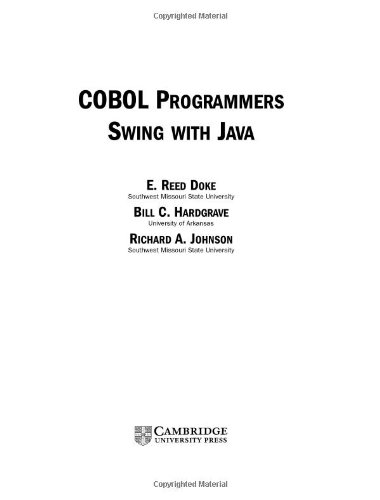
COBOL Programmers Swing with Java 2nd Edition by Reed Doke ISBN 9780521546843 0521546842


Original price was: $50.00.$35.00Current price is: $35.00.
COBOL Programmers Swing with Java 2nd Edition by E. Reed Doke – Ebook PDF Instant Download/Delivery: 9780521546843, 0521546842
Full download COBOL Programmers Swing with Java 2nd Edition after payment
Product details:
ISBN 10: 0521546842
ISBN 13: 9780521546843
Author: E. Reed Doke
In the fast moving world of information technology, Java is now the number 1 programming language. Programmers and developers everywhere need to know Java to keep pace with traditional and web-based application development. COBOL Programmers Swing with Java provides COBOL programmers a clear, easy transition to Java programming by drawing on the numerous similarities between COBOL and Java. The authors introduce the COBOL programmer to the history of Java and object-oriented programming and then dive into the details of the Java syntax, always contrasting them with their parallels in COBOL. A running case study gives the reader an overall view of application development with Java, with increased functionality as new
Table of contents:
Chapter 1
Why You Should Learn Java
Objectives
History and Overview of Java
The Popularity of Java
What Makes Java Different?
Java Is Simple
Java Is Object-Oriented
Java Is Portable
Will Java Replace COBOL? How to Use This Book
Summary of Key Points in Chapter 1
Bibliography
Chapter 2
An Introduction to Object-Oriented Programming
Objectives
The Community National Bank
History of OO
Objects
Classes
Diagramming Classes and Objects
Class Relationships
Inheritance
Aggregation
Association
Object Communication
Polymorphism
Dynamic Binding
Summary of Key Points in Chapter 2
Bibliography
Chapter 3
Java Structure
Objectives
A Class Program
Listing 3.1: Customer.java
Java Column Restrictions
Writing Comments in Java
Naming Rules and Conventions
Creating Objects
Listing 3.2: Customer.java
Invoking Methods
Listing 3.3: CustomerProcessor.java
Working with Subclasses
Listing 3.4: Account.java
Listing 3.5: CheckingAccount.java
Listing 3.6: AccountProcessor.java
Summary of Key Points in Chapter 3
Chapter 4
Defining Data
Objectives
COBOL Picture Clause
Defining Java Variables
Writing Java Literals
The Scope of Variables
Defining Java Constants
String Variables
Listing 4.1: StringDemo.java
Changing Variable Types
Listing 4.2: CastDemo.java
Variables for Community National Bank
Summary of Key Points in Chapter 4
Chapter 5
Computation
Objectives
Exceptions
Listing 5.1: try-catch Structure
Listing 5.2:
ArithmeticExceptionDemo.java
Custom Exception Classes
Listing 5.3: CheckingAccount.java with NSFException
Listing 5.4: AccountProcessor.java with
try-catch
A Review of Primitive Data Types
Wrapper Classes
Listing 5.5: WrapperDemo.java
Arithmetic Operators
The Math Class
Listing 5.6: MathClassDemo.java
The NumberFormat Class
Listing 5.7: NumberFormatDemo.java
Summary of Key Points in Chapter 5
Chapter 6
Decision Making
Objectives
Service Charges at Community National Bank
The if Statement
Using the else Clause
Nested if Statements
Writing Compound Conditions
Java’s Conditional Operator
Condition Names
Computing the Service Charge with if Statements
Listing 6.1: COBOL Service Charge Computation
Using IF Statements
Listing 6.2: ComputeServiceCharge method Using if Statements
Case Structure: COBOL EVALUATE and Java switch
Computing the Service Charge Using switch
Listing 6.3: COBOL Service Charge Computation Using EVALUATE
Listing 6.4: Java Service Charge Computation
Using switch
Summary of Key Points in Chapter 6
Chapter 7
Loops
Objectives
Loop Structure
The COBOL PERFORM Statement
The Java while Statement
Listing 7.1: WhileLoopDemo.java
The Java do Statement
Listing 7.2: DoLoopDemo.java
The Java for Statement
Listing 7.3: ForLoopDemo.java
Nested Loops
Java break and continue Statements
Producing a Loan Amortization Schedule
Listing 7.4: Amortizer.java
Summary of Key Points in Chapter 7
Chapter 8
Arrays
Objectives
Declaring One-Dimensional Arrays
Populating One-Dimensional Arrays
Creating String Arrays
Listing 8.1: OneDimArrayDemo.java
Declaring Two-Dimensional Arrays
Populating Two-Dimensional Arrays
Listing 8.2: TwoDimArrayDemo.java
Passing Arrays as Arguments
Searching Arrays
Listing 8.3: FindZipCode.java
Listing 8.4: ZipCodeProcessor.java
Summary of Key Points in Chapter 8
Chapter 9
Data Access
Objectives
Java’s I-O Class Library (java.io)
Object Persistence
Sequential File I-O
Listing 9.1: SequentialFileDemo.java
Database Access
Listing 9.2: COBOL SQL Example
Listing 9.3: DatabaseDemo.java
Object Serialization
Listing 9.4:
ObjectSerializationDemo.java
Network Access
Summary of Key Points in Chapter 9
Chapter 10
Graphical User Interfaces
Objectives
Java’s Swing Components
Event-Driven Programming
JFrame: Displaying and Closing a Window
Listing 10.1-CustomerGUIOne.java
JLabel: Adding Labels to a Window
Listing 10.2: CustomerGUITwo.java
JTextField: Adding Text Fields to a Window
Listing 10.3-CustomerGUIThree.java
JButton: Adding Buttons to a Window
Listing 10.4-CustomerGUIFour.java
How Java Handles Events
Improving the Window Layout
Listing 10.5: CustomerGUIFive.java
Creating Drop-Down Menus
Listing 10.6-CustomerGUISix.java
Writing Applets
Summary of Key Points in Chapter 10
Chapter 11
Object-Oriented Development Issues
Objectives
Developing Object-Oriented Systems
OO Methodologies
OO Analysis
OO Design
Three-Tier Design
Architecture Issues
Performance Issues
Summary of Key Points in Chapter 11
Bibliography
Glossary
Index
People also search for:
cobol programmers wanted
cobol programmer shortage
cobol programmers salary
what is cobol programming used for
programming cobol
Tags: Reed Doke, COBOL Programmers, Swing with Java